
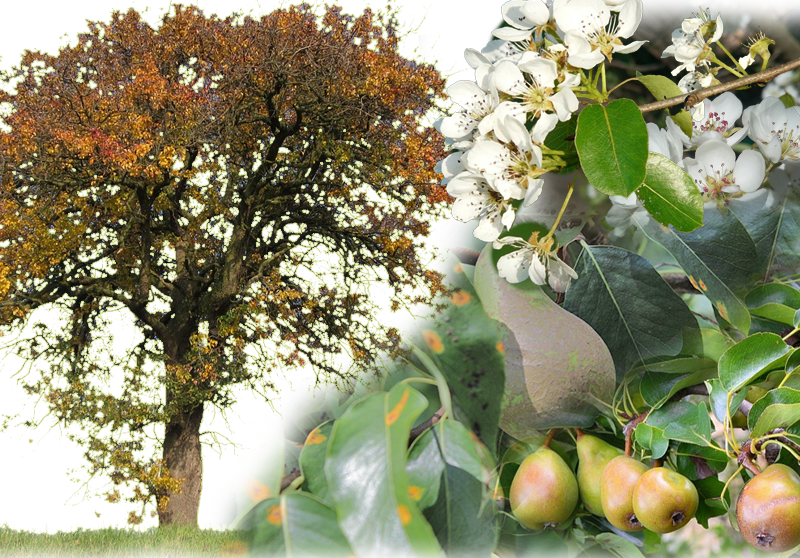
European pear
 9
9 5
5 7
7Will it grow where I live?
European pear is hardy to zone 4 – that covers all of Central Europe and the British Isles, and every USDA zone from 4 upwards.
Or check it for your location right here:
Profile
- Family
- Rosaceae
- Habit
- Tree
- Height
- 15 m
- Spread
- 10 m
- Growth
- fast
- Lifespan
- 130 years
- First yield
- after 6 years
- Full yield
- after 8–10 years
- Yield per plant
- up to 200 kg a year
- Yield in cultivation
- up to 22 t/ha
- Energy yield
- 1250 kcal per m² a year
- Hardiness
- zone 4–9
- Shade tolerance
- partial shade
- Soil
- Sand, Silt, Loam, Clay
- Soil moisture
- dry – very moist
- pH
- 6 – 7.5
- Synonyms
- Birnenbaum, Birne,
- Planned in gardens
- 4×
Flowering & harvest
| J | F | M | A | M | J | J | A | S | O | N | D | |
|---|---|---|---|---|---|---|---|---|---|---|---|---|
| Flowering | ||||||||||||
| Fruit harvest |
Varieties (110)
110 varieties of European pear are listed in the Permaplans variety finder — each with its own page: taste, ripening time, disease resistance, parentage and use.
- Abbé Fétel Elegant, elongated bottle-shaped pear – Italy's commercial star with sweet, juicy, fine flesh.
- Alexander Lucas Large, juicy-sweet winter pear that keeps well in storage.
- Amanlis Butterbirne Melting, juicy early pear of very strong growth, only briefly storable.
- Benita Crisp apple-pear (Nashi hybrid) with refreshing sweet juice.
- Beurré Bosc Long-necked, entirely cinnamon-russeted classic – spicy-sweet and ideal for baking.
- Beurré d'Anjou Egg-shaped, neckless keeping pear – mildly sweet, juicy and storable for months.
- Beurré Président Drouard Hardy, large-fruited winter pear – storable well into spring.
- Birne von Echem
- Black Worcester
- Blumenbachs Butterbirne Half-melting winter pear with a melon-like spice and a few weeks of storage.
- Bunte Julibirne One of the earliest pears - a small, sweet summer pear for immediate eating.
- Champagner Bratbirne Württemberg perry and distilling pear with high sugar content.
- Clairgeaus Butterbirne Barely scab-prone winter pear with sweet-sour flesh and two months of storage.
- Clapp's Favourite Early, juicy melting table pear with a sun-side blush.
- Concorde Modern cross of Conference and Comice – sweet, aromatic and reliably fruitful.
- Conference Globally popular, fully melting dessert pear with very juicy, sweet flesh.
- Dessertnaja
- Deutsche NationalbergamotteRobust, widely adaptable bergamot pear for rougher sites and versatile use.
- Diels Butterbirne Demanding, spiced dessert pear for warm, sheltered sites and weak rootstocks.
- Doppelte Philippsbirne Vigorous autumn pear with sweet-sour flesh, scab-resistant but fireblight-prone.
- Doyenné du Comice Regarded by many as the world's finest dessert pear – melting, richly aromatic and lavishly juicy.
- Dr. Jules Guyot Early, robust summer pear with juicy, mild flesh.
- Dycker Schmalzbirne Very juicy, spiced utility pear from the Rhineland for juice and drying.
- Echte Knausbirne Sturdy, tangy-sweet utility pear for brandy, drying and cider blends.
- Edelcrassane Late winter dessert pear with melting flesh for warm wine-growing sites.
- ElsaFrost- and scab-tolerant autumn dessert pear with a bold aroma.
- Esperens Bergamotte Aromatic winter dessert pear for warm sites, ready from December.
- Esperens HerrenbirneA top-flavoured variety among early-autumn dessert pears.
- EwartLate-blooming, very healthy dessert pear for wide cultivation.
- Feigenbirne von Alençon Old French table pear with almond-sweet, melting flesh.
- Forelle Small pear with trout-like red speckling – crisp-sweet and decorative.
- Frankelbacher Mostbirne Rhineland-Palatinate perry pear for juice and cider.
- Gansels Late Bergamotte
- Gelbmöstler Yellow perry pear from the Lake Constance region, mild and juice-rich.
- Gellerts Butterbirne Fine French butter pear - melting, juicy, aromatic.
- Général Leclerc Large-fruited Comice descendant with melting, sweet flesh.
- Giffards Butterbirne Finest early summer butter pear with tender, melting flesh.
- Gräfin von Paris Late winter pear, storable into January/February.
- Gräling Hardy regional utility pear for drying and pear syrup.
- Großer Katzenkopf
- Grumkower Butterbirne Large-fruited, wine-tart autumn dessert pear for warm sites.
- Gute Graue Russeted autumn pear with juicy-sweet, melting flesh.
- Gute Luise Popular autumn table pear - juicy, melting, finely aromatic.
- Hardenponts Winterbutterbirne Warmth-loving winter butter pear for warm sites, ripening into January.
- Harrow Delight
- Harrow Sweet Fireblight-tough modern variety – sweet, juicy and ideal for low-spray growing.
- Hochfeine Butterbirne Finely melting dessert pear with delicate wine-tart noble flavour.
- Hofratsbirne Productive, half-melting utility pear for rough, windy sites.
- Holländische Zuckerbirne
- Hufenbirne Rare, robust local Rhineland pear, classic for pear syrup.
- Jeanne d'Arc Fully melting winter dessert pear with noble aroma, ripening into January.
- Joséphine de Malines Aromatic winter pear with pink-tinged flesh – ripening to perfection only in January.
- Karcherbirne
- Knollbirne Tangy-spicy utility and cider pear for warmer orchard sites.
- Kongressbirne Large-fruited, sweet autumn dessert pear with little aroma.
- Köstliche von Charneux Belgian autumn pear, juicy-melting and aromatically sweet.
- Kuhfuß Westphalian orchard variety, sweet and cinnamon-spiced, excellent for drying.
- Le Bruns Butterbirne Robust, melting butter pear with pleasant spice, widely adaptable.
- Le Lectier Refined winter dessert pear for warm, sheltered sites.
- Liegels WinterbutterbirneAromatic winter butter pear with a distinctive spicy note.
- Lucius Early autumn pear best used soon after picking.
- Luxemburger Mostbirne High-yielding perry and drying pear, also for harsh uplands.
- Madame Bonnefond Mild winter pear for cellar storage.
- Madame FavreFine, spicy-aromatic autumn dessert pear.
- Madame Verte Low-vigour winter pear with fine wine acidity.
- Margarete Marillat Large, juicy early dessert pear with a muscat note.
- MarianneUndemanding autumn pear even for harsh sites.
- Martinsbirne Robust cooking and utility pear with very long keeping.
- Metzer Bratbirne Traditional roasting and perry pear from the Metz area.
- Mollebusch Historic table pear with tender melting, spicy-sweet flesh.
- Napoleons Butterbirne Juice-rich melting pear with balanced aroma.
- Neue Poiteau Versatile autumn pear between dessert and utility use.
- Nojabrskaja
- Nordhäuser Winterforelle Red-speckled winter pear – sweet, storable and hardy in orchard meadows.
- Novembra Robust, large-fruited winter pear, storable into January.
- Oberösterreichische Weinbirne Hardy cider pear rich in sugar and tannins for full-bodied juice and brandy.
- Olivier de Serres Fine winter dessert pear for warm wine-growing sites with a delicately spiced flavour.
- Packham's Triumph The southern hemisphere's most-grown winter pear – sweet, juicy and superbly storable.
- Palmischbirne
- Pastorenbirne Large, curved winter and utility pear – hardy, heavy-bearing and versatile.
- Petersbirne Early, hardy summer pear with a cinnamon-like spice and small aromatic fruits.
- Pierre Corneille Healthy top-quality autumn dessert pear with a sweet, wine-like flavour.
- Pitmaston Juicy, melting autumn dessert pear with a refined wine-tart, delicately spiced taste.
- Präsident Heron Weak-growing dessert pear with fully melting, spicy flesh for home garden and espalier.
- Präsident Mas Large-fruited, sweet late-autumn dessert pear for eating fresh.
- Précoce de Trévoux One of the best early summer pears – juicy and refreshing, best eaten straight off the tree.
- Premices de Maria Lesueur Healthy, undemanding autumn dessert pear with sweet, semi-melting flesh.
- Professeur Grosdemange
- Regentin Fine winter pear with sweet, wine-spiced melting flesh, ideal for espaliers.
- Robert de Neufville Early, melting-juicy dessert pear from Geisenheim with a subtle muscat aroma.
- Rocha Portugal's protected national pear – small, sweet and exceptionally storable.
- Rote Bergamotte Old, hardy bergamot pear (from 1588) with a wine-tart, mild-bitter melting flesh.
- Rote Dechantsbirne
- Red Bartlett Red-skinned Williams sport - juicy, melting, muscat-aromatic.
- Saint Remy Very long-keeping utility pear that stays available into early summer.
- Saxonia Elektra Modern, scab- and mildew-resistant table pear from Pillnitz.
- Schweizer Wasserbirne Hardy heavy cropper for juice, cider and spirit with a crisp, tart water-pear character.
- Sievenicher Mostbirne Weather-hardy cider pear for rough sites with excellent juice and blending value.
- Sixs Butterbirne Butter-soft melting dessert pear for warmer, sheltered sites.
- Sommerblutbirne
- Sterkmanns Butterbirne
- Stuttgarter Geißhirtle Small, honey-sweet Stuttgart summer pear with fine aroma.
- Tongern Scab-resistant autumn dessert pear with a spicy, wine-tart juiciness.
- Triumph von Vienne Late-flowering melting autumn pear with a spicy, sweet-winey aroma.
- Vereinsdechantsbirne Fine, richly sweet November dessert pear brimming with juice.
- Wahlsche Schnapsbirne Aromatic distilling pear of South Germany for fine fruit brandies.
- Williams' Bon Chrétien / Bartlett World-famous, muscat-flavoured melting summer pear for table, jar and spirit.
- Winterdechantsbirne Demanding winter dessert pear for warm espalier sites with long storage.
- WinterlonchenSweet, melting winter dessert pear for the store cupboard up to Christmas.
- Winternelis Spicy-sweet winter dessert pear of weak growth, keeping into January.
Uses
Edible: Pears are eaten raw, cooked, dried or pressed. They consist of about 83 per cent water, around 10 per cent carbohydrate and 3 per cent fibre, and contain less fruit acid than apples, which makes them milder and easier on sensitive stomachs. They are climacteric fruits: they go on ripening after picking, and precisely there lies the craft — pears left to ripen on the tree go mealy from the core, while those picked at the right moment develop their sugar and aroma in the store. The eating window is short, in some summer cultivars only two or three days. Cooking pears and wild pears stay hard and tart and are meant for compote, pear bread, dried fruit and perry; their high tannin content is what gives perry its structure. Boiled-down juice makes pear syrup, fermented juice makes pear brandy and, in parts of Central Europe, perry wine.
Medicinal: The plant was utilized for treating old injuries, while its seeds were consumed to provoke vomiting for colic therapy.
Other uses: Pear wood is heavy, fine and evenly structured, hard and remarkably dimensionally stable — it barely moves once dried. That makes it the classic wood for drawing instruments, rulers, type cases and printing blocks, and for furniture, turnery and musical instruments; stained black it long served as a substitute for ebony, for instance in piano parts. The leaves yield a yellow-brown dye. Outdoors the pear matters beyond its fruit as a structural tree: standards on seedling rootstock grow old and broad-crowned, develop cavities and deadwood and are therefore a load-bearing element of traditional orchard meadows. In shelterbelts and field hedges the wild pear is planted for its drought tolerance and deep root system.
Growing
Site: The pear flowers in April and therefore early — a frost hollow at the foot of a slope costs the crop every other year, while a slight slope or the shelter of a house saves it. What stands nearby is decisive: pears are self-sterile and need a second, simultaneously flowering cultivar within reach of the bees. Just as important is what must not stand nearby. Pear rust alternates between pear and juniper; savin and Chinese juniper in the garden or next door are the cause of those orange leaf spots, and without the juniper the fungus disappears. Fireblight attacks quince, hawthorn, rowan and cotoneaster alongside pear; in fruit-growing regions outbreaks are notifiable. On size: on a seedling rootstock the pear becomes a 15-metre tree living over a century, on quince it stays at three to four metres — that, not the cultivar, decides space and ladder length. Care: Pears take less pruning than apples and answer hard cutting with steep water shoots that carry nothing. Prune moderately in winter, and tie steep shoots down rather than cutting them out. On quince rootstock lime in the soil is a problem: leaves yellow between the veins, and not every cultivar is compatible with quince at all — the only remedy is an interstem, which must already be there when you buy. Young trees need a stake, a vole basket and, where deer are about, a wire guard against fraying and bark gnawing. The commonest mistake is at harvest: pears are picked at picking ripeness and ripen indoors, whereas on the tree they go mealy from the core outwards. Keeping cultivars want cool, airy storage, and the eating window is often only a few days. Against pear sucker no spray helps; encouraging earwigs and withholding nitrogen do.
Propagation
Mainly propagated by grafting onto quince rootstocks to improve growth habit and fruit quality. Seeds can be sown fresh in autumn or after 8 to 10 weeks of cold stratification at around 1 °C in early spring. Germination takes several weeks. Seedlings are grown in pots or protected areas during the first year and planted out in late spring or early summer. Cuttings and layering are rarely used.
Value for wildlife
Flowers provide nectar and pollen for bees, beetles, and other insects, serving as important early-season food for pollinators. Fruits are eaten by birds and mammals, aiding seed dispersal. The tree offers shelter and nesting sites for birds. Young plants may suffer from browsing by wildlife.
Notable
Special features: drought and pollutant tolerant; often grafted onto quince +aroma Pears (special varieties) are very productive as espalier fruit and easy to harvest: one farm shows yields of almost 60t/ha with 6100 trees/ha; Alexander Lucas (+storage pear); Conference (+yielding pear) Brought to us by the Persians, Greeks, Romans.
Origin & habitat
Central Europe, southeastern Europe and western Asia. The cultivated pear is not a wild species but a crop of hybrid origin: it arose from several wild species, above all the Central European wild pear (Pyrus pyraster), the western Asian Pyrus syriaca and the south Mediterranean snow pear (Pyrus nivalis). It was first cultivated in western Asia; Neolithic finds document it around Lake Constance, and cultivation in Greece is attested from about 1000 BC. After the end of Roman antiquity it declined sharply and was taken up again by the monasteries from the 7th century onward; the great wealth of cultivars dates from about 1750. Today the pear is grown throughout the temperate zones of both hemispheres.
As a crop the pear has no natural habitat, but its requirements betray the origin of its parent species in the open woodland, woodland edges and scrub margins of western Asia and southeastern Europe. It wants a rather dry, warm climate and deep, fertile soil with good water supply free of waterlogging — pears root markedly deeper than apples and draw their water from below, so they cope better with summer drought while failing on compacted and wet ground. Their sensitivity lies at the other end: flowering in April falls into the late frost period, and frost hollows regularly cost the crop. The naturalised wild pear is a species of warm oak woods and hedgerows in Central Europe and is considered rare.
Frequently asked questions
European pear: how big does it get?
European pear (Pyrus communis) grows as a Tree and reaches roughly 15 m in height when mature, with a spread of about 10 m. Growth is fast.
European pear: what site does it need?
European pear tolerates partial shade. Suitable soils are Sand, Silt, Loam, Clay. Soil moisture should be in the range dry – very moist. The pH may lie between 6 and 7.5.
European pear: is it hardy?
European pear is listed as hardy in zone 4–9 and survives normal winters outdoors there.
European pear: will it grow in Central Europe?
European pear is hardy to zone 4 – that covers all of Central Europe and the British Isles, and every USDA zone from 4 upwards.
European pear: when does it flower?
In a temperate northern-hemisphere climate it flowers in April.
European pear: when is it harvested?
In a temperate northern-hemisphere climate the fruit ripens from October to November.
European pear: when does it start cropping, and how much?
European pear first crops after 6 years. Full yield comes after 8–10 years. A mature plant gives up to 200 kg a year, in cultivation up to 22 t per hectare. Figures assume a good site; variety, soil and climate shift them considerably.
European pear: is it poisonous?
Individual parts of European pear are noted as mildly problematic — the plant does not count as poisonous. With wild plants, never rely on a database alone, only on a confident identification.
European pear: what is it used for?
Rated on a scale up to 10: Edible 9/10, Medicinal 5/10, Other uses 7/10.
Which European pear varieties are there?
The Permaplans variety finder lists 110 varieties of European pear, including Abbé Fétel, Alexander Lucas, Amanlis Butterbirne, Benita, Beurré Bosc, Beurré d'Anjou, Beurré Président Drouard, Birne von Echem, Black Worcester, Blumenbachs Butterbirne, Bunte Julibirne, Champagner Bratbirne and 98 more. Each variety has its own page with taste, ripening time, disease resistance and parentage.
Plan this plant into your own garden
Permaplans plans your garden to scale on the map — with a site check, harvest calendar and over 1,000 plants. Free for iPhone, Android, Mac, Windows & Linux.
Will this plant grow where you live? → Check your site
Community experience
No first-hand reports for this plant yet.
Growing it? Write in the app what works for you – your post will show up here.
💬 Get the app and join in