
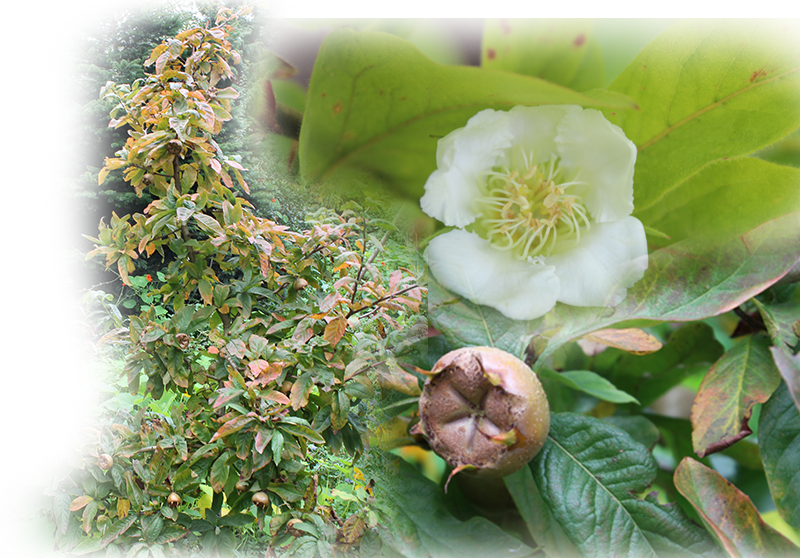
Medlar
 8
8 6
6 6
6Will it grow where I live?
Medlar is hardy to zone 6, which covers nearly all of Central Europe and the British Isles; only harsh upland sites (Alps, high ridges) call for winter protection. It also needs warm summers – in Central Europe that means wine-growing regions, cities or a sheltered south-facing wall.
Or check it for your location right here:
Profile
- Family
- Rosaceae
- Habit
- Tree
- Height
- 6 m
- Spread
- 6 m
- Growth
- medium
- Lifespan
- 150 years
- First yield
- after 4 years
- Yield per plant
- up to 50 kg a year
- Yield in cultivation
- up to 15 t/ha
- Energy yield
- 1300 kcal per m² a year
- Hardiness
- zone 6–10
- Shade tolerance
- partial shade
- Soil
- Sand, Silt, Loam
- Soil moisture
- semi-dry – moist
- pH
- 6 – 7.5
Flowering & harvest
| J | F | M | A | M | J | J | A | S | O | N | D | |
|---|---|---|---|---|---|---|---|---|---|---|---|---|
| Flowering | ||||||||||||
| Fruit harvest |
Varieties (13)
13 varieties of Medlar are listed in the Permaplans variety finder — each with its own page: taste, ripening time, disease resistance, parentage and use.
- Apyrena
- Bredase Reus Large-fruited Dutch medlar from the Breda region.
- Große aus Holland The classic large-fruited medlar – vigorous, hardy and widely available.
- Holländische
- Kurpfälzer / Süßmispel
- MacrocarpaVery large-fruited medlar form for generous crops.
- Metz
- Mondacce
- Musegg
- Nottingham Small-fruited English medlar with rich flavour.
- Royal Medium-sized medlar prized for its rich, refined flavour.
- Szentesi rózsa Hungarian medlar variety.
- Westerveld Reliable Dutch medlar with uniform fruits.
Uses
Edible: Fruit can be consumed either raw or cooked. In regions with cooler temperate climates, the fruits may not fully ripen but can still be picked when firm in late autumn, preferably after exposure to frost. Before consuming raw, these fruits need to be cored. To do this, they are stored upside down in a cool place until they reach a stage just before rotting, known as incipient blight. During this phase, the white flesh transforms into brown, becomes very soft, and offers a high level of sweetness with an exceptionally delightful taste, somewhat similar to a delicious tropical fruit. While the wild species' fruits typically have a diameter of up to 25 mm, certain varieties can grow to 65 mm or even larger.
Other uses: Medlar wood is hard, tough and fine-grained with diffuse porosity; turners and cabinetmakers have long valued it for small work, tool parts and inlay, and it also serves as firewood or for making charcoal. Its high tannin content matters more commercially: leaves and bark were used for tanning leather, and the pharmaceutical industry still processes bark, leaves and unripe fruit for their tannins. The juice of unripe fruit flocculates protein and is therefore used to fine cloudy fruit wines and musts. Its large white flowers, handsome foliage and striking fruit also make it worth planting as an ornamental.
Growing
Site: The medlar reaches 3 to 6 m and is often wider than tall, so it needs room. Its straggling habit with twisted branches makes it appealing as a specimen but useless as a screen. Wild forms and seedlings carry thorns on their short shoots, which is a nuisance beside narrow paths and seating. As a bee plant it is excellent: 41 wild bee species have been recorded at its large white May flowers. The fruit ripens only from October and drops soft and bletted, so do not let it overhang a terrace or paving. Whether it transmits fire blight is judged differently by different sources; near pome fruit orchards, caution is advisable. Care: It is self-fertile, so one tree suffices. Prune as little as possible, because the flowers form at the shoot tips and any regular cutting back costs yield directly: taking out crowded or old branches is enough. Spacing runs at 3 x 3 m for small cultivars and 6 x 5 m for half-standards worked on pear. On ground that is too wet the shoots ripen poorly in autumn. Plant protection is largely unnecessary, but deer browse and fray young trees, so a stem guard pays in areas with game. Harvest from late October; the fruit only becomes edible after frost or some 20 days in store.
Propagation
Cultivars and selections can only be kept true vegetatively, and grafting is the usual method. Rootstocks include medlar itself but more often hawthorn, as well as quince clonal stocks, rowan or pear; the choice governs vigour and final size. Raising from seed is possible but demands patience: the seed has a very hard, water-impermeable coat and normally germinates only after two winters. The best approach is to harvest the fruit green, while the seed coat has not yet hardened, and sow at once; stored seed should be soaked in warm water for a day and then cold-stratified for two to three months. Layering also works but takes around 18 months to root. Hardwood cuttings offer only poor prospects of success.
Value for wildlife
The medlar is a notably good bee plant: 41 wild bee species have been recorded at its large solitary white flowers in May, among them numerous mining and furrow bees, yellow-face, small carpenter and mason bees, plus five bumblebee species. Because the bloom comes late and lasts comparatively long, it bridges the gap between orchard blossom and the summer flora. As a larval food plant it is far more modest, with three species including the plum lappet and the brown oak tortrix. The fruit hangs until the frosts and is then taken by hawfinches, blackbirds and other thrushes. As an archaeophyte the species has been established here for centuries.
Notable
Special features: archaeophyte - brought to central and western Europe by the Romans, a widely grown fruit in the Middle Ages, today of no commercial importance; fruit only bletted+edible after frost or ~20 days' storage; unripe fruit (~2.6% tannin) flocculates protein fining cloudy fruit wines+musts; flowers only in May and terminally -> late frost practically no threat; 'Kurpfalzmispel' almost tannin-free, edible raw before frost; self-fertile; lives up to 70 years
Origin & habitat
The Caucasus to northern Iran and Asia Minor. Despite its German name the medlar does not come from Central Europe but from the region between the Caucasus and northern Iran, from where it reached Greece via Asia Minor; by around 300 BC several distinct types were already in cultivation there. From about 200 BC the Romans spread it across western and central Europe as far as southern Scandinavia, where it established itself as an archaeophyte. In the Middle Ages it was one of the widely grown fruits of the continent. Commercial growing is now confined to Italy, the Balkans, Turkey, Iran and Britain; it is naturalised in California and Japan.
In the wild the medlar grows along sunny woodland edges, in dry scrub and on other warm, favoured sites. It is a plant of margins rather than closed forest. It prefers full sun to partial shade, rather dry and sheltered positions on deep soils, and readily accepts a high lime content. Ground that is too wet does not suit it: there the shoots finish growth very late in autumn and ripen poorly. In the Caucasus it climbs to altitudes of around 1,000 to 1,200 m. In Central Europe it escapes occasionally, such occurrences usually arising from seedlings of isolated planted trees.
⚠️ Hazards
The seeds contain toxic hydrogen cyanide, which is responsible for the flavor of almonds, and should not be consumed in large amounts.
Frequently asked questions
Medlar: how big does it get?
Medlar (Mespilus germanica) grows as a Tree and reaches roughly 6 m in height when mature, with a spread of about 6 m. Growth is medium.
Medlar: what site does it need?
Medlar tolerates partial shade. Suitable soils are Sand, Silt, Loam. Soil moisture should be in the range semi-dry – moist. The pH may lie between 6 and 7.5.
Medlar: is it hardy?
Medlar is listed as hardy in zone 6–10 and survives normal winters outdoors there.
Medlar: will it grow in Central Europe?
Medlar is hardy to zone 6, which covers nearly all of Central Europe and the British Isles; only harsh upland sites (Alps, high ridges) call for winter protection. It also needs warm summers – in Central Europe that means wine-growing regions, cities or a sheltered south-facing wall.
Medlar: when does it flower?
In a temperate northern-hemisphere climate it flowers in May.
Medlar: when is it harvested?
In a temperate northern-hemisphere climate the fruit ripens in November.
Medlar: when does it start cropping, and how much?
Medlar first crops after 4 years. A mature plant gives up to 50 kg a year, in cultivation up to 15 t per hectare. Figures assume a good site; variety, soil and climate shift them considerably.
Medlar: is it poisonous?
Individual parts of Medlar are noted as mildly problematic — the plant does not count as poisonous. With wild plants, never rely on a database alone, only on a confident identification.
Medlar: what is it used for?
Rated on a scale up to 10: Edible 8/10, Medicinal 6/10, Other uses 6/10.
Which Medlar varieties are there?
The Permaplans variety finder lists 13 varieties of Medlar, including Apyrena, Bredase Reus, Große aus Holland, Holländische, Kurpfälzer / Süßmispel, Macrocarpa, Metz, Mondacce, Musegg, Nottingham, Royal, Szentesi rózsa and 1 more. Each variety has its own page with taste, ripening time, disease resistance and parentage.
Plan this plant into your own garden
Permaplans plans your garden to scale on the map — with a site check, harvest calendar and over 1,000 plants. Free for iPhone, Android, Mac, Windows & Linux.
Will this plant grow where you live? → Check your site
Community experience
No first-hand reports for this plant yet.
Growing it? Write in the app what works for you – your post will show up here.
💬 Get the app and join in