
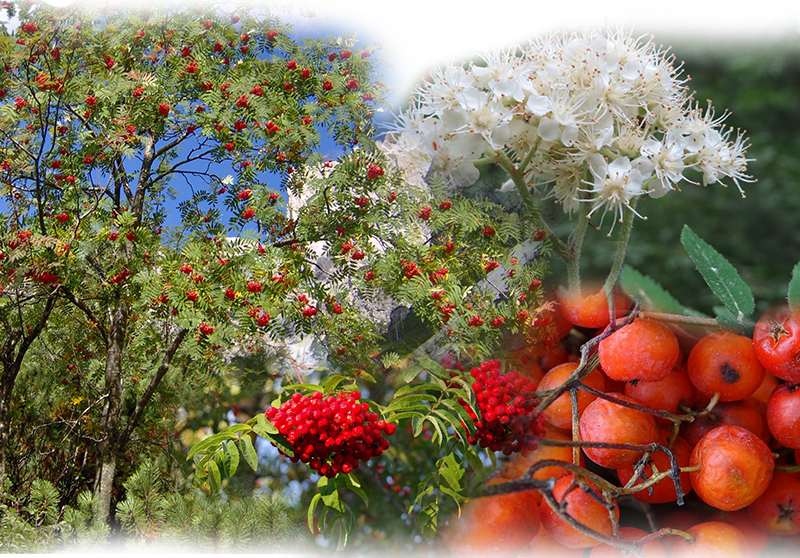
Rowan
 7
7 5
5 7
7Will it grow where I live?
Rowan is hardy to zone 3 – that covers all of Central Europe and the British Isles, and every USDA zone from 3 upwards.
Or check it for your location right here:
Profile
- Family
- Rosaceae
- Habit
- Tree
- Height
- 15 m
- Spread
- 7 m
- Growth
- medium
- Lifespan
- 80 years
- First yield
- after 5 years
- Yield per plant
- up to 40 kg a year
- Yield in cultivation
- up to 8 t/ha
- Energy yield
- 800 kcal per m² a year
- Hardiness
- zone 3–8
- Shade tolerance
- light shade
- Soil
- Sand, Silt, Loam, Clay
- Soil moisture
- semi-dry – very moist
- pH
- 6 – 8.5
- Synonyms
- Vogelbeere
Flowering & harvest
| J | F | M | A | M | J | J | A | S | O | N | D | |
|---|---|---|---|---|---|---|---|---|---|---|---|---|
| Flowering | ||||||||||||
| Fruit harvest |
Uses
Edible: Fruit can be consumed raw or cooked, known for its high acidity that may lead to stomach issues in excessive amounts. It is commonly utilized for making tasty jams and preserves, and can also be dried and combined with grains to make flour. The fruit, approximately 7.5 mm in size, grows in sizeable clusters, facilitating the harvesting process. Its leaves and flowers are brewed as a tea alternative. While young leaves are considered emergency food, they contain a cyanogenic glycoside, so caution is advised. Additionally, the roasted seed is suggested as a coffee substitute in the report.
Medicinal: The fruit's bark is utilized for diarrhea treatment and as a vaginal injection for leukorrhea. The fruit itself has antiscorbutic and astringent properties, commonly used in jams or infusions for diarrhea and hemorrhoids. An infusion serves as a gargle for sore throats and a wash for hemorrhoids and excessive vaginal discharge. Removing the seeds is crucial due to their cyanogenic glycosides content, which can produce toxic hydrogen cyanide when in contact with water. Both the flowers and the fruit exhibit laxative, diuretic, and emmenagogue characteristics.
Other uses: Oil is obtained from the seeds of the plant. The fruits are utilized in facial masks for anti-wrinkle purposes. The young branches yield a dark dye. The plant as a whole is rich in tannin and serves as a dye source. The trees are resilient to wind and are ideal for windbreaks. The wood is tough, with a fine texture, dense, and flexible. It is favored by woodworkers and is employed in crafting tires, gears, and furniture.
Propagation
Seeds should be planted right after they mature, preferably in a cool environment. If there are enough seeds, they can also be planted in an outdoor seedbed. For better germination, it is recommended to stratify stored seeds in warm conditions for 2 weeks followed by cold conditions for 14-16 weeks. Therefore, it is advisable to sow them as early as possible in the year. Once the seedlings are big enough, transplant them into individual pots. During the first year or two, the seedlings will grow slowly upwards but will develop a strong root system. It is recommended to keep them in pots in a cool environment during the first winter and then transfer them to their permanent location in late spring.
Notable
Special features: tolerant to pollutants; hybridizes freely with other Sorbus species; produces special breeding selections/crosses with Aronia, medlar, hawthorn, ... =+ biodiversity (feeds 31 mammal, 72 insect, 63 bird species); bitter fruits are edible after frost, vinegar or cooking; rods as versatile magic wands; tree humus buildup;
Origin & habitat
Europe, from south and east of Iceland to Spain, Macedonia, and the Caucasus.
2400 meters.
⚠️ Hazards
Large consumption of the raw fruit may lead to vomiting, particularly for individuals unaccustomed to it. The seeds are believed to contain hydrogen cyanide, the substance responsible for the distinctive taste of almonds. Unless the seed is extremely bitter, it is generally safe when consumed in moderate quantities. Nevertheless, excessive intake can result in respiratory issues and potentially fatal outcomes.
Frequently asked questions
Rowan: how big does it get?
Rowan (Sorbus aucuparia) grows as a Tree and reaches roughly 15 m in height when mature, with a spread of about 7 m. Growth is medium.
Rowan: what site does it need?
Rowan tolerates light shade. Suitable soils are Sand, Silt, Loam, Clay. Soil moisture should be in the range semi-dry – very moist. The pH may lie between 6 and 8.5.
Rowan: is it hardy?
Rowan is listed as hardy in zone 3–8 and survives normal winters outdoors there.
Rowan: will it grow in Central Europe?
Rowan is hardy to zone 3 – that covers all of Central Europe and the British Isles, and every USDA zone from 3 upwards.
Rowan: when does it flower?
In a temperate northern-hemisphere climate it flowers in May.
Rowan: when is it harvested?
In a temperate northern-hemisphere climate the fruit ripens in October.
Rowan: when does it start cropping, and how much?
Rowan first crops after 5 years. A mature plant gives up to 40 kg a year, in cultivation up to 8 t per hectare. Figures assume a good site; variety, soil and climate shift them considerably.
Rowan: is it poisonous?
Individual parts of Rowan are noted as mildly problematic — the plant does not count as poisonous. With wild plants, never rely on a database alone, only on a confident identification.
Rowan: what is it used for?
Rated on a scale up to 10: Edible 7/10, Medicinal 5/10, Other uses 7/10.
Which Rowan varieties are there?
The Permaplans variety finder lists 2 varieties of Rowan, including Edulis, Rosina. Each variety has its own page with taste, ripening time, disease resistance and parentage.
Plan this plant into your own garden
Permaplans plans your garden to scale on the map — with a site check, harvest calendar and over 1,000 plants. Free for iPhone, Android, Mac, Windows & Linux.
Will this plant grow where you live? → Check your site
Community experience
No first-hand reports for this plant yet.
Growing it? Write in the app what works for you – your post will show up here.
💬 Get the app and join in