Cherry plum
 7
7 3
3 6
6Will it grow where I live?
Cherry plum is hardy to zone 4 – that covers all of Central Europe and the British Isles, and every USDA zone from 4 upwards.
Or check it for your location right here:
Profile
- Family
- Rosaceae
- Habit
- Tree
- Height
- 7.5 m
- Spread
- 9 m
- Growth
- medium
- Lifespan
- 60 years
- First yield
- after 3 years
- Full yield
- after 10 years
- Productive years
- 20–40 years
- Yield per plant
- up to 347 kg a year
- Yield in cultivation
- up to 12 t/ha
- Energy yield
- 660 kcal per m² a year
- Hardiness
- zone 4–9
- Shade tolerance
- partial shade
- Soil
- Sand, Silt, Loam, Clay
- Soil moisture
- dry – very moist
- pH
- 5 – 8
- Synonyms
- Myrobalane
Flowering & harvest
| J | F | M | A | M | J | J | A | S | O | N | D | |
|---|---|---|---|---|---|---|---|---|---|---|---|---|
| Flowering | ||||||||||||
| Fruit harvest |
Varieties (2)
2 varieties of Cherry plum are listed in the Permaplans variety finder — each with its own page: taste, ripening time, disease resistance, parentage and use.
Uses
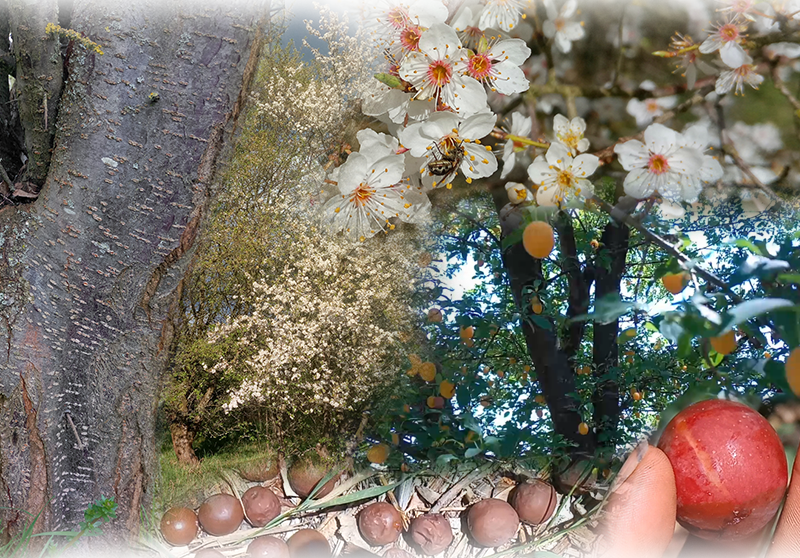
Edible: The fruits are round to oval, two to three centimetres across and, depending on cultivar, blue, red or yellow. The flesh is juicy and sweet, usually clings to the stone and is therefore best eaten fresh; blue-fruited cultivars are considered the finest in flavour. Because the cherry plum ripens very early, it fills the gap between cherry and plum. It works well for purée, jam and compote, and equally for juice and fruit brandy. The species is one of the two parents of the cultivated plum, which arose from the cross between cherry plum and blackthorn — and in flavour it sits between the two.
Medicinal: The fruit is rich in pectin, vitamins A and C and antioxidants; as a gentle aid for constipation and intestinal health it works on the same principle as prunes, through fibre and sorbitol rather than any single active compound. The flower is used as a Bach flower remedy for the fear of losing control — a tradition without pharmacological evidence. The seeds contain amygdalin, which releases hydrogen cyanide on chewing and is dangerous in quantity. Amygdalin is not a vitamin; the designation "vitamin B17" comes from the discredited laetrile cancer claim and should not be used.
Other uses: The cherry plum's main practical value beyond its fruit lies in its role as a rootstock: vegetatively propagated types are used worldwide for plums and damsons, because they suit even extreme sites, are free of sharka and are cheap to produce; peach and apricot are also worked on them. In commercial fruit growing it has lost ground only because it is too vigorous. As a dense, wind-firm large shrub it serves as a windbreak and hedging plant and is among the toughest woody plants for difficult positions. Its hard, brittle, reddish wood can be turned into jewellery and bowls. A green dye is obtained from the leaves and a dark grey one from the fruit. Red-leaved forms such as 'Atropurpurea' and 'Nigra' are widely planted as ornamentals in parks and streets, where fruit use is of no account.
Growing
Site: Sun to partial shade, though it only crops heavily in full sun. Calcareous, lighter and rather dry soils are ideal. It tolerates drought and temporary wet alike — a combination rare among fruit trees that recommends it for difficult positions. It is among the toughest fruiting woody plants there are, hardy and wind-firm. Because it flowers very early, from February, positions sheltered from late frost have the advantage. Do not plant near plum-growing districts. As a tree it reaches five to eight metres; in a hedge allow one to two metres spacing, and pollinators must come from the Prunus cerasifera group. Care: It takes pruning well and can be grown as a tree or a hedge. Only formative and shaping cuts are needed, with careful thinning of over-dense crowns where required. As with plums, plum ermine moth and sawflies occur, and in warm humid weather botrytis rot of the fruit. One pitfall lies in winter: in mild winters with warm spells followed by frost, even minus 25 degrees can cause severe damage, although in its natural range it survives minus 40.
Propagation
The cherry plum is one of the few Prunus species that can be raised from seed successfully, standing as it does close to the wild form; the stones need cold stratification over winter and are best sown outdoors or in a seedbed straight after harvest. Seedlings are variable, however, so named cultivars are grafted — with the species itself among the most important rootstocks for plums and damsons. Root suckers thrown by older trees can be severed and grown on. Seed and young plants need protection from mice.
Value for wildlife
The cherry plum is not native to Central Europe but has established itself firmly as one of the earliest forage shrubs. It often flowers from February onwards, before the leaves open, and then supplies plenty of pollen and moderate nectar — for mining bees, the horned mason bee and furrow bees this is one of the first dependable sources of the year; more than 34 wild bee species have been counted at the flowers. Thirty-six caterpillar species feed on the leaves, two of them specialists: brown hairstreak and white satin-spinner, alongside brown-tail, blackthorn tussock moth and pale tussock. Birds and small mammals take the fruit and disperse it. As a dense, often multi-stemmed large shrub it also serves as a bird shelter and food plant.
Notable
Special features: the most site-tolerant (salt, limestone, slope, etc.) wild "plum"; the early blooms smell good and attract countless bees, butterflies, etc.; differs from Mirabelle: this is thornless, blooms later, the leaves are toothed instead of serrated, and the fruits easily separate from the stone; various varieties for different fruit, leaf, and flower colors.
Origin & habitat
South-eastern Europe to Central Asia. The cherry plum comes from a belt running from the Balkans across the Crimea and the Caucasus to Iran and south-western Siberia. It is not native to Central Europe, but has been planted so long and so widely — as a rootstock for plums and damsons, as a landscape shrub and in red-leaved ornamental forms along roads — that it is now naturalised in many places. In the Caucasus it played a decisive part in the origin of the damson, held to be an ancient cross between cherry plum and blackthorn. As a cultivated plant its range now extends across all of Europe, western Asia and parts of North America.
In its homeland the cherry plum grows in open scrub, at woodland edges and on stony slopes in warmer districts. In Central Europe it turns up along field margins, railway embankments, banks, in hedges and beside roads — wherever rootstocks have thrown up shoots or birds have carried the stones. It prefers calcareous, lighter and rather dry soils in positions sheltered from late frost; waterlogged ground is unfavourable. Wind firmness, drought tolerance and the ability to survive periodic wet make it one of the toughest fruit trees for difficult sites. It takes sun and part shade, but crops heavily only in the sun.
⚠️ Hazards
Toxic kernels and leaves, toxic to dogs, cats and horses As in all Prunus species, the seeds, leaves and bark contain cyanogenic glycosides that release hydrogen cyanide when chewed or crushed. A single intact stone swallowed by accident is harmless, larger quantities of chewed kernels are not, and home-made kernel extracts are best avoided. The same plant parts are considered toxic to dogs, cats and horses. The flesh of the fruit itself is harmless. The gum that exudes from wounds indicates pruning at the wrong time of year, not a hazard.
Frequently asked questions
Cherry plum: how big does it get?
Cherry plum (Prunus cerasifera) grows as a Tree and reaches roughly 7.5 m in height when mature, with a spread of about 9 m. Growth is medium.
Cherry plum: what site does it need?
Cherry plum tolerates partial shade. Suitable soils are Sand, Silt, Loam, Clay. Soil moisture should be in the range dry – very moist. The pH may lie between 5 and 8.
Cherry plum: is it hardy?
Cherry plum is listed as hardy in zone 4–9 and survives normal winters outdoors there.
Cherry plum: will it grow in Central Europe?
Cherry plum is hardy to zone 4 – that covers all of Central Europe and the British Isles, and every USDA zone from 4 upwards.
Cherry plum: when does it flower?
In a temperate northern-hemisphere climate it flowers from March to April.
Cherry plum: when is it harvested?
In a temperate northern-hemisphere climate the fruit ripens from July to August.
Cherry plum: when does it start cropping, and how much?
Cherry plum first crops after 3 years. Full yield comes after 10 years. A mature plant gives up to 347 kg a year, in cultivation up to 12 t per hectare. The productive period lasts about 20–40 years, within a lifespan of around 60 years. Figures assume a good site; variety, soil and climate shift them considerably.
Cherry plum: is it poisonous?
Individual parts of Cherry plum are noted as mildly problematic — the plant does not count as poisonous. With wild plants, never rely on a database alone, only on a confident identification.
Cherry plum: what is it used for?
Rated on a scale up to 10: Edible 7/10, Medicinal 3/10, Other uses 6/10.
Which Cherry plum varieties are there?
The Permaplans variety finder lists 2 varieties of Cherry plum, including Milanka, Trenthorster Zufallssämling. Each variety has its own page with taste, ripening time, disease resistance and parentage.
Plan this plant into your own garden
Permaplans plans your garden to scale on the map — with a site check, harvest calendar and over 1,000 plants. Free for iPhone, Android, Mac, Windows & Linux.
Will this plant grow where you live? → Check your site
Community experience
No first-hand reports for this plant yet.
Growing it? Write in the app what works for you – your post will show up here.
💬 Get the app and join in