
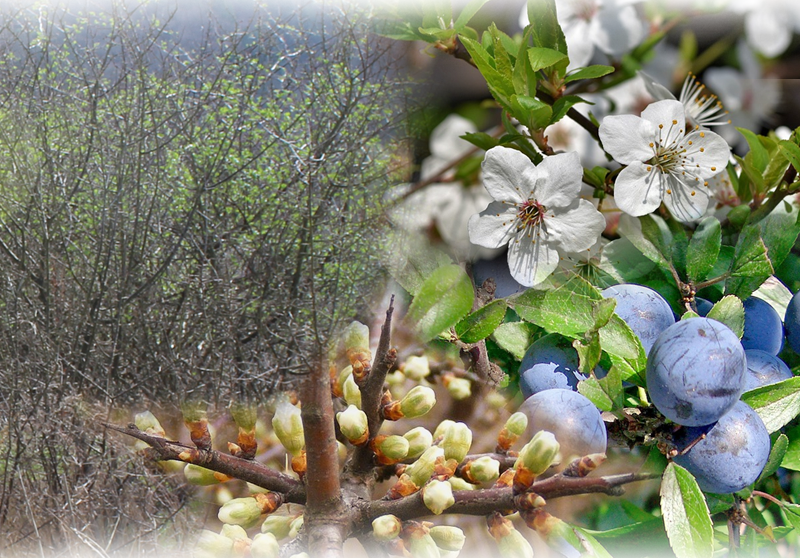
Blackthorn
 4
4 5
5 6
6Will it grow where I live?
Blackthorn is hardy to zone 4 – that covers all of Central Europe and the British Isles, and every USDA zone from 4 upwards.
Or check it for your location right here:
Profile
- Family
- Rosaceae
- Habit
- Shrub
- Height
- 4 m
- Spread
- 3 m
- Growth
- medium
- Lifespan
- 70 years
- First yield
- after 8 years
- Yield per plant
- up to 30 kg a year
- Yield in cultivation
- up to 3 t/ha
- Energy yield
- 210 kcal per m² a year
- Hardiness
- zone 4–9
- Shade tolerance
- partial shade
- Soil
- Sand, Silt, Loam
- Soil moisture
- dry – very moist
- pH
- 6 – 8.5
- Synonyms
- Schlehe
Flowering & harvest
| J | F | M | A | M | J | J | A | S | O | N | D | |
|---|---|---|---|---|---|---|---|---|---|---|---|---|
| Flowering | ||||||||||||
| Fruit harvest |
Uses
Edible: Sloes ripen very late, from the end of September into November, and often stay on the bush into winter. Raw they are strongly astringent from their tannins; only after frost do they taste sweet-sour, and even then they are barely worth eating raw. The high stone content of around 20 per cent and the clinging flesh make matters worse. Processing is the sensible route, best as a blend with low-acid fruit into jam, jelly, syrup and juice; sloe spirit, sloe liqueur and sloe wine are particularly prized, and pickled in vinegar, sugar and water they make an accompaniment to beef. Documented contents are 0.4 to 0.5 per cent fruit acids, up to 10.7 per cent sugar, pectin, tannins, minerals and about 50 mg vitamin C per 100 g. Dried flowers and leaves make a tea — with the flowers, avoid overdosing, as they contain traces of a cyanogenic glycoside.
Medicinal: The flowers, bark, leaves and fruits of blackthorn are held to be astringent, diuretic, febrifuge, mildly laxative and anti-inflammatory; the tannins and fruit acids are chiefly responsible. Dried flowers and leaves are used as a tea said to cleanse the blood, and the fruit juice is regarded as strengthening during convalescence. Restraint is appropriate with the flowers: they contain traces of a cyanogenic glycoside and should not be taken in excess. Blackthorn is unusually well attested in European herbal tradition. Hildegard of Bingen recommended it for loss of appetite, inflammation, sleeplessness and bladder complaints. In the sixteenth century Hieronymus Bock described a decoction of berries or root bark in water or sour wine, with alum and honey added, for rinsing and gargling against ulcers of the mouth, gums and throat. Sebastian Kneipp called it the most blameless of laxatives and held that it should be missing from no household medicine chest. These uses are historically handed down and not demonstrated effective in the modern sense; they do show how continuously the species was used across centuries.
Other uses: Fruit: Used for facial masks, dyes range from green to dark gray, can be used as a textile stamp. Leaves: Green in color, can serve as a substitute for tobacco. Bark: Contains tannin, yields red ink, turns yellow when boiled in lye. Wood: Extremely hard, ideal for woodturning, carving, making rakes, and walking sticks. Properties: Effective for slope stabilization and snow protection.
Growing
Site: Full sun — in shade blackthorn barely flowers or fruits. It is undemanding as to soil and lime-loving, but manages on moderately acid and dry ground too. Decisive is its urge to spread: suckers reach up to ten metres and form impenetrable thickets. It therefore belongs only where that room exists — in free-growing hedges, on sunny banks, as a field copse; otherwise a rhizome barrier or an annually mown strip is needed. Do not plant near fruit-growing districts, as it can harbour plum pox virus. The very early flowering from mid-March is at risk from late frost. Care: No pruning is needed, and none is done for yield; on sunny sites up to 30 kilograms of fruit per bush are possible. Harvest after the first frost, which mellows the fruit. Pests include plum ermine moth, plum sawfly, scale and aphids and spider mites; among diseases, pocket plum. The thorns are long and hard — stout gloves belong to both care and harvest.
Propagation
Sowing is the usual route: the stones are harvested before full ripeness, washed and cold-stratified over winter; the early harvest date markedly improves germination. Simplest is a sheltered outdoor seedbed left standing until the second spring, since germination is irregular. For quicker results, use the root suckers: they can be severed with a spade in autumn or early spring and moved, and a single shrub yields plenty. Large-fruited selections such as 'Merzig', 'Maarli' or 'Nittel' and the ornamental forms are grafted on plum rootstocks instead, since they do not come true from seed.
Value for wildlife
Blackthorn is one of the most valuable hedgerow shrubs in Central Europe. It flowers from mid-March to mid-April before the leaves open and is then a substantial source of pollen and nectar: 51 wild bee species have been recorded at the flowers, plus 20 hoverfly species. Its greatest contribution is the foliage — 159 caterpillar species feed on it, 18 of them exclusively on blackthorn, among them the brown hairstreak. Twenty bird and 18 mammal species take the fruit, which stays on the shrub into winter. The thorny, dense scrub is at the same time an excellent nesting and shelter plant; the red-backed shrike impales its prey on the thorns. A single species thus covers forage, caterpillar host, winter fruit and cover.
Notable
Special features: drought+salt+pollutant+sea wind tolerant; runners!!; Quickly forms large, impenetrable thickets; Good for dozens of birds; Not very opaque in winter; Planted as a protective belt around fields and farms; Ink: bark soaked in water for >3 days, boiled, mixed with wine+boiled down; For Celts: guide between the worlds; root creeping pioneer; Ink: bark beaten from twigs, |:3 days in water, drained, boiled,
Origin & habitat
Europe to western Asia. Blackthorn was originally native to western and Central Asia; in the Caucasus it played a decisive part in the origin of the damson. Its range today runs from Europe to western Asia, and it is naturalised in north-western Africa. It has been present in Central Europe for a very long time — stones were found in the lake dwellings on Lake Constance. In the Alps it climbs to 1600 metres on sunny woodland edges. The district between the Black Forest, the Strohgäu and the Enz valley is named Heckengäu or Schlehengäu after its abundance there.
Blackthorn is a sun- and light-loving fringe shrub. It grows in hedges and scrub, on woodland edges, clear-fells, spoil heaps, rock and scree slopes, stone banks, embankments, in vineyards and abandoned quarries. It accepts every site from dry and lean to fresh and nutrient-rich, on stony as on loamy soils, lime-loving but also on moderately acid ground. Through root suckers reaching up to ten metres it forms closed, impenetrable thickets and advances from hedges into adjoining open land — on grazed dry grassland it is therefore both a habitat builder and a scrub-encroachment problem.
⚠️ Hazards
Toxic kernels and leaves, toxic to dogs, cats and horses As in all Prunus species, the seeds, leaves and bark contain cyanogenic glycosides that release hydrogen cyanide when chewed or crushed. A single intact stone swallowed by accident is harmless, larger quantities of chewed kernels are not, and home-made kernel extracts are best avoided. The same plant parts are considered toxic to dogs, cats and horses. The flesh of the fruit itself is harmless. The gum that exudes from wounds indicates pruning at the wrong time of year, not a hazard.
Frequently asked questions
Blackthorn: how big does it get?
Blackthorn (Prunus spinosa) grows as a Shrub and reaches roughly 4 m in height when mature, with a spread of about 3 m. Growth is medium.
Blackthorn: what site does it need?
Blackthorn tolerates partial shade. Suitable soils are Sand, Silt, Loam. Soil moisture should be in the range dry – very moist. The pH may lie between 6 and 8.5.
Blackthorn: is it hardy?
Blackthorn is listed as hardy in zone 4–9 and survives normal winters outdoors there.
Blackthorn: will it grow in Central Europe?
Blackthorn is hardy to zone 4 – that covers all of Central Europe and the British Isles, and every USDA zone from 4 upwards.
Blackthorn: when does it flower?
In a temperate northern-hemisphere climate it flowers in April.
Blackthorn: when is it harvested?
In a temperate northern-hemisphere climate the fruit ripens in October.
Blackthorn: when does it start cropping, and how much?
Blackthorn first crops after 8 years. A mature plant gives up to 30 kg a year, in cultivation up to 3 t per hectare. Figures assume a good site; variety, soil and climate shift them considerably.
Blackthorn: is it poisonous?
Individual parts of Blackthorn are noted as mildly problematic — the plant does not count as poisonous. With wild plants, never rely on a database alone, only on a confident identification.
Blackthorn: what is it used for?
Rated on a scale up to 10: Edible 4/10, Medicinal 5/10, Other uses 6/10.
Plan this plant into your own garden
Permaplans plans your garden to scale on the map — with a site check, harvest calendar and over 1,000 plants. Free for iPhone, Android, Mac, Windows & Linux.
Will this plant grow where you live? → Check your site
Community experience
No first-hand reports for this plant yet.
Growing it? Write in the app what works for you – your post will show up here.
💬 Get the app and join in