
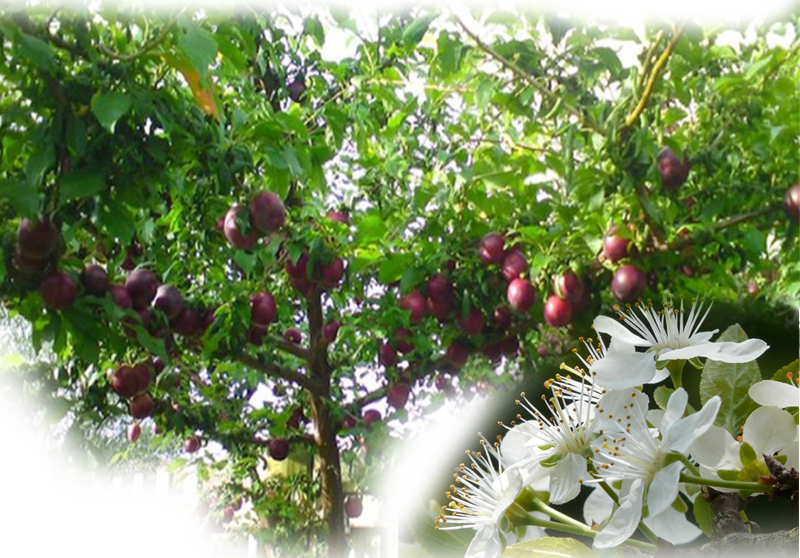
Plum
 9
9 3
3 6
6Will it grow where I live?
Plum is hardy to zone 5 – that covers all of Central Europe and the British Isles, and every USDA zone from 5 upwards.
Or check it for your location right here:
Profile
- Family
- Rosaceae
- Habit
- Tree
- Height
- 11 m
- Spread
- 10 m
- Growth
- medium
- Lifespan
- 120 years
- First yield
- after 5 years
- Yield per plant
- up to 60 kg a year
- Yield in cultivation
- up to 12 t/ha
- Energy yield
- 550 kcal per m² a year
- Hardiness
- zone 5–9
- Shade tolerance
- partial shade
- Soil
- Sand, Silt, Loam, Clay
- Soil moisture
- semi-dry – very moist
- pH
- 6 – 7.5
- Synonyms
- Pflaumenbaum
- Planned in gardens
- 4×
Flowering & harvest
| J | F | M | A | M | J | J | A | S | O | N | D | |
|---|---|---|---|---|---|---|---|---|---|---|---|---|
| Flowering | ||||||||||||
| Fruit harvest |
Varieties (32)
32 varieties of Plum are listed in the Permaplans variety finder — each with its own page: taste, ripening time, disease resistance, parentage and use.
- Angelina Burdett
- Anna Späth Late plum that stays fresh and tasty on the tree into October.
- Auerbacher Hardy, self-fertile German plum – reliable for the home garden.
- Bellamira Large golden mirabelle with sweet aroma and strong disease resistance.
- Bluefre Very large, late blue plum – firm-fleshed and ships well.
- Bühler Frühzwetschge
- Čačanska Lepotica Early, heavy-bearing blue plum from Serbia – dessert and processing.
- Čačanska Najbolja Large, flavoursome blue dessert plum from Serbia.
- Čačanska Rodna Very fertile, self-fertile blue plum – sweet, versatile and productive.
- Fellenberg
- Gelber Spilling
- Count Althann's Gage Refined gage with golden, juicy-sweet flesh.
- Große Grüne Reneklode Ancient green gage – the epitome of sweet, aromatic dessert fruit.
- Gute von Bry
- Haferpflaume
- Haroma Robust, very sweet plum with strikingly orange flesh.
- Hauszwetschge
- Jefferson
- Jubileum Very large, sweet blue-red dessert plum from Sweden – premium fruit size.
- Mirabelle von Nancy
- Ontario Large greenish-yellow round plum with juicy, mildly sweet flesh – versatile kitchen plum.
- Opal Early, sweet dessert plum with reddish-purple skin and gage-like aroma.
- Ortenauer
- President Very late, large blue plum with good keeping quality.
- Reine Claude d'Oullins Large golden gage with honey-sweet juicy flesh – a self-fertile garden favourite.
- Stanley The world's leading prune and processing plum – sweet and self-fertile.
- The Czar Early, frost-tolerant cooking and preserving plum with dark blue skin.
- Tophit Very large, late German premium plum with outstanding aroma.
- Toptaste Modern dessert plum with high sugar content and top flavour.
- Valor Large, late blue-purple dessert plum of excellent quality.
- Victoria The English classic: hardy, self-fertile all-round plum for dessert and kitchen.
- Wangenheimer Frühzwetsche
Uses
Edible: Plums and damsons are eaten raw, made into purée, jam and cake toppings, dried, or fermented into spirit and liqueur; thanks to their firm, freestone flesh damsons are the classic baking and drying fruit, while juicy round plums are better fresh. Drying raises the sugar content sharply, and dried plums keep well. The flowers can be scattered over salads as an edible garnish, and an edible gum exudes from wounds in the trunk. The seeds inside the stone contain around twenty per cent oil; sweet-kernelled types taste of almond, whereas bitter-tasting kernels contain amygdalin, which releases hydrogen cyanide on chewing, and do not belong on the plate. Yield estimates run to some twelve tonnes per hectare, equivalent to about 552 kilocalories per square metre.
Medicinal: Dried plums act as a mild laxative; the effect comes from their high sorbitol and fibre content rather than any single active compound. It is well documented and the only reliable medicinal use of the species. An infusion of the bark as a fever remedy is recorded in folk medicine but has not been clinically tested. The seeds inside the stone contain amygdalin; bitter-tasting kernels release hydrogen cyanide on chewing and are not a food. For raw apricot kernels, chemically comparable, the EU sets a maximum of 20 milligrams of hydrogen cyanide per kilogram — a useful yardstick for plum kernels too. Leaves and bark also contain cyanogenic glycosides and do not belong in teas.
Other uses: Dyeing: Leaves are colored green, fruits are tinted gray-green, and the bark is dyed yellow. Resin acts as a glue. The seeds have oil. The wood is tough, dense, fragile, and challenging to dry, shrinking significantly and prone to cracking. Ideal for woodturning.
Growing
Plums thrive in well-drained, moisture-retaining soil and prefer a sheltered location. They do well in partial shade but bear more fruit in sunny spots, especially in loamy soil with some lime content. The pH of the soil should range between 6 and 6.5. Cultivated widely in temperate regions for their edible fruits, plums come in various varieties that yield fresh fruit from late July to November or December. While most types are self-fertile, some need cross-pollination, and a few are partially self-sterile. In limited spaces or challenging climates, plums can be grown against walls, with sunny south- or west-facing walls being ideal for most varieties. Believed to be a hybrid of P. spinosa and P. cerasifera with chromosome doubling, plums do not cross with Japanese plums, P. salicina. Plums thrive in a continental climate, with mild winters leading to earlier flowering but posing a risk of frost damage to blossoms. The best fruiting occurs away from the western side of the region. Plum trees generally have shallow roots and tend to form runners if the roots are harmed. Plants in this genus are highly vulnerable to the honey fungus.
Propagation
Plum cultivars are grafted, since seedlings do not come true. The usual method is budding in August at ten to twenty centimetres above ground, with whip and cleft grafting as late-winter options. The rootstock determines vigour, soil tolerance and suckering: St. Julien A suits light soils and unirrigated plantings, WaVit and WeiWa good sites; all three produce almost no root suckers, which was the failing of older stocks such as 655/2. For restrained growth in gardens, Pixy is appropriate. One speciality is own-rooted propagation: the German prune and some landraces sucker freely, and these suckers can be lifted in winter and planted straight out — the traditional route in old orchards. Sowing serves only to raise rootstocks; the stones need cold-moist stratification over winter.
Value for wildlife
Plum blossom opens early in the year and ranks among the richest food sources of the season, offering abundant nectar and pollen at a time when little else is in flower. Around 46 wild bee species have been recorded at the flowers, most of them mining bees of the genus Andrena, and the bloom falls into the critical build-up phase of young bumblebee and honeybee colonies. Some 65 moth and butterfly species use plum as a larval food plant, five of them closely tied to it, including the black hairstreak. Several beetle species feed on wood, bark or blossom. Ripe and windfall fruit is taken by thrushes, starlings, finches and corvids, while older limbs give cavity-nesting birds a foothold.
Notable
Special features: hybrid [cherry plum (P. cerasifera) x blackthorn (P. spinosa)]; subspecies: German prune/quetsche(subsp. domestica), damson and bullace(insititia), half-damson(intermedia), gage(italica), spilling(pomariorum), ziparte(prisca), mirabelle(syriaca); flowers later than cherry plum+apricot+peach → less late-frost damage; no wild stands (pure cultivated hybrid); propagation: grafting(St. Julien A, WaVit, WeiWa, Pixy) + root suckers(own-rooted in Hauszwetschge);
Origin & habitat
Western Asia and the Caucasus, now grown throughout the temperate zone. The plum is not a wild species but a natural hybrid of blackthorn and cherry plum that probably arose between the Caucasus and the Caspian Sea; more recent work attributes the main share to various ploidy levels of the cherry plum. By way of the Near East — Damascus gave the damson its name — it reached the Mediterranean and came to Central Europe with the Romans. It occurs naturalised in hedges and along waysides, but genuine wild populations do not exist. The largest producer today is China with a good half of the world harvest, followed by Romania, Serbia, Chile and Turkey; in Germany around 71 per cent comes from Baden-Württemberg and Rhineland-Palatinate.
The plum is a cultivated hybrid without natural wild stands; its habitat is the farmed landscape. Traditionally it grows in orchard meadows, cottage gardens and hedgerows, and it also escapes onto field margins, waysides, railway embankments and open scrub, where root suckers often build dense groups. It needs a medium-heavy, humus-rich, nutrient-rich and well-aerated soil that stays fresh but never waterlogged; compacted ground troubles it as much as shallow dry soils. Sunny to partly shaded, warm positions suit it best. Because it flowers later than cherry plum, apricot and peach, its blossom is caught by late frosts less often — which makes it worth growing in rougher districts and higher valley sites as well.
⚠️ Hazards
Toxic kernels and leaves, toxic to dogs, cats and horses As in all Prunus species, the seeds, leaves and bark contain cyanogenic glycosides that release hydrogen cyanide when chewed or crushed. A single intact stone swallowed by accident is harmless, larger quantities of chewed kernels are not, and home-made kernel extracts are best avoided. The same plant parts are considered toxic to dogs, cats and horses. The flesh of the fruit itself is harmless. The gum that exudes from wounds indicates pruning at the wrong time of year, not a hazard.
Frequently asked questions
Plum: how big does it get?
Plum (Prunus domestica) grows as a Tree and reaches roughly 11 m in height when mature, with a spread of about 10 m. Growth is medium.
Plum: what site does it need?
Plum tolerates partial shade. Suitable soils are Sand, Silt, Loam, Clay. Soil moisture should be in the range semi-dry – very moist. The pH may lie between 6 and 7.5.
Plum: is it hardy?
Plum is listed as hardy in zone 5–9 and survives normal winters outdoors there.
Plum: will it grow in Central Europe?
Plum is hardy to zone 5 – that covers all of Central Europe and the British Isles, and every USDA zone from 5 upwards.
Plum: when does it flower?
In a temperate northern-hemisphere climate it flowers in May.
Plum: when is it harvested?
In a temperate northern-hemisphere climate the fruit ripens from August to September.
Plum: when does it start cropping, and how much?
Plum first crops after 5 years. A mature plant gives up to 60 kg a year, in cultivation up to 12 t per hectare. Figures assume a good site; variety, soil and climate shift them considerably.
Plum: is it poisonous?
Individual parts of Plum are noted as mildly problematic — the plant does not count as poisonous. With wild plants, never rely on a database alone, only on a confident identification.
Plum: what is it used for?
Rated on a scale up to 10: Edible 9/10, Medicinal 3/10, Other uses 6/10.
Which Plum varieties are there?
The Permaplans variety finder lists 32 varieties of Plum, including Angelina Burdett, Anna Späth, Auerbacher, Bellamira, Bluefre, Bühler Frühzwetschge, Čačanska Lepotica, Čačanska Najbolja, Čačanska Rodna, Fellenberg, Gelber Spilling, Count Althann's Gage and 20 more. Each variety has its own page with taste, ripening time, disease resistance and parentage.
Plan this plant into your own garden
Permaplans plans your garden to scale on the map — with a site check, harvest calendar and over 1,000 plants. Free for iPhone, Android, Mac, Windows & Linux.
Will this plant grow where you live? → Check your site
Community experience
No first-hand reports for this plant yet.
Growing it? Write in the app what works for you – your post will show up here.
💬 Get the app and join in