
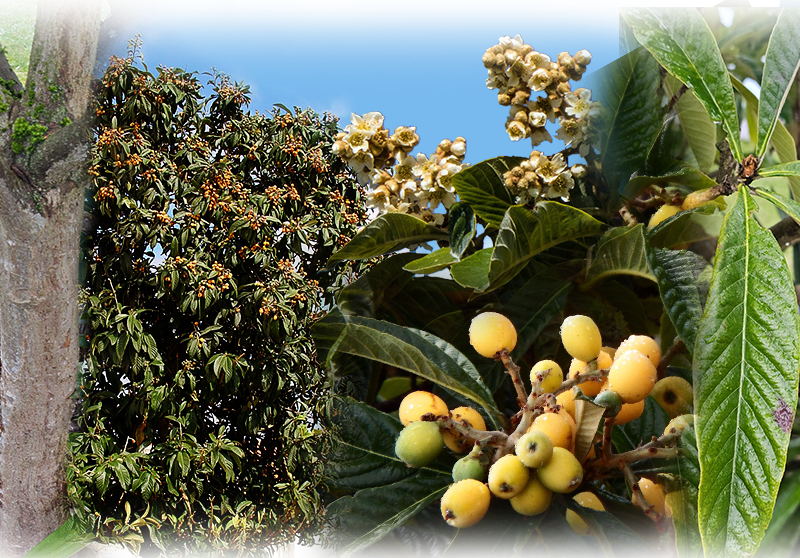
Loquat
 9
9 8
8 3
3Will it grow where I live?
Loquat is only hardy to zone 8, so outdoors year-round it needs the mildest spots in Central Europe – wine-growing regions, the Rhine valley, coasts, Lake Constance, Ticino – or a container overwintered under cover. Most of the British Isles and the Pacific coast of North America qualify. It also needs warm summers – in Central Europe that means wine-growing regions, cities or a sheltered south-facing wall.
Or check it for your location right here:
Profile
- Family
- Rosaceae
- Habit
- Tree
- Height
- 8 m
- Spread
- 6 m
- Growth
- medium
- Lifespan
- 60 years
- First yield
- after 5 years
- Full yield
- after 20 years
- Productive years
- 20 years
- Yield in cultivation
- up to 40 t/ha
- Energy yield
- 500 kcal per m² a year
- Hardiness
- zone 8–12
- Shade tolerance
- partial shade
- Soil
- Sand, Silt, Loam
- Soil moisture
- dry – very moist
- pH
- 5 – 8
- Synonyms
- Japanische Wollmispel, Nespoli, Loquat
Flowering & harvest
| J | F | M | A | M | J | J | A | S | O | N | D | |
|---|---|---|---|---|---|---|---|---|---|---|---|---|
| Flowering | ||||||||||||
| Fruit harvest | ||||||||||||
| Leaf harvest |
Varieties (1)
1 varieties of Loquat are listed in the Permaplans variety finder — each with its own page: taste, ripening time, disease resistance, parentage and use.
Uses
Edible: The fruits are botanically pomes, three to five centimetres across, oval to pear-shaped, with a thin, slightly downy yellow to orange skin and juicy flesh. Inside sit two to five large glossy brown seeds, which cut the edible proportion considerably. The flavour is sweet-sharp and aromatic, described according to cultivar as somewhere between apricot, mango and pear; fruit picked fully ripe is far better than fruit that has travelled, because loquats do not ripen after picking and quickly bruise. They are rich in potassium and carotenoids. They are eaten fresh and peeled, processed into jam, jelly, compote and chutney, or steeped for liqueur; in Japan and Spain they count as a spring fruit. The seeds are roasted as a coffee substitute or ground as a spice.
Other uses: Beyond its fruit the loquat's main value lies in its evergreen foliage: leaves up to 25 centimetres long, leathery and deeply veined with a felted underside, give it a striking, almost subtropical presence and make it one of the very few evergreen small trees that also bear fruit. As a container plant on a terrace or in a conservatory that is precisely what it is grown for. The timber is pink, hard and fine-grained but little used because of its small dimensions — in South Asia it serves for turnery and small tools. Young shoots and leaves are cut locally as livestock fodder, and in East Asia the leaves are used as a tea infusion. The fallen leaves break down slowly and make a durable mulch.
Growing
Site: The decisive peculiarity of the loquat is its inverted year: it flowers in October and November and ripens fruit in April and May. The wood is hardy to about -12 to -15 °C, but open flowers and young fruitlets die at around -3 °C — so in Central Europe it is not winter hardiness that decides the crop but whether it freezes at all between flowering and fruit set. As a fruit tree it is worth planting only in mild wine-growing districts against a warm, south-facing wall with shelter from north winds; otherwise grow it in a container overwintered bright and frost-free at five to ten degrees. Cherry laurel makes a useful hardiness yardstick: where that dies back regularly, the loquat will stay fruitless. It is a host of fireblight — keep it away from pome fruit plantings and quinces, and observe reporting requirements in affected areas. Care: Here the evergreen tree stays small at two to five metres and grows slowly. Feed sparingly and only until June; late nitrogen forces soft wood that the first frost takes. Do not forget to water in winter — the leathery leaves keep transpiring even in frost, and the commonest cause of loss is drought over frozen ground rather than cold itself. Prune after harvest in early summer, and lightly: thin, remove dead wood, correct the shape. For decent fruit, thin the trusses to three or four, or they stay small. Partial self-fertility gives a basic crop; a second seedling improves it markedly. Plants killed back to old wood usually reshoot — do not give up too early, but wait until midsummer growth.
Propagation
Raising loquats from seed could hardly be simpler and is the usual starting point: take the large, glossy brown pips from a ripe fruit, wash them and sow at once, moist and warm at about 20 °C — they must not dry out and then germinate reliably within a few weeks. Seedlings grow fast but vary in fruit quality and need eight to ten years to first flowering. Commercial growing therefore uses grafted trees: scions are whip-grafted onto loquat seedlings in late winter or budded in summer, and grafted trees crop after three to four years. In southern Europe quince (Cydonia oblonga) serves as a dwarfing rootstock, keeping the tree smaller and suited to containers, though it is not compatible with every cultivar. Cuttings root only with difficulty and play no practical role.
Value for wildlife
The loquat's value to wildlife falls at an unusual point in the year: it flowers in October and November, when almost nothing else does. In mild districts and in southern Europe it is therefore one of the last sources of nectar and pollen, worked by honeybees on warm autumn days and taken by bumblebee queens before they overwinter; the flowers are strongly scented and depend on insect pollination. In Central Europe that counts for less, because bees barely fly at the temperatures usual by then. This East Asian newcomer has no caterpillars or beetles tied to it here. What remains is structure: the dense, evergreen, large-leaved canopy gives small birds winter cover, and where the fruit does ripen in spring it is taken by blackbirds and starlings before the gardener gets there.
Notable
Special features: tolerates dry soils and coastal climates, does not like lime or cold wind/too much nitrogen/fertilizer; at -3°C, mature flowers die in winter!, then no fruit; in commercial cultivation, only 3-4m tall grafted varieties are planted with 500 trees per hectare; in tropical climates, the tree can flower and bear fruit 2-3 times a year.
Origin & habitat
East Asia: the natural range is strikingly small, confined to two occurrences in central China, near Nanchuan in Chongqing and near Yichang in Hubei. Whether the species was also originally wild in southern Japan or merely brought into cultivation there very early remains unresolved. It has been grown in China for more than a thousand years; in 1778 Joseph Banks carried it from Japan to England, which is where the misleading epithet comes from. The loquat is now cultivated in every country with a Mediterranean or subtropical climate, chiefly in China, Japan, Spain and Turkey. In Germany it thrives only in mild-winter districts along the Upper Rhine, for instance at Karlsruhe.
In its Chinese homeland the loquat grows in mild-wintered, humid mountain and hill forest of the subtropical zone, on fresh, free-draining, humus-rich soils in sheltered valleys. As an evergreen tree of the second canopy layer it is adapted to high humidity and the absence of hard frost — the wood copes better with cold itself than with winter drought. Its life cycle is built around that frost-free winter: it flowers when vegetation further north is dormant and ripens its fruit in spring. That is exactly where it fails in Central Europe, where the tree survives but loses its flowers year after year.
⚠️ Hazards
Seeds contain hydrogen cyanide.
Frequently asked questions
Loquat: how big does it get?
Loquat (Eriobotrya japonica) grows as a Tree and reaches roughly 8 m in height when mature, with a spread of about 6 m. Growth is medium.
Loquat: what site does it need?
Loquat tolerates partial shade. Suitable soils are Sand, Silt, Loam. Soil moisture should be in the range dry – very moist. The pH may lie between 5 and 8.
Loquat: is it hardy?
Loquat is listed as hardy in zone 8–12 and survives normal winters outdoors there.
Loquat: will it grow in Central Europe?
Loquat is only hardy to zone 8, so outdoors year-round it needs the mildest spots in Central Europe – wine-growing regions, the Rhine valley, coasts, Lake Constance, Ticino – or a container overwintered under cover. Most of the British Isles and the Pacific coast of North America qualify. It also needs warm summers – in Central Europe that means wine-growing regions, cities or a sheltered south-facing wall.
Loquat: when does it flower?
In a temperate northern-hemisphere climate it flowers from November to April.
Loquat: when is it harvested?
In a temperate northern-hemisphere climate the fruit ripens from May to June.
Loquat: when does it start cropping, and how much?
Loquat first crops after 5 years. Full yield comes after 20 years. In cultivation, up to 40 t per hectare is typical. The productive period lasts about 20 years, within a lifespan of around 60 years. Figures assume a good site; variety, soil and climate shift them considerably.
Loquat: is it poisonous?
Individual parts of Loquat are noted as mildly problematic — the plant does not count as poisonous. With wild plants, never rely on a database alone, only on a confident identification.
Loquat: what is it used for?
Rated on a scale up to 10: Edible 9/10, Medicinal 8/10, Other uses 3/10.
Which Loquat varieties are there?
The Permaplans variety finder lists 1 varieties of Loquat, including Rose-Anne. Each variety has its own page with taste, ripening time, disease resistance and parentage.
Plan this plant into your own garden
Permaplans plans your garden to scale on the map — with a site check, harvest calendar and over 1,000 plants. Free for iPhone, Android, Mac, Windows & Linux.
Will this plant grow where you live? → Check your site
Community experience
No first-hand reports for this plant yet.
Growing it? Write in the app what works for you – your post will show up here.
💬 Get the app and join in