
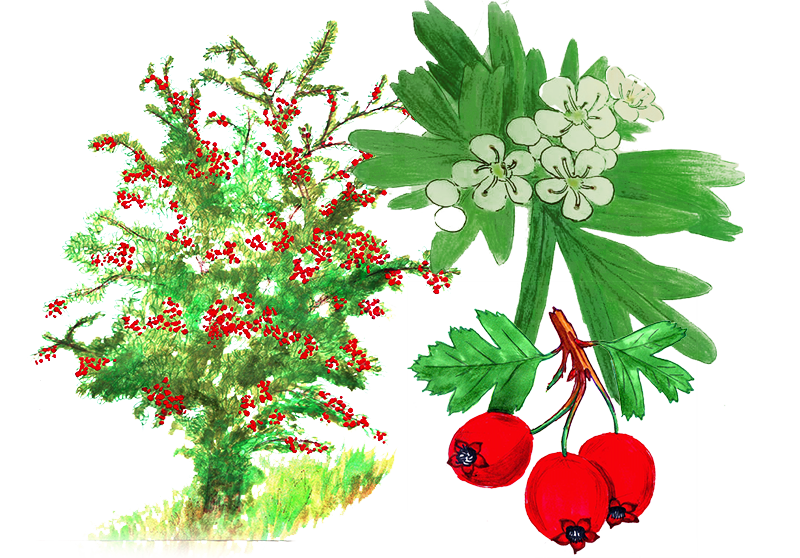
Azarole
 7
7 4
4 7
7Will it grow where I live?
Azarole is hardy to zone 6, which covers nearly all of Central Europe and the British Isles; only harsh upland sites (Alps, high ridges) call for winter protection.
Or check it for your location right here:
Profile
- Family
- Rosaceae
- Habit
- Tree
- Height
- 10 m
- Spread
- 10 m
- Growth
- medium
- Lifespan
- 300 years
- First yield
- after 6 years
- Hardiness
- zone 6–9
- Shade tolerance
- partial shade
- Soil
- Sand, Silt, Loam, Clay
- Soil moisture
- dry – near water
- pH
- 6 – 8
- Planned in gardens
- 3×
Flowering & harvest
| J | F | M | A | M | J | J | A | S | O | N | D | |
|---|---|---|---|---|---|---|---|---|---|---|---|---|
| Flowering | ||||||||||||
| Fruit harvest |
Uses
Edible: The fruits reach two to three and a half centimetres and turn distinctly sweeter with plenty of sun. Eaten raw while still firm they are apple-like with a note of roses, and fully ripe more berry-like; individual cultivars develop a pronounced strawberry aroma and rank among the best wild fruits of all. In pomological literature the yellow-fruited forms are held to be the finest of the whole genus, and the vitamin C content is very high. On Mediterranean markets the fruit is still sold today. It is preserved dried, cooked down or laid up in honey; mixed with flour it makes a filling addition. Two selections are in circulation, 'Red Azarole' and 'Yellow Azarole', which differ only in fruit colour.
Medicinal: The fruits and flowers of plants such as hawthorn possess properties that can strengthen the heart and reduce blood pressure. They are suitable for preparing teas or tinctures.
Other uses: As in all hawthorns, azarole wood is heavy, hard, tough and fine-grained — it turns cleanly, takes a polish and yields tool handles, turnery and small implements; as firewood it has a high calorific value. Its main practical garden use, though, is as hedging: densely branched, shear-tolerant and stiff despite its weak thorns, it makes an impenetrable boundary planting that flowers and fruits, shelters hedge-nesting birds and breaks the wind. Hawthorns also serve as grafting rootstock for medlar and are occasionally used for pear, though compatibility remains cultivar-dependent. Because of its tolerance of drought, wind and air pollution it is planted around the Mediterranean as a street and embankment tree as well.
Growing
Site: The azarole needs the warmest, fully sunlit spot in the garden — in a wine-growing climate it crops reliably, while in cool districts it flowers but the fruit stays hard and sour. Soil matters less: free-draining and preferably calcareous is ideal, yet it accepts heavy clay and temporary wet and tolerates drought once established. One advantage over other hawthorns is its weak thorning, often absent altogether, which suits it to paths and seating areas. Fireblight, on the other hand, must be considered: like all hawthorns it hosts Erwinia amylovora and can carry the disease into neighbouring apple, pear and quince plantings — in fruit-growing regions check local rules before planting. The orange-red to yellow fruits drop and stain pale paving. Care: It grows slowly and stays permanently small, which makes it easy to look after. Train it as a small tree or multi-stemmed large shrub; prune sparingly and in late winter, essentially only thinning, because the flower clusters sit on two-year and older wood. Do not feed, and water only in the planting year and in extreme drought. The main ongoing task is watching for fireblight: shoots that wilt suddenly in early summer, turn brown-black and hook over are cut well back into sound wood, the prunings destroyed and the tools disinfected. Mildew and leaf spot also occur but are of no consequence. Young plants get a vole basket and a browsing guard. Harvest from September into October, fully ripe and ideally after a run of sunny weeks.
Propagation
Seeds are ideally sown right after they mature in autumn and are placed in a cold storage. While some seeds may sprout in the following spring, most will likely require an additional year. Stored seeds can have a slow and irregular germination process; to help speed it up, they should undergo a warm stratification at 15°C for 3 months followed by a cold stratification at 4°C for another 3 months. Even with these treatments, it may still take up to 18 months for the seeds to germinate. To potentially reduce this time, scoring the seed before stratification could be beneficial. Another method to hasten germination is by fermenting the seed in its pulp for a few days. Alternatively, harvesting the seed while still "green" and planting it immediately in a cold storage can lead to spring germination if timed correctly. For those cultivating small quantities of plants, it's recommended to pot the seedlings early and keep them in individual pots for the first year before transferring them to nursery beds or permanent positions in late spring. In the case of larger quantities, direct outdoor sowing in a protected seedbed is advisable, ensuring protection from seed-eating animals. The plants should remain in the seedbed until they are sufficiently developed to be transplanted, with root pruning necessary if they will be undisturbed for over two years.
Value for wildlife
For the azarole itself no Central European counts of wild bees, butterflies or beetles exist — here it is a rare cultivated tree, not part of the native fauna, and figures recorded for common hawthorn cannot simply be transferred. What can be said follows from its structure. In May and June it carries open, flat, saucer-shaped flowers in broad corymbs, typical of hawthorns and fully accessible to short-tongued insects: honeybees, mining and furrow bees, hoverflies and pollen beetles all take them. The scent is notably pungent and draws flies as well. The orange-red to yellow pome fruits hang long after ripening and are bird food; in its home range birds disperse the stones. Its dense, stiff growth makes it a proven nesting shrub for hedge-nesting birds.
Notable
Special features: drought, wind, and pollutant-resistant; alternatively: apple, scarlet, and Chinese hawthorn; naturally crosses with other hawthorn species; the fruits are very rich in vitamin C; the blossoms have a very strong, distinctive odor; information on yield and calories cannot be found even in Italian literature (where it is a well-known cultivated fruit).
Origin & habitat
Mediterranean and western Asia: the range covers the whole Mediterranean basin including the islands, reaches south into coastal North Africa and west to southern France and Tunisia; eastwards it extends across western Asia with the Caucasus region, Turkey, Syria, Iraq and Iran as far as Central Asia. The centre of the wild populations lies in western Asia, from where the species was carried westwards as a fruit tree in antiquity; around the Mediterranean it is still widely cultivated and its fruit is sold in markets. North of the Alps the azarole was once a common orchard tree and is documented in Germany from 1656. Today it appears in Central Europe only rarely, escaped from old plantings, and its fruit usually fails to ripen here.
The azarole belongs to the summer-warm, winter-wet hill and mountain country of the Mediterranean and western Asia. There it grows in open sclerophyll vegetation and its margins: on dry slopes, in open oak and scrub woodland, in hedges and along field edges, standing as a light-demanding small tree of four to five, rarely up to ten metres. It prefers free-draining, often calcareous and stony soils; once established it survives summer drought with a deep root system, but it equally tolerates heavy and periodically wet ground. Unlike most hawthorns it is often only weakly thorned or entirely unarmed. What limits it in Central Europe is not frost but heat sum: the plant itself is hardy here, yet without sufficient summer warmth its fruit does not ripen.
Frequently asked questions
Azarole: how big does it get?
Azarole (Crataegus azarolus) grows as a Tree and reaches roughly 10 m in height when mature, with a spread of about 10 m. Growth is medium.
Azarole: what site does it need?
Azarole tolerates partial shade. Suitable soils are Sand, Silt, Loam, Clay. Soil moisture should be in the range dry – near water. The pH may lie between 6 and 8.
Azarole: is it hardy?
Azarole is listed as hardy in zone 6–9 and survives normal winters outdoors there.
Azarole: will it grow in Central Europe?
Azarole is hardy to zone 6, which covers nearly all of Central Europe and the British Isles; only harsh upland sites (Alps, high ridges) call for winter protection.
Azarole: when does it flower?
In a temperate northern-hemisphere climate it flowers in May.
Azarole: when is it harvested?
In a temperate northern-hemisphere climate the fruit ripens from August to November.
Azarole: is it poisonous?
No toxicity is recorded for Azarole. With wild plants, never rely on a database alone — only on a confident identification.
Azarole: what is it used for?
Rated on a scale up to 10: Edible 7/10, Medicinal 4/10, Other uses 7/10.
Plan this plant into your own garden
Permaplans plans your garden to scale on the map — with a site check, harvest calendar and over 1,000 plants. Free for iPhone, Android, Mac, Windows & Linux.
Will this plant grow where you live? → Check your site
Community experience
No first-hand reports for this plant yet.
Growing it? Write in the app what works for you – your post will show up here.
💬 Get the app and join in