
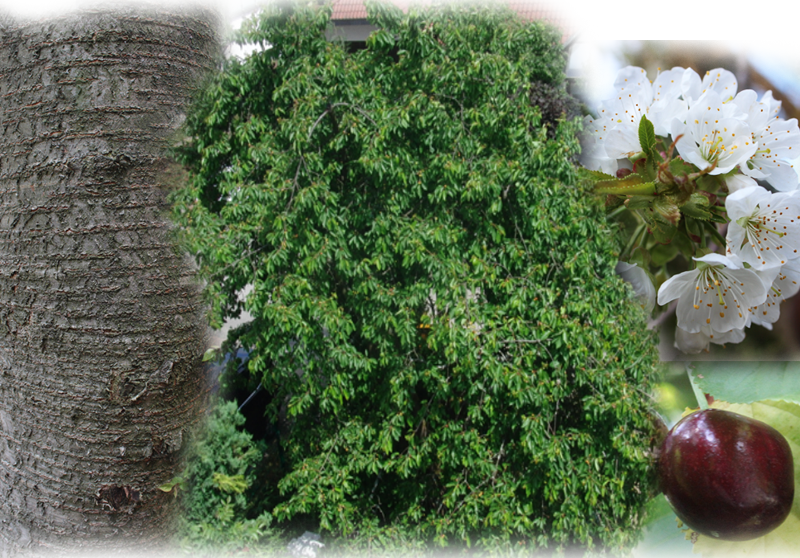
Wild cherry
 6
6 4
4 5
5Will it grow where I live?
Wild cherry is hardy to zone 3 – that covers all of Central Europe and the British Isles, and every USDA zone from 3 upwards.
Or check it for your location right here:
Profile
- Family
- Rosaceae
- Habit
- Tree
- Height
- 19 m
- Spread
- 12 m
- Growth
- fast
- Lifespan
- 100 years
- First yield
- after 6 years
- Yield per plant
- up to 30 kg a year
- Yield in cultivation
- up to 6 t/ha
- Energy yield
- 300 kcal per m² a year
- Hardiness
- zone 3–8
- Shade tolerance
- partial shade
- Soil
- Sand, Silt, Loam
- Soil moisture
- semi-dry – very moist
- pH
- 5.5 – 7
- Synonyms
- Kirschbaum
- Planned in gardens
- 5×
Flowering & harvest
| J | F | M | A | M | J | J | A | S | O | N | D | |
|---|---|---|---|---|---|---|---|---|---|---|---|---|
| Flowering | ||||||||||||
| Fruit harvest |
Varieties (46)
46 varieties of Wild cherry are listed in the Permaplans variety finder — each with its own page: taste, ripening time, disease resistance, parentage and use.
- Adlerkirsche von Bärtschi
- Alma
- Annabella
- Badeborner
- Bernhard Nette
- Bing World's best-known dark commercial cherry with large, firm, juicy fruit.
- Burlat The classic early sweet cherry, ripe from the second cherry week.
- Büttners Rote Knorpelkirsche Old yellow-red marbled firm cherry with very firm flesh and good crack resistance.
- Charmes
- Dollenseppler
- Dönissens Gelbe Knorpelkirsche Pure yellow, firm cherry – less prone to cherry fruit fly and bird damage.
- Frühe Rote Meckenheimer
- Früheste der Mark
- Garrns Bunte
- Gelbe KnorpelkirscheYellow-fleshed firm cherry with dense, sweet flesh.
- Große Schwarze Knorpelkirsche Classic black-red firm cherry with firm flesh – a proven old orchard variety.
- Hedelfinger Proven, robust old German firm cherry with good crack and frost tolerance.
- Kassins Frühe
- Kordia Large, dark firm cherry with crisp flesh – highly crack-resistant and grown worldwide.
- Lapins Self-fertile, firm dark cherry of the late season with heavy, reliable yields.
- Merchant Early, reliable English dark cherry with good yields for cooler climates.
- Mödinger
- Querfurter Königskirsche
- Rainier Premium bicolour yellow-red firm cherry with very high sugar content.
- Regina Late, highly crack-resistant premium sweet cherry with large, firm fruit.
- Ritterkirsche
- Rottaler Sämling
- Sam Robust, crack-resistant black cherry and valued pollinizer.
- Schneiders Späte Knorpelkirsche Large, refined dark red firm cherry with excellent flavour – a German standard.
- Schwarze KnorpelkirscheDark, firm cherry with sweet, juicy flesh.
- Schwarze Schüttler
- Skeena Very large, self-fertile late variety with excellent firmness and crack resistance.
- Spitze Braune
- Star
- Starking Hardy Giant
- Stella
- Summit Very large, heart-shaped cherry with juicy, sweet, mild flavour.
- Sunburst Self-fertile, very large dark cherry with juicy, sweet flesh.
- Sweetheart Very late, self-fertile variety extending the season into the final cherry week.
- Teickners Schwarze Herzkirsche
- Tilgeners Rote Herzkirsche
- Unterländer
- Valeska
- Van Classic, very productive dark red firm cherry and key pollinizer.
- Werdersche Braune
- Zum Feldes Frühe Schwarze
Uses
Edible: The fruit is edible either raw or cooked, with a taste that can range from sweet to bitter. It is not sour. Common uses for the fruit include making pies or preserves. It has a water content of around 78% and sugar content between 8.5-14%. The fruit is approximately 20 mm in size and has a sizable seed inside. This seed can be consumed raw or cooked, as long as it is not overly bitter. Cutting into the rind can yield an edible gum.
Medicinal: Cherry stalks are the traditional remedy: a decoction of the dried fruit stalks is taken as a mild diuretic and astringent and was used in folk medicine for cystitis, oedema, diarrhoea, anaemia and bronchial complaints. None of these uses has been confirmed by clinical study, so the tea is best regarded as a household tradition rather than a treatment. Resin exuding from the trunk was inhaled as a steam against persistent coughs. As in all Prunus species, seeds and leaves contain cyanogenic glycosides that release hydrogen cyanide on chewing; the kernels are not a food and the leaves do not belong in infusions. The flesh of the fruit is harmless and supplies vitamins A, C and E, folate and potassium.
Other uses: A green dye can be obtained from the leaves, while a dark gray to green dye can be extracted from the fruit. The bark typically has low tannin content, occasionally reaching up to 16%. The wood, known for its firm, compact, and silky grain, is utilized in turning, furniture making, and instrument crafting.
Growing
Requires well-drained, moisture-retaining soil and thrives in light shade, but fruits better in a sunny location. It prefers loamy soil with some chalk content, but can suffer from chlorosis if there is an excess. This species grows quickly in deep, moist soils with shallow roots, casting light shade and not tolerating heavy shade. It produces many root suckers, forming thickets, especially after the main stem is cut down. A parent to various cultivated sweet cherry forms, especially the black-fruited ones, they can be trained against a wall in limited spaces or at the edge of their climatic range. While most varieties prefer sunny south- or west-facing walls, they are not suitable for east- or north-facing ones. The main challenges of wall training are its self-sterility, needing different varieties for cross-pollination, and its vigorous growth that is hard to manage. Members of this genus have shallow roots and tend to form runners if roots are damaged. It attracts insects and provides food for birds. Not a good companion for potatoes due to disease susceptibility and wheat growth suppression. It also doesn't thrive near plum trees due to root exudation issues. Particularly vulnerable to honey fungus.
Propagation
The wild form is raised from seed. The stones are cleaned of pulp from fully ripe fruit and cold-moist stratified over winter; they germinate the following spring provided they are protected from mice. Only the wild form comes reasonably true — which is why cherry seedlings remain the classic rootstock for sweet and ornamental cherries, producing large-crowned, long-lived trees. To propagate a particular selection, graft: budding in August or whip grafting in late winter, onto seedling stock for standards, or onto dwarfing types such as Gisela where a small crown is wanted. Cuttings are of little use for wild cherry. Root suckers form mainly after root damage or after the main stem is felled, and can then be used for propagation.
Value for wildlife
The wild cherry is a first-rate tree ecologically as well. Its April flowering falls into a period when little else is out, making it good bee forage for honeybees, bumblebees and early-flying solitary bees. The fruit is taken by blackbirds, starlings, hawfinches and crows — the German name "bird cherry" is well earned — and also feeds mice, martens, fox, badger and wild boar, all of which disperse the stones. The foliage supports numerous moth and butterfly caterpillars, and the bark, which peels in horizontal bands, offers hiding places for spiders and insects. Old trees with cavities and broken limbs are used for nesting by tits, nuthatches and starlings.
Notable
Special features: on forest edges and in sunny hilly areas; leaves used as tobacco; e.g., cherry branches cut on December 4th bloom by December 24th; cherry pit contains the stone fruit-typical amygdalin/vitamin B17 =+ also collected for hand warmers/cherry pit pillows; ~0.4% of German forests; 1500 kWh/m²; 4.5 kWh/kg
Origin & habitat
Europe, the Caucasus and north-west Africa. The wild cherry grows from southern Scandinavia to southern Italy and North Africa, and eastwards through Turkey into the Caucasus. It is native throughout Central Europe and climbs to about 1,400 metres in the Alps. As the wild ancestor of the sweet cherry it was taken into cultivation well before the Christian era and spread northwards as a cultivated form through the Roman Empire, which is why wild and cultivated forms now stand side by side in many places and interbreed. It reaches an age of 80 to 90 years, occasionally up to 150.
The wild cherry is a tree of deciduous mixed woodland and hardwood floodplain forest; in beech and oak woods it usually occurs scattered rather than forming stands, and as a fast-growing pioneer it colonises banks, woodland edges and fallow ground. It requires deep, humus-rich, free-draining loam of good nutrient status and rather calcareous character; it avoids acid peat and shallow limestone soils. It needs plenty of light — full sun to light partial shade — and juvenile growth of up to seventy centimetres a year lets it close gaps in the canopy quickly. It is hardy to around minus twenty-eight degrees Celsius.
⚠️ Hazards
Toxic kernels and leaves, toxic to dogs, cats and horses Stones, leaves and bark contain hydrocyanic acid. As in all Prunus species, the seeds, leaves and bark contain cyanogenic glycosides that release hydrogen cyanide when chewed or crushed. A single intact stone swallowed by accident is harmless, larger quantities of chewed kernels are not, and home-made kernel extracts are best avoided. The same plant parts are considered toxic to dogs, cats and horses. The flesh of the fruit itself is harmless. The gum that exudes from wounds indicates pruning at the wrong time of year, not a hazard.
Frequently asked questions
Wild cherry: how big does it get?
Wild cherry (Prunus avium) grows as a Tree and reaches roughly 19 m in height when mature, with a spread of about 12 m. Growth is fast.
Wild cherry: what site does it need?
Wild cherry tolerates partial shade. Suitable soils are Sand, Silt, Loam. Soil moisture should be in the range semi-dry – very moist. The pH may lie between 5.5 and 7.
Wild cherry: is it hardy?
Wild cherry is listed as hardy in zone 3–8 and survives normal winters outdoors there.
Wild cherry: will it grow in Central Europe?
Wild cherry is hardy to zone 3 – that covers all of Central Europe and the British Isles, and every USDA zone from 3 upwards.
Wild cherry: when does it flower?
In a temperate northern-hemisphere climate it flowers in April.
Wild cherry: when is it harvested?
In a temperate northern-hemisphere climate the fruit ripens in July.
Wild cherry: when does it start cropping, and how much?
Wild cherry first crops after 6 years. A mature plant gives up to 30 kg a year, in cultivation up to 6 t per hectare. Figures assume a good site; variety, soil and climate shift them considerably.
Wild cherry: is it poisonous?
Individual parts of Wild cherry are noted as mildly problematic — the plant does not count as poisonous. With wild plants, never rely on a database alone, only on a confident identification.
Wild cherry: what is it used for?
Rated on a scale up to 10: Edible 6/10, Medicinal 4/10, Other uses 5/10.
Which Wild cherry varieties are there?
The Permaplans variety finder lists 46 varieties of Wild cherry, including Adlerkirsche von Bärtschi, Alma, Annabella, Badeborner, Bernhard Nette, Bing, Burlat, Büttners Rote Knorpelkirsche, Charmes, Dollenseppler, Dönissens Gelbe Knorpelkirsche, Frühe Rote Meckenheimer and 34 more. Each variety has its own page with taste, ripening time, disease resistance and parentage.
Plan this plant into your own garden
Permaplans plans your garden to scale on the map — with a site check, harvest calendar and over 1,000 plants. Free for iPhone, Android, Mac, Windows & Linux.
Will this plant grow where you live? → Check your site
Community experience
No first-hand reports for this plant yet.
Growing it? Write in the app what works for you – your post will show up here.
💬 Get the app and join in