Permaplans
English
DeutschEspañolFrançais
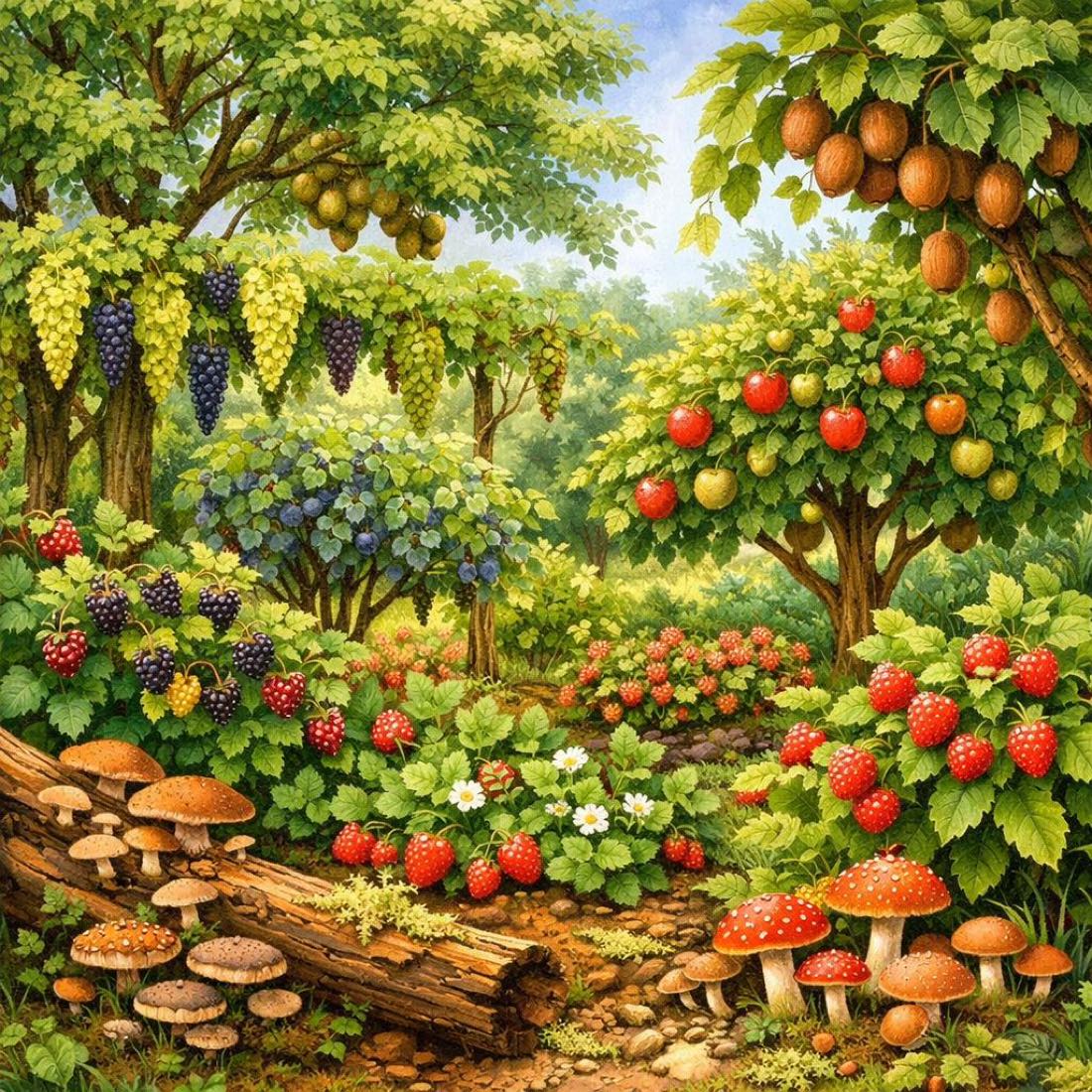
Forest garden in storeys: fruit trees, berry bushes, herbs and ground covers growing one above the other

Knowledge · Forest garden

Forest Garden: Structure, Layers and Benefits

A forest garden takes the structure of a natural woodland edge and turns it into land that produces food. Trees, shrubs, herbs, ground covers and root crops grow in storeys, one above the other, and share light, water and nutrients instead of each competing for them alone. Once established, such a planting keeps producing for decades, with no ploughing and no yearly resowing. And along the way it does work that society otherwise pays for: holding water, building soil, storing carbon, cooling the landscape.

7 storeysfrom the canopy down to the root layer: one piece of land, used several times over
6 servicesbesides the harvest: water, soil, carbon, cooling, habitat, recreation
0×digging: no ploughing, no yearly resowing
Decadesof yield from a single planting: fruit, nuts, wood

How to plant a forest garden in 8 steps The 7 layers

What is a forest garden?

A forest garden is a planting that copies the structure of a natural woodland edge but is made up almost entirely of useful species. Trees, shrubs, perennials, ground covers, root crops and climbers grow in up to seven layers, one above the other. Once established, it provides fruit, nuts, berries, herbs and wood for decades, with no ploughing and no yearly resowing.

You will also hear it called a food forest, and the practice forest gardening; close relatives are agroforestry and permaculture. How it differs from a traditional meadow orchard or a typical home garden: there, a single storey of trees stands above mown grass or vegetable beds. In a forest garden every storey is filled, from the canopy to below ground, and hardly any open lawn is left. It looks denser and wilder, more like a jungle than an orchard.

The storeys

The 7 layers of a forest garden

The classification goes back to the English forest garden pioneer Robert Hart. It describes which plants use which light and which root space, and so how many plants can fit on one piece of land without crowding each other out.

The seven layers of a forest garden in cross-section On the left, to the north, a tall tree with a climber on its trunk; in front of it a low tree, a shrub, perennials, ground covers along the sunny southern edge and tubers in the soil. The layers are numbered 1 to 7. ← North South → 1 2 3 4 5 6 7
Cross-section from north to south: the tall trees stand at the back so that their shade does not fall on the lower storeys.
  1. 1

    Canopy layer

    tall trees, over 10 m (33 ft)

    The roof of the forest garden. It casts the most shade, provides nuts, fruit and timber, and determines what can grow beneath it.

    Walnuts, sweet chestnuts, service tree and other whitebeams, cherries, lindens

  2. 2

    Sub-canopy (low tree layer)

    small trees, 3-10 m (10-33 ft)

    Fruit trees on semi-vigorous rootstocks and species with small crowns. In a small garden, this is the top storey.

    Apples, pears, plums, mulberries, medlars

  3. 3

    Shrub layer

    shrubs, 0.5-5 m (1.5-16 ft)

    Berries and nuts in the dappled shade of the trees, plus nitrogen fixers such as autumn olive, sea buckthorn or alder that feed their neighbours.

    Hazels, blackcurrants, chokeberries, serviceberries, autumn olives

  4. 4

    Herbaceous layer

    perennials and herbs, up to about 1.5 m (5 ft)

    Perennial vegetables, culinary and medicinal herbs, plus dynamic accumulators whose leaves are left in place as mulch.

    Comfrey, rhubarb, lovage, asparagus

  5. 5

    Ground cover layer

    creeping or low, under 0.5 m (1.5 ft)

    Living mulch: keeps the soil covered and moist and leaves little room for weeds.

    Wild strawberries, mints, wild garlic

  6. 6

    Root layer (rhizosphere)

    below ground

    Tubers and root vegetables, plus deep-rooted plants that break up compacted soil.

    Jerusalem artichoke, chicory, onions and leeks

  7. 7

    Climber layer (vines)

    vertical, on trees and supports

    They use height without building a trunk of their own. They need a strong host: a tree that can bear the weight.

    Grapevines, hardy kiwis, hops

The examples show what can belong in a layer. They are not a planting recommendation. What fits where in your garden depends on climate, soil, light and on what you want to use the garden for. A nitrogen fixer that is worth its weight in gold on poor sandy soil is more likely to make extra work on rich garden soil. Worked-out combinations are on the plant guilds page, the order of planning in How to plant a forest garden.

Which species suit your climate? Plants by layer

Here is how to find your favourites for each layer: from the plant database, matched to your climate, grouped by layer. In the app the classification is graded more finely by height than the seven layers above; the tree layer, for example, is split into three height bands.

Some add an eighth layer: fungi. They connect roots with the soil and help decide which species grow well side by side. More on this under mycorrhiza. You can filter which species belongs in which layer in the Plant Finder.

Structure

Forest garden structure: how the layers work together

The model is the woodland edge, not the forest

In a closed forest, hardly any light reaches the ground, so very little that you can eat grows there. At the woodland edge, by contrast, trees, shrubs and perennials step down from tall to low, and that is where diversity is greatest. A forest garden recreates this edge and makes it as long as possible (more on that in a moment). It usually opens to the south (in the northern hemisphere): tall trees on the north side, the lower ones in front of them, and shrubs, perennials and ground covers along the sunny edge. That way every storey gets its light.

The edge effect: why the edge is the most productive place

There is a reason the woodland edge, of all places, is the model, and permaculture has made it one of its core rules: the edge effect. Where two habitats meet (woodland and meadow, water and land, hedge and bed), you find the species of both sides plus some that live only there. Ecologists call this transition zone an ecotone. Light and shade, moisture and dryness, root space and open soil all come together here; this is where the most niches are, and so the most life. Bill Mollison turned this into a design rule, and David Holmgren sums it up as a principle: Use edges and value the marginal.

The conclusion is simple: more edge, more life, more yield. A straight line between a row of trees and a meadow is the shortest boundary there is. The same area with scalloped bays has an edge almost twice as long. Taken to its logical end, this leads to the fractal: a line like the edge of the Mandelbrot set or a coastline, which reveals new bays every time you look more closely and becomes infinitely long within a limited area. Nature builds like this all the time: woodland edges, river deltas, leaf veins, roots.

Edge effect: the same area, edges of different length Three areas of equal width with trees and shrubs at the top and meadow at the bottom. On the left a straight edge; in the middle a wavy edge with bays, about 1.7 times as long; on the right a fractal edge in the style of the Koch curve, about 2.4 times as long. Straight edge Edge length 1× Bays Edge length ≈ 1.7× Fractal, 3rd iteration Edge length ≈ 2.4×
Same width, roughly the same amount of trees and shrubs, yet the edge, where most of the life happens, gets longer with every bay.

Infinite edge? The limit is the scale of the plants

In the garden, the fractal idea has a practical limit: a bay is only worth as much as what fits into it. If it is narrower than the crown of a shrub, it closes up within a few years and the edge turns back into a line. Too much edge also means work: every edge is a place where grass creeps in and needs mowing. So the art is not infinite edge but edge at the scale of the plants: bays as large as the guild that is meant to stand in them, nested in several sizes, with large bays for trees and small ones along their rim for berries and herbs. That is exactly where the fractal lies.

The best-known form is the sun trap: a horseshoe-shaped bay that opens to the south, tall at the back and low at the front. It catches light and warmth, keeps out the wind and is noticeably warmer than the open ground next to it. It is the spot for warmth-loving species such as persimmon, fig or apricot. A forest garden made of several such bays has an edge many times longer than its outer boundary.

Guilds as building blocks

You do not plan layer by layer across the whole site, but tree by tree. Around each large tree grows a small group of partners that benefit it: a nitrogen fixer, a dynamic accumulator, a ground cover, something that attracts beneficial insects. These groups are called plant guilds. At heart, a forest garden is an alliance of guilds.

A forest garden moves

The structure is not fixed. In its first years a forest garden is a sunny perennial garden with small trees; after fifteen years it is an open woodland. What stands in the sun today will then be in partial shade, and light-hungry species move out to the edge. Fast-growing nurse trees (poplar, alder, autumn olive) protect the young trees and are removed once they are no longer needed. If you think about this while planning, you save yourself transplanting later. How to see your garden twenty years from now before you plant is covered in step 7 of the guide.

Ready to plant?From a bare plot to planting, in the order that works.
How to plant a forest garden in 8 steps →

What makes a forest garden different

Why a forest garden?

Why a forest garden at all, rather than a field or an orchard?

Because it combines two things that farming usually keeps apart: the yield of a crop and the self-organisation of a forest. A field produces one crop and has to be worked again every year to do so. An orchard uses a single storey and leaves grassland underneath. A forest garden stacks trees, shrubs, herbs, ground covers and root crops on top of each other and uses the same land several times over: in height, in depth and across the year.

The result is a system that does part of its own work: nutrient cycling, shade, shelter from the wind, pest control. What a field gets from outside as fertiliser, tillage and crop protection, a forest garden produces between its species. Once established, such a planting keeps producing for decades, which is why forest gardeners like to say: plant once, harvest forever.

Does a forest garden need less fertiliser and spraying?

Yes, and that is one of the main reasons to plant one. Leaves and prunings stay on site and build humus. Nitrogen fixers such as alders, autumn olives or lupins feed their neighbours. Deep-rooted plants draw nutrients and water from layers that annual crops never reach, and at night they release some of that water into the topsoil, a process known as hydraulic lift.

The diversity of species keeps pests in check, because beneficial insects find food and shelter all year round. Much of what you would otherwise have to buy in, the system largely takes care of itself.

A good part of this happens below ground, through the fungal partners on the roots, and that is where it is decided which species can stand side by side. What lies behind it, and what remains of the story of the underground network: Mycorrhiza: which plant goes with which fungus.

What does a forest garden do with compacted, depleted soil?

It breaks it up, from below. Deep-rooted species such as chicory, comfrey or elecampane push through compacted layers and leave root channels behind that let water and air in. Over the years a living soil develops that soaks up rain instead of letting it run off.

The numbers

Is a forest garden economically viable? Surely a hectare of maize earns more.

It depends on what you count. If you only look at the sales revenue of a single crop, the field usually wins. If you also count what a hectare does besides (storing water, holding soil, capturing CO₂, cooling, habitat, recreation), the picture changes. Floods, drought damage and soil loss cost society billions. A forest garden offsets exactly that. Once ecosystem services are rewarded, it is among the most productive forms of land use we have.

Then there is risk. A model by the US Forest Service compared agroforestry with pure arable farming and pure tree plantations: arable farming alone was not clearly ahead in any risk scenario, and as soon as the risk of crop failure rises (for instance through more frequent droughts and floods), agroforestry came out with higher average yields and lower risk.

In plain English: there is always something to harvest, whether wood, fruit, nuts or field crops. A total crop failure becomes very unlikely.

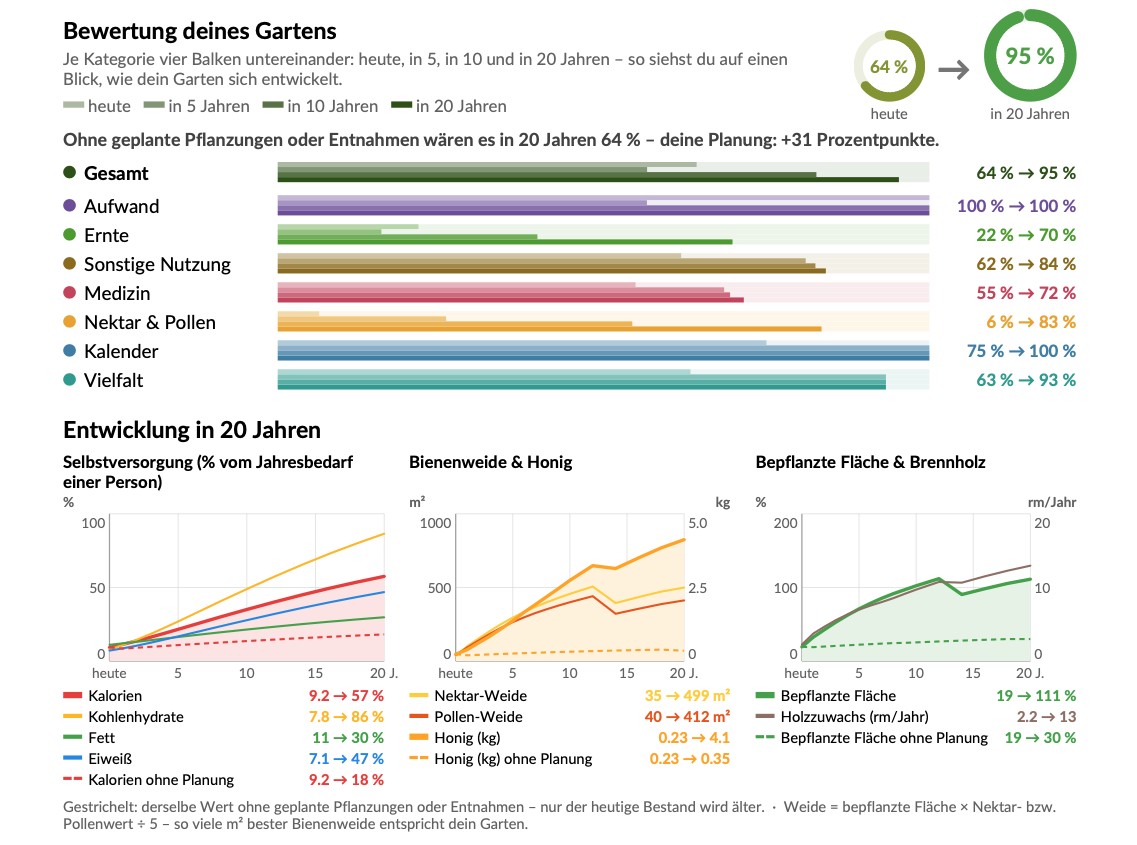
Analysis from the Permaplans PDF: garden rating today and in 5, 10 and 20 years, plus self-sufficiency, bee forage and firewood over 20 years
This is what the analysis looks like in the PDF you can export from Permaplans: rating today and in 5, 10 and 20 years, plus self-sufficiency, bee forage and firewood.

Plan it yourself: start in your browser →

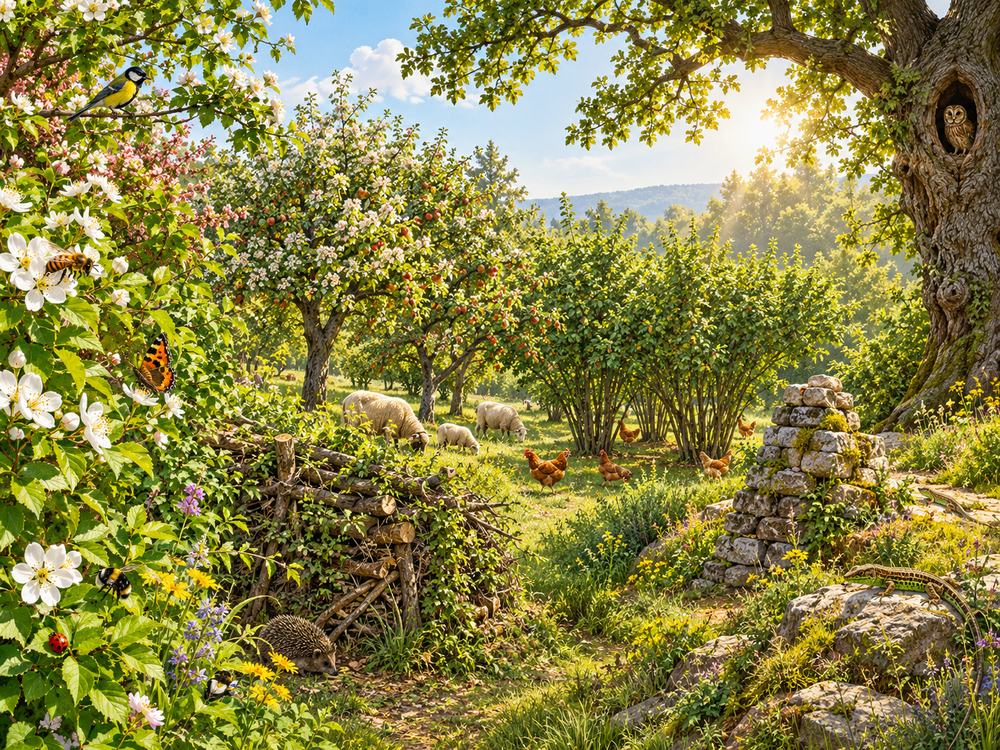
Chickens under hazel bushes, sheep under fruit trees, lizards on stone towers and insects on a flowering hedge
Chickens under hazels, sheep under fruit trees, lizards on stone towers, insects on the flowering hedge: productive use and nature conservation on the same land.

Side by side, not at odds

How does a forest garden fit with nature conservation and farming?

It brings both together instead of playing one off against the other. Grassland, conservation and cultivation do not exclude each other when you plan them as one system: flowering trees and shrubs for insects, deadwood and hedges for birds, grazing under trees for livestock, and in between, a harvest for people.

What ecosystem services does a forest garden provide?

Am I doing something for society with it? Yes. Every forest garden keeps water in the landscape, cools its surroundings, stores carbon and creates habitat. These are measurable benefits for everyone who lives nearby, not a mere side effect. Anyone who plants a forest garden makes a contribution that reaches far beyond their own fence.

Getting started

Forest gardening for beginners: how do I start without overreaching?

The permaculture principles are the first help. Three fit especially well here: “Observe and interact”, “Use small and slow solutions” and “Design from patterns to details”.

Because the other way round usually goes wrong: if you start planting straight away (trees, shrubs, perennials, ground covers), you lose a lot of it again and only realise afterwards that it does not fit yet.

Then there is natural succession. If all you have at the start is a meadow, you first plant a few pioneer trees and shrubs. They grow fast and create the conditions for your later productive plants: shelter from the wind, a microclimate, beneficial insects, mycorrhiza.

So before the first planting there is a sequence:

  1. Your dream. What should be here in twenty years, and for whom?
  2. A long-term plan for how to get there.
  3. Reading the land. Observe and divide the site into suitable spaces and zones of use.
  4. Water, paths, infrastructure. How do you guide water, where do you hold it, where do you drain it away? Where do paths and gathering spots go, where should which structures stand? What earthworks, access routes and unloading areas do you need, where do utility lines run or where should they go? Only once water management, logistics and infrastructure fit your vision and your land do you move on to the detailed planting.
  5. The planting, again from pattern to detail. First the tall main trees or crops, hedges for shelter and privacy, wind corridors and sightlines. Then the smaller trees and shrubs beneath them (keyword: plant guilds), and finally ground covers and the like. And last of all the timeline: what starts in year 1, what is added when, and what comes out again when?

Only then do you plant. Good planning pays off, because afterwards much of it falls into place by itself. And for that you need the right tool. That is exactly what Permaplans is for.

The whole sequence (from observing through hedges and boundary distances to planting) is in the guide How to plant a forest garden in 8 steps.

Three things

What you need for a forest garden: a plan, exchange, like-minded people

At the opening event of a forest gardener training course, exactly this question was asked. The participants' answers came down to three things.

🗺️

A plan that lasts

A forest garden is a complex system with a long time horizon: the decisions of the first year still matter twenty years later. Without a plan you plant too close, in the wrong spot, and only notice once the tree is big.

That is what Permaplans is built for: site data for your coordinates, over 1,100 species with mature size and growth rate, layers, yield forecasts over decades, and the time slider that shows what it will look like in ten years.

💬

Exchange

Nobody learns this alone. You need places where knowledge, experience and mistakes are shared: what worked for you and what did not, on which soil, in which climate.

In Permaplans you can share your garden, rate your experience with individual species and see what others have done under similar conditions.

📍

Like-minded people nearby

Projects you can join. People looking for help. Land that needs someone. If you want to get started, you first need to see who else is out there.

That is exactly what the map makes visible.

That is why Permaplans is more than a drawing program: planning, knowledge and exchange belong together, because a forest garden does not come about without all three.

Plan a forest garden in your browser All features

Start your garden

Try it for free — right in your browser, no sign-up.

Open in the browserGet the app