
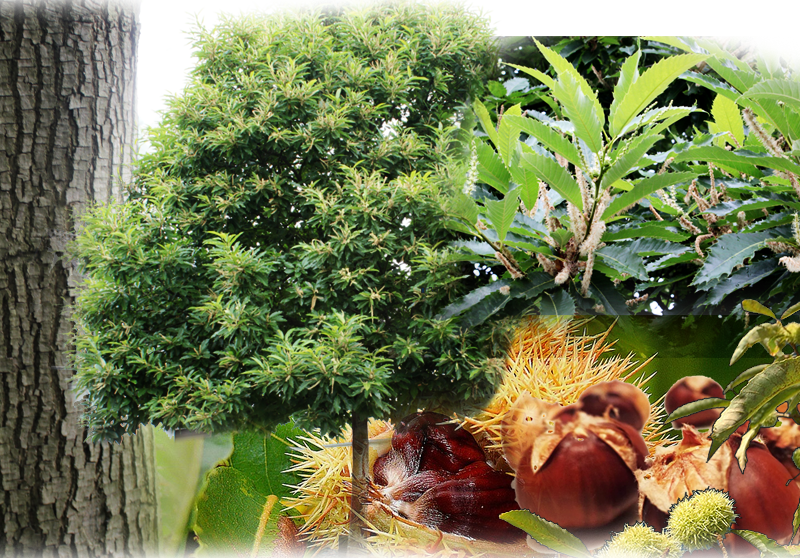
Sweet chestnut
 9
9 7
7 8
8Will it grow where I live?
Sweet chestnut is hardy to zone 6, which covers nearly all of Central Europe and the British Isles; only harsh upland sites (Alps, high ridges) call for winter protection. It also needs warm summers – in Central Europe that means wine-growing regions, cities or a sheltered south-facing wall.
Or check it for your location right here:
Profile
- Family
- Fagaceae
- Habit
- Tree
- Height
- 30 m
- Spread
- 15 m
- Growth
- medium
- Lifespan
- 600 years
- First yield
- after 20 years
- Yield per plant
- up to 100 kg a year
- Yield in cultivation
- up to 4 t/ha
- Energy yield
- 700 kcal per m² a year
- Hardiness
- zone 6–9
- Shade tolerance
- full sun
- Soil
- Sand, Silt, Loam
- Soil moisture
- very dry – very moist
- pH
- 3.5 – 6.5
- Synonyms
- Marone, Maronenbaum, Kastanienbaum
Flowering & harvest
| J | F | M | A | M | J | J | A | S | O | N | D | |
|---|---|---|---|---|---|---|---|---|---|---|---|---|
| Flowering | ||||||||||||
| Fruit harvest |
Varieties (18)
18 varieties of Sweet chestnut are listed in the Permaplans variety finder — each with its own page: taste, ripening time, disease resistance, parentage and use.
- Belle Épine Late-flowering French variety — an ideal pollinator for other chestnuts.
- Bouche de Betizac
- Bouche Rouge Southern-French heirloom with red-brown skin and fine flavour.
- Brunella
- Castanea sativa
- Castanea sativa x crenata
- Castel del Rio IGP marrone from the Santerno valley of Emilia-Romagna with sweet, refined flavour.
- Dore de Lyon Early, golden-brown Lyon variety valued for fresh market and processing.
- Ecker 10
- Ecker 3
- Garrone Rosso Red-shelled Piedmontese marrone, basis of the Marrone di Cuneo IGP.
- Maraval
- Marigoule
- Marlhac
- Marradi IGP-protected marrone from the Mugello, the epitome of Italian sweet chestnut.
- Marron de Lyon Classic French marron variety prized for glace confections and roasting.
- Marrone di Chiusa Pesio High-quality Piedmontese marrone for glace confections and confectionery.
- Pandora
Uses
Edible: The seed can be consumed either raw or cooked. Eating it raw may have a slightly astringent taste, which greatly improves through cooking. Once cooked, the seed becomes delicious with a floury texture similar to sweet potatoes. It is high in carbohydrates and can be dried, ground, and utilized as flour in different recipes like bread, puddings, and soups. Roasted seeds can serve as a coffee alternative, and sugar can be derived from them.
Other uses: Tannin is derived from different parts of the plant, with the husks having 10–13% tannin, bark containing 6.8% at 10% moisture, and wood containing 13.4%. Seed flour was historically utilized for starch and whitening linen, while the leaves and husks are used in a hair shampoo for a golden shine. The wood, known for its hardness, strength, and lightness, serves multiple functions like carpentry, woodturning, basket making, and as fence posts, besides being an excellent fuel source.
Growing
Sweet chestnut needs a deep, loose, evenly moist soil well supplied with potassium and phosphorus; volcanic substrates suit it best, heavy clay does not. It is markedly calcifuge and thrives in the acid range, though it tolerates old, deep limestone soils up to roughly 20 percent carbonate. Warmth decides everything else: annual means of 8 to 15 degrees, at least six months above 10 degrees and a warm autumn are needed for the nuts to ripen. North of roughly 48 to 50 degrees latitude that no longer happens reliably, and the tree serves as a timber and park species instead. Late frosts do real damage, as do wet weeks during the June bloom. Neither drought stress nor waterlogging is tolerated; 600 to 1600 millimetres of annual rainfall suit it. As a light-demanding tree it needs space — orchards are planted at 80 to 100 trees per hectare.
Propagation
Named chestnut cultivars are propagated vegetatively, normally by grafting, since seedlings crop unevenly. Seed is used for rootstocks and forest stands, and the nuts must be handled fresh: they lose viability quickly on drying and can only be held for a few months cool and moist. Seed and seedlings need effective protection from mice and squirrels, which seek them out. The decisive point is self-incompatibility: a solitary tree sets no fruit, and because many cultivars are male-sterile, dedicated pollen donors have to be planted alongside. Traditional coppice stands are renewed from stool shoots on a 15 to 30 year rotation.
Value for wildlife
The flowers provide abundant nectar and pollen, making them an important food source for bees and other insects. The nuts serve as food for animals such as squirrels, dormice, crows, and jays, which also aid in seed dispersal. Certain butterfly caterpillars feed on the leaves. The dense crown and broad growth offer birds shelter and nesting sites. Browsing by wild animals can occur but is generally limited.
Notable
Special features: Highly drought-resistant; requires a wine-growing climate of 16°C, dry summers, and nutrient-rich, deep soil. To preserve the seeds: water, smoke, dry, and peel them to keep them cool and dry for 2-3 years, or freeze them after cutting. Sweet chestnut trees can grow enormous, or you can top them every 10-30 years.
Origin & habitat
Mediterranean and Asia Minor. The original range of sweet chestnut can no longer be drawn precisely, because the tree has been cultivated throughout the Mediterranean and the regions adjoining it to the north since antiquity. The northern limit of the presumed native range runs along the Pyrenees, the southern rim of the Alps, the Bosnian mountains, the Rhodopes and the Caucasus, with further occurrences in Asia Minor, Syria and North Africa. Large stands today lie in France, particularly the Ardèche, the Cévennes and the Périgord, and from the Hungarian plain to the Black Sea. North of the Alps scattered plantings reach Germany and southern Scandinavia, in Germany mainly the Palatinate and the Rhine tributaries, in Switzerland concentrated in Ticino. Outside Greece, European stands derive from Asia Minor planting stock introduced over the past two thousand years.
Across its core range sweet chestnut is a submontane-Mediterranean tree of deciduous woodland communities in the Querco-Fagetea class, especially acid oak-birch woods of the Betulo-Quercetum. Being light-demanding, it cannot hold its own under a closed canopy of shade-tolerant species and depends on gaps, margins or human favour. It occupies humid, oceanic situations with warm summers and avoids both drying slopes and waterlogged hollows. In Central Europe it occurs almost only where historical cultivation established it: in the warm valley and slope positions of the wine-growing climate, often alongside oak and hornbeam.
Frequently asked questions
Sweet chestnut: how big does it get?
Sweet chestnut (Castanea sativa) grows as a Tree and reaches roughly 30 m in height when mature, with a spread of about 15 m. Growth is medium.
Sweet chestnut: what site does it need?
Sweet chestnut tolerates full sun. Suitable soils are Sand, Silt, Loam. Soil moisture should be in the range very dry – very moist. The pH may lie between 3.5 and 6.5.
Sweet chestnut: is it hardy?
Sweet chestnut is listed as hardy in zone 6–9 and survives normal winters outdoors there.
Sweet chestnut: will it grow in Central Europe?
Sweet chestnut is hardy to zone 6, which covers nearly all of Central Europe and the British Isles; only harsh upland sites (Alps, high ridges) call for winter protection. It also needs warm summers – in Central Europe that means wine-growing regions, cities or a sheltered south-facing wall.
Sweet chestnut: when does it flower?
In a temperate northern-hemisphere climate it flowers from June to July.
Sweet chestnut: when is it harvested?
In a temperate northern-hemisphere climate the fruit ripens from September to October.
Sweet chestnut: when does it start cropping, and how much?
Sweet chestnut first crops after 20 years. A mature plant gives up to 100 kg a year, in cultivation up to 4 t per hectare. Figures assume a good site; variety, soil and climate shift them considerably.
Sweet chestnut: is it poisonous?
No toxicity is recorded for Sweet chestnut. With wild plants, never rely on a database alone — only on a confident identification.
Sweet chestnut: what is it used for?
Rated on a scale up to 10: Edible 9/10, Medicinal 7/10, Other uses 8/10.
Which Sweet chestnut varieties are there?
The Permaplans variety finder lists 18 varieties of Sweet chestnut, including Belle Épine, Bouche de Betizac, Bouche Rouge, Brunella, Castanea sativa, Castanea sativa x crenata, Castel del Rio, Dore de Lyon, Ecker 10, Ecker 3, Garrone Rosso, Maraval and 6 more. Each variety has its own page with taste, ripening time, disease resistance and parentage.
Plan this plant into your own garden
Permaplans plans your garden to scale on the map — with a site check, harvest calendar and over 1,000 plants. Free for iPhone, Android, Mac, Windows & Linux.
Will this plant grow where you live? → Check your site
Community experience
No first-hand reports for this plant yet.
Growing it? Write in the app what works for you – your post will show up here.
💬 Get the app and join in