
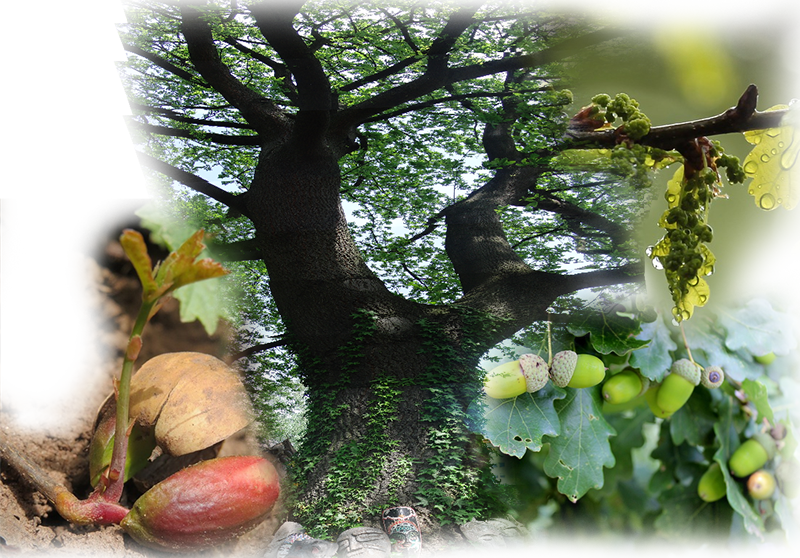
English oak
 3
3 7
7 8
8Will it grow where I live?
English oak is hardy to zone 4 – that covers all of Central Europe and the British Isles, and every USDA zone from 4 upwards.
Or check it for your location right here:
Profile
- Family
- Fagaceae
- Habit
- Tree
- Height
- 35 m
- Spread
- 30 m
- Growth
- slow
- Lifespan
- 1000 years
- First yield
- after 50 years
- Yield per plant
- up to 60 kg a year
- Yield in cultivation
- up to 1 t/ha
- Energy yield
- 190 kcal per m² a year
- Hardiness
- zone 4–8
- Shade tolerance
- partial shade
- Soil
- Sand, Silt, Loam, Clay
- Soil moisture
- dry – near water
- pH
- 5 – 8
- Synonyms
- Eiche
- Planned in gardens
- 5×
Flowering & harvest
| J | F | M | A | M | J | J | A | S | O | N | D | |
|---|---|---|---|---|---|---|---|---|---|---|---|---|
| Flowering | ||||||||||||
| Fruit harvest |
Uses
Edible: The plant's seed is available for purchase and can be used as a substitute for almonds once chopped and roasted. It can also be dried, ground into a powder, and utilized as a thickening agent in stews or for baking. Care should be taken to wash the seed thoroughly before consumption to eliminate bitter tannins, although this process may result in the loss of some minerals. A traditional way of preparing the seed involved burying it in damp soil during winter and unearthing it in spring to reduce its astringency. The roasted seed is suitable as a coffee alternative. Additionally, the plant's bark yields an edible gum that can be used as manna.
Medicinal: All galls produced on the tree are highly astringent and can be used to treat bleeding, chronic diarrhea, and dysentery.
Other uses: A leaf mulch made from fresh leaves can hinder plant growth, but it can repel slugs and grubs. The bark, rich in calcium, is a key ingredient in the herbal compost activator "Quick Return," which accelerates bacterial activity in compost. Oak galls, formed by insect larvae, provide tannin and dye for making black dye and long-lasting ink. Trees are harvested for various purposes like basketry, fuel, and construction. The wood yields tar, quaiacol, acetic acid, creosote, and tannin. Tannin, extracted commercially from the bark and present in the leaves, constitutes 11.6% in the bark and 9.2% in the wood with 10% moisture. The bark, easily separable from the wood in April and May, can produce a violet dye when infused with copperas. The hard, tough, and durable wood is valuable for furniture, construction, and as fuel or charcoal.
Growing
Site: The pedunculate oak needs room for centuries, 15 to 25 metres around it and 25 to 35 metres of height. In a domestic garden it belongs at the edge or in a field hedge, not beside the house or terrace: old oaks shed whole heavy limbs without warning during drought. Foliage and acorns are toxic to horses and cattle, so it has no place over pasture or small livestock pens. The oak processionary moth appears regularly on sun-exposed free-standing trees and renders affected trees beside seating and play areas unusable for years. In return, no other native woody plant supports more animal species. Avoid hollows and cold-air pockets, as it is sensitive to late frost. Care: Sow directly in the final position if you can, and buy plants as small as possible, because the taproot resents transplanting and from the third year it hardly succeeds at all. Young plants need protection from mice, squirrels and jays that dig the acorns up again, plus browsing protection against roe and red deer. As a rule no pruning; do any necessary work in late summer, since old trees respond to large wounds with rot. Young oaks tolerate coppicing reliably. Oak mildew weakens seedlings but they grow out of it. Fresh oak leaves are unsuitable as mulch in the vegetable bed because of their tannins.
Propagation
Acorns only germinate fresh. They lose viability as soon as they dry out and therefore cannot be stored like ordinary seed. The simplest approach is to sow immediately after they fall in October, about five centimetres deep either in the final position or into a seedbed secured with wire against mice, squirrels and jays. If you must wait until spring, store the acorns moist in sand at one to four degrees. A float test before sowing is worthwhile: whatever floats is grub-eaten or empty. More important than any technique is an early final position, because the pedunculate oak forms a strong taproot straight away. Directly sown trees grow better for good than transplanted ones, and from the third year moving them hardly succeeds at all. Vegetative propagation plays no part, but stump sprouting from young trees is reliable and was the basis of coppice management.
Value for wildlife
Hardly any Central European woody plant supports more animal species than the pedunculate oak. 182 species of moth and butterfly feed on its foliage as caterpillars, 44 of them exclusively on oaks; to these are added 37 beetle species, among them the stag beetle whose larvae live for years in the crumbling wood of old trunks, plus eight solitary bee and eight hoverfly species. The flowers are wind-pollinated and yield no nectar, but plenty of pollen, which honeybees collect in late April and May. Autumn belongs to the acorns: jay, woodpigeon, nuthatch, great spotted woodpecker, squirrel, edible dormouse and wild boar live on them, and the jay buries so many caches that it sows the species over wide areas. Old oaks provide holes for woodpeckers, owls, bats and hornets, and the coarsely fissured bark offers crevices for treecreepers and overwintering insects. The tree reaches its full value only in old age and with standing deadwood.
Notable
Special features: prefers water veins and attracts lightning, fire-resistant; root fungus: porcini mushroom; tannin- and calcium-rich bark is harvested from 5-12 year-old branches (April-May); galls are used for dyeing/ink; serves as a habitat for more than 1000 animal and plant species; ~10% of German forests; 2100 kWh/m²; 4.2 kWh/kg
Origin & habitat
Europe: from Ireland and Portugal to the Urals, from central Scandinavia to southern Italy and the Caucasus. The pedunculate oak is the most widespread oak in Central Europe and, because it copes well with continental climate, extends considerably further east than the sessile oak. It is absent from southern Spain, Sicily, southern Greece, northern Scandinavia and northern Russia. Its centre of gravity lies in the lowlands; it climbs above 490 metres in the Harz, to 700 metres in the Bavarian Forest and to about 950 metres in the Bavarian Alps. It has been introduced as a park and forestry tree to North America, New Zealand and southern Australia.
The pedunculate oak is the tree of moist plains and large river floodplains. Two situations dominate its occurrence: hardwood floodplain forest and oak-hornbeam woodland on heavy, seasonally waterlogged loams and clays on the one hand, and moist, sandy, acid oak-birch and pine-oak woodland on the other. It grows best on fertile, deep loam and clay soils with more or less pronounced water retention, but also tolerates wet ground right to the edge of lowland and transition mires. Compared with the sessile oak it is regarded as more demanding of moisture and nutrients while needing at least as much warmth. As a light-demanding species it is displaced by beech on average sites and holds its own where the soil is too wet, too poor or too acid for beech. It roots intensively and deeply and opens up the soil well.
Frequently asked questions
English oak: how big does it get?
English oak (Quercus robur) grows as a Tree and reaches roughly 35 m in height when mature, with a spread of about 30 m. Growth is slow.
English oak: what site does it need?
English oak tolerates partial shade. Suitable soils are Sand, Silt, Loam, Clay. Soil moisture should be in the range dry – near water. The pH may lie between 5 and 8.
English oak: is it hardy?
English oak is listed as hardy in zone 4–8 and survives normal winters outdoors there.
English oak: will it grow in Central Europe?
English oak is hardy to zone 4 – that covers all of Central Europe and the British Isles, and every USDA zone from 4 upwards.
English oak: when does it flower?
In a temperate northern-hemisphere climate it flowers from May to June.
English oak: when is it harvested?
In a temperate northern-hemisphere climate the fruit ripens in October.
English oak: when does it start cropping, and how much?
English oak first crops after 50 years. A mature plant gives up to 60 kg a year, in cultivation up to 1 t per hectare. Figures assume a good site; variety, soil and climate shift them considerably.
English oak: is it poisonous?
No toxicity is recorded for English oak. With wild plants, never rely on a database alone — only on a confident identification.
English oak: what is it used for?
Rated on a scale up to 10: Edible 3/10, Medicinal 7/10, Other uses 8/10.
Plan this plant into your own garden
Permaplans plans your garden to scale on the map — with a site check, harvest calendar and over 1,000 plants. Free for iPhone, Android, Mac, Windows & Linux.
Will this plant grow where you live? → Check your site
Community experience
No first-hand reports for this plant yet.
Growing it? Write in the app what works for you – your post will show up here.
💬 Get the app and join in