
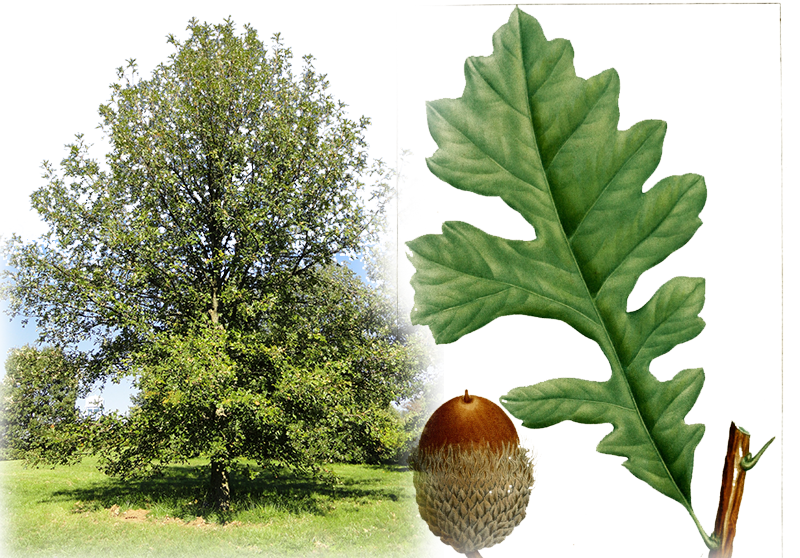
Bur oak
 6
6 4
4 8
8Will it grow where I live?
Bur oak is hardy to zone 3 – that covers all of Central Europe and the British Isles, and every USDA zone from 3 upwards.
Or check it for your location right here:
Profile
- Family
- Fagaceae
- Habit
- Tree
- Height
- 15 m
- Spread
- 8 m
- Growth
- very slow
- Lifespan
- 400 years
- First yield
- after 35 years
- Full yield
- after 75–150 years
- Productive years
- 400 years
- Yield per plant
- up to 60 kg a year
- Yield in cultivation
- up to 2.5 t/ha
- Hardiness
- zone 3–8
- Shade tolerance
- partial shade
- Soil
- Silt, Loam, Clay
- Soil moisture
- very dry – very moist
- pH
- 5 – 8
- Synonyms
- Großfruchtige Eiche, Bur-Eiche
Flowering & harvest
| J | F | M | A | M | J | J | A | S | O | N | D | |
|---|---|---|---|---|---|---|---|---|---|---|---|---|
| Flowering | ||||||||||||
| Fruit harvest |
Uses
Edible: The seed of this species is notably large, with dimensions of around 5 cm x 4 cm, although its size and shape can vary. It can be crushed into a fine powder and utilized in baking bread, making dumplings, and as a soup thickener. Regarded as one of the most flavorful among oak trees, many trees bear sweet seeds low in tannin, suitable for raw or cooked consumption. Bitterness in the seed is attributed to the presence of tannins, which can be removed by washing the dried and ground seed thoroughly in water, albeit resulting in some mineral loss. Traditionally, the seed was prepared by burying it in damp soil during winter, with the germinated seed unearthed in spring, having shed most of its astringency. When roasted, the seed serves as a coffee alternative.
Medicinal: All galls produced on the tree have astringent properties and can be used to treat bleeding, chronic diarrhea, dysentery, and other conditions.
Other uses: A layer of oak leaves can deter slugs and maggots, but avoid using fresh leaves to prevent hindering plant growth. Oak galls, formed by insect larvae, provide nutrients and can be utilized for tannin and dye once the insect matures. Oak bark was historically employed as a mordant in dyeing processes. Known for its hardness, weight, strength, toughness, and durability, oak wood finds applications in construction, basket making, flooring, carpentry, shipbuilding, and as a fuel source.
Propagation
Seed viability decreases rapidly when it dries out. It is recommended to sow the seeds right after they mature in an outdoor seedbed, ensuring protection from rodents. Alternatively, seeds can be stored in a cool, moist place over winter. For small seed quantities, deep pots in a cold environment can be used. The plants form a strong taproot and should be relocated to their final position promptly. Ideally, trees should be directly sown in their permanent spot for optimal growth. It is advised not to keep trees in a nursery bed for more than two growing seasons to avoid difficulties during transplantation.
Notable
Special features: drought, pollutant, fire, wind, and pest resistant; heat-loving; freely hybridizes with other oak species: great cross-breeding potential! Cuttings bear fruit after just a few years; no precise, differentiated data can be found regarding the yield and calories of this acorn species; probably the same as for common oak: 1500 kWh/m³; 4.1 kWh/kg
Origin & habitat
Eastern North America - Nova Scotia to Manitoba, Wyoming, Massachusetts, Georgia, Kansas, and Texas.
Forests and shrubs in arid, rocky areas.
Frequently asked questions
Bur oak: how big does it get?
Bur oak (Quercus macrocarpa) grows as a Tree and reaches roughly 15 m in height when mature, with a spread of about 8 m. Growth is very slow.
Bur oak: what site does it need?
Bur oak tolerates partial shade. Suitable soils are Silt, Loam, Clay. Soil moisture should be in the range very dry – very moist. The pH may lie between 5 and 8.
Bur oak: is it hardy?
Bur oak is listed as hardy in zone 3–8 and survives normal winters outdoors there.
Bur oak: will it grow in Central Europe?
Bur oak is hardy to zone 3 – that covers all of Central Europe and the British Isles, and every USDA zone from 3 upwards.
Bur oak: when does it flower?
In a temperate northern-hemisphere climate it flowers in May.
Bur oak: when is it harvested?
In a temperate northern-hemisphere climate the fruit ripens in October.
Bur oak: when does it start cropping, and how much?
Bur oak first crops after 35 years. Full yield comes after 75–150 years. A mature plant gives up to 60 kg a year, in cultivation up to 2.5 t per hectare. The productive period lasts about 400 years. Figures assume a good site; variety, soil and climate shift them considerably.
Bur oak: is it poisonous?
No toxicity is recorded for Bur oak. With wild plants, never rely on a database alone — only on a confident identification.
Bur oak: what is it used for?
Rated on a scale up to 10: Edible 6/10, Medicinal 4/10, Other uses 8/10.
Plan this plant into your own garden
Permaplans plans your garden to scale on the map — with a site check, harvest calendar and over 1,000 plants. Free for iPhone, Android, Mac, Windows & Linux.
Will this plant grow where you live? → Check your site
Community experience
No first-hand reports for this plant yet.
Growing it? Write in the app what works for you – your post will show up here.
💬 Get the app and join in