
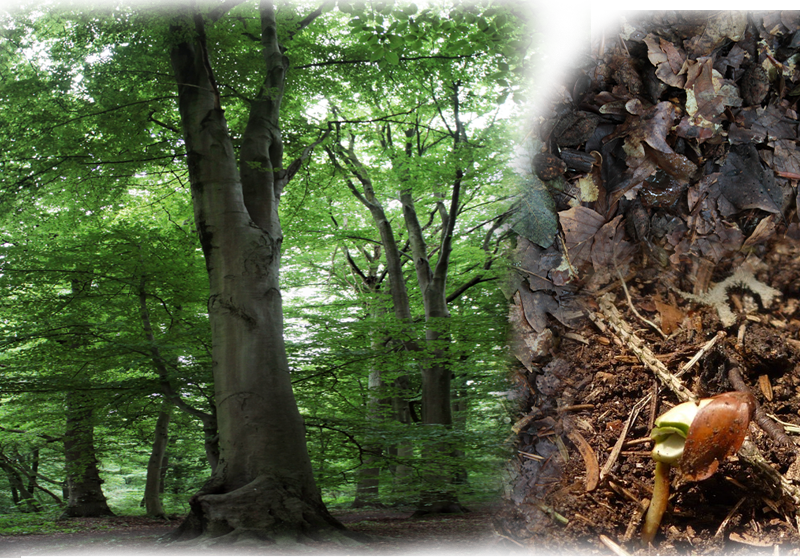
European beech
 3
3 3
3 8
8Will it grow where I live?
European beech is hardy to zone 5 – that covers all of Central Europe and the British Isles, and every USDA zone from 5 upwards.
Or check it for your location right here:
Profile
- Family
- Fagaceae
- Habit
- Tree
- Height
- 35 m
- Spread
- 20 m
- Growth
- medium
- Lifespan
- 300 years
- First yield
- after 30 years
- Yield per plant
- up to 40 kg a year
- Yield in cultivation
- up to 0.3 t/ha
- Energy yield
- 20 kcal per m² a year
- Hardiness
- zone 5–8
- Shade tolerance
- full shade
- Soil
- Sand, Silt, Loam, Clay
- Soil moisture
- semi-dry – very wet
- pH
- 4.5 – 7.5
- Synonyms
- Buche
Flowering & harvest
| J | F | M | A | M | J | J | A | S | O | N | D | |
|---|---|---|---|---|---|---|---|---|---|---|---|---|
| Flowering | ||||||||||||
| Fruit harvest | ||||||||||||
| Leaf harvest |
Uses
Edible: Fresh young leaves are ideal for mixed salads, offering a delicate flavor. To ensure tenderness, only the youngest leaves should be used, as older ones may be tough. Typically, new growth happens twice a year, lasting for three weeks each time during spring and midsummer. The seeds, with a pleasantly sweet taste, can be consumed raw or cooked, although they are usually small and fibrous. They can also be dried and ground into a powder for baking purposes. Rich in oil that has a long shelf life without turning rancid, the seeds' oil is comparable in delicacy to olive oil and can be used for dressings and cooking. Caution is advised against consuming the seeds in large amounts due to a harmful component. Roasted seeds are commonly utilized as a coffee alternative, while the seed residue is toxic.
Medicinal: Buckwheat is a herb with a bitter yet pleasant taste, commonly utilized for its medicinal properties due to its high rutin content. Rutin is effective in addressing various circulatory issues by widening blood vessels, decreasing capillary permeability, and reducing blood pressure. The pungent, astringent, and vasodilating qualities of buckwheat leaves and shoots make them valuable in treating conditions such as hypertension, gout, varicose veins, chilblains, and radiation damage. Combining buckwheat with vitamin C is recommended to enhance absorption, often paired with linden flowers for treating retinal hemorrhages. Harvested during the flowering stage, the leaves and flower stalks are dried for storage in dark conditions to prevent rapid degradation of active components. Buckwheat should be used cautiously as it can cause photosensitive dermatitis, although a seed poultice is known to stimulate milk flow in lactating women. Additionally, an herbal infusion of buckwheat has been historically employed to address erysipelas, while the leaves are a key ingredient in a homeopathic remedy for eczema and liver ailments.
Other uses: An oil with semi-drying properties is obtained from the seeds, serving various purposes such as kindling fuel, lubrication, and wood polishing. The seed residue is toxic. Leaf buds, gathered during winter and air-dried on branches, function as toothpicks. During autumn, the leaves are gathered for mattress stuffing. The plant's wood, known for its hardness, weight, strength, and durability, is utilized in furniture, flooring, woodturning, and other applications. While not ideal for outdoor settings and prone to attacks by a small beetle, the wood is valued for its high heat combustion and quality charcoal production. Historically, the wood was also utilized in the production of creosote, tar, and various chemical substances.
Growing
Site: The common beech reaches 30 to 40 metres, forms a dense canopy and casts such deep shade that almost nothing grows beneath it — as a free-standing tree it only suits large properties, while in an ordinary garden it works as a hedge or as a weak-growing ornamental cultivar. The soil is decisive: deep, reliably fresh, well-aerated and preferably base-rich, without stagnant water. On shallow or dry sites it is the loser of climate change; the dry years from 2018 onwards killed beech across large areas of Central Europe. As a shallow-rooting tree it competes strongly with beds and lawn, lifts paving and is prone to windthrow. Two further points belong in the planning: if suddenly exposed, the thin smooth bark suffers sunscald, and beech nuts in quantity are a problem for horses and grazing livestock — do not plant it beside a paddock. Young flowers and leaves are sensitive to late frost, so a sheltered position pays off. Care: As a hedge, beech takes pruning extremely well. The right moment is late summer, roughly late July to August, after the second growth flush — cut then, and the plant keeps its dead leaves through the winter and stays a screen. What it cannot take is coppicing: beech cut to the stool regrows barely or very weakly and is overgrown by other plants. Young plants need protection from deer browsing and water during dry spells while establishing. Do not hoe or compact the root plate, which is sensitive; a layer of leaf mulch beats any fertiliser. After drought stress, bark necroses and beech bark disease appear, and on old trees above paths and seating areas branch failure is the real risk — have old beeches inspected regularly.
Propagation
The seeds should be sown promptly in autumn in a cool environment due to their short lifespan. Guard against mice. Germination typically happens in spring. Once the seedlings reach a suitable size, transfer them to separate pots and allow them to develop in a greenhouse for at least the initial winter. Plant them in their final position in late spring or early summer, post the final anticipated frosts. The seedlings grow slowly initially and are highly vulnerable to damage from late frosts. Alternatively, the seeds can be sown in an outdoor seedbed during autumn. The seedlings can stay outdoors for up to three years before transplantation, but they thrive best when relocated to their permanent spot promptly and shielded from spring frosts.
Value for wildlife
Beech is wind-pollinated and offers pollinators little — only two wild bee species are recorded on it, and they take pollen, not nectar. Its value lies elsewhere, and it is considerable. Some 170 to 180 invertebrate herbivores live on it, including 83 butterfly and moth species whose caterpillars eat its leaves, sixteen of them exclusively on beech; the beech leaf-mining weevil is the only strictly monophagous beetle, and the beech aphid has beech as its sole host. In mast years the nuts are a key food: squirrels, bank, wood and yellow-necked mice lay up winter stores and, through the caches they forget, carry out the regeneration themselves. Hawfinch, woodpigeon, jay, great spotted woodpecker and blue tit are among at least two dozen bird species using the tree. The real weight comes with age: woodpecker holes in mature beeches become quarters for hole-nesting birds and bats, and over three hundred wood-dwelling beetle species are tied to beech deadwood, sixty-three of them primeval-forest relict species. A young beech is a tree; an old one is a habitat.
Notable
Special features: perfectly adapted to the Central European climate; nutrient-rich foliage; can be used as a hedge for lettuce leaves in spring; good potash: Celts invented the first soap from beech potash and horseradish oil, branches served as rune sticks; ~15% of German forests; 2100 kWh/rm; 4.0 kWh/kg
Origin & habitat
Western and Central Europe, with outliers as far as Crimea. The natural range of the common beech covers almost all of central and western Europe: from southern Scandinavia and southern England across France, the Alps and the Balkans to northern Spain, central Italy and Greece, where it has its southern outposts in the mountains. In the east the range limit coincides with that of the sessile oak and runs through Poland and western Ukraine to Crimea; beyond that it is replaced by the closely related oriental beech. Its centre of gravity lies in the atlantic to subcontinental climate zone, which is why the range shows large gaps on dry sites. In Germany, Austria and Switzerland it is the most important native broadleaf tree of all.
Beech shapes the potential natural vegetation of Central Europe: without human intervention much of the land would be beech forest. Depending on the substrate it forms limestone beech woods, brown-earth beech woods and acid beech woods, and at higher elevations spruce-fir-beech woods. It requires deep, reliably moist, well-aerated and preferably base-rich soils without stagnant water, and avoids high water tables, poor nutrition and drought as much as periodically flooded bottomland. The climate of its range spans 4 to 12 degrees mean annual temperature and 450 to over 2,000 millimetres of rainfall, centred on oceanic western and central Europe. In the north it descends to the coast and has no lower altitude limit; in the south it is a tree of hill and mountain country — to 600 to 800 metres in the Harz, 1,500 in the Black Forest, 1,700 in the northern Alps. Young trees endure deep shade, and as a late-successional climax tree beech outgrows its competitors from about its forty-fifth year.
⚠️ Hazards
Large quantities of seeds can be harmful. It is advisable to consume them in moderation to prevent negative consequences.
Frequently asked questions
European beech: how big does it get?
European beech (Fagus sylvatica) grows as a Tree and reaches roughly 35 m in height when mature, with a spread of about 20 m. Growth is medium.
European beech: what site does it need?
European beech tolerates full shade. Suitable soils are Sand, Silt, Loam, Clay. Soil moisture should be in the range semi-dry – very wet. The pH may lie between 4.5 and 7.5.
European beech: is it hardy?
European beech is listed as hardy in zone 5–8 and survives normal winters outdoors there.
European beech: will it grow in Central Europe?
European beech is hardy to zone 5 – that covers all of Central Europe and the British Isles, and every USDA zone from 5 upwards.
European beech: when does it flower?
In a temperate northern-hemisphere climate it flowers from April to May.
European beech: when is it harvested?
In a temperate northern-hemisphere climate the fruit ripens from September to October.
European beech: when does it start cropping, and how much?
European beech first crops after 30 years. A mature plant gives up to 40 kg a year, in cultivation up to 0.3 t per hectare. Figures assume a good site; variety, soil and climate shift them considerably.
European beech: is it poisonous?
Individual parts of European beech are noted as mildly problematic — the plant does not count as poisonous. With wild plants, never rely on a database alone, only on a confident identification.
European beech: what is it used for?
Rated on a scale up to 10: Edible 3/10, Medicinal 3/10, Other uses 8/10.
Plan this plant into your own garden
Permaplans plans your garden to scale on the map — with a site check, harvest calendar and over 1,000 plants. Free for iPhone, Android, Mac, Windows & Linux.
Will this plant grow where you live? → Check your site
Community experience
No first-hand reports for this plant yet.
Growing it? Write in the app what works for you – your post will show up here.
💬 Get the app and join in