
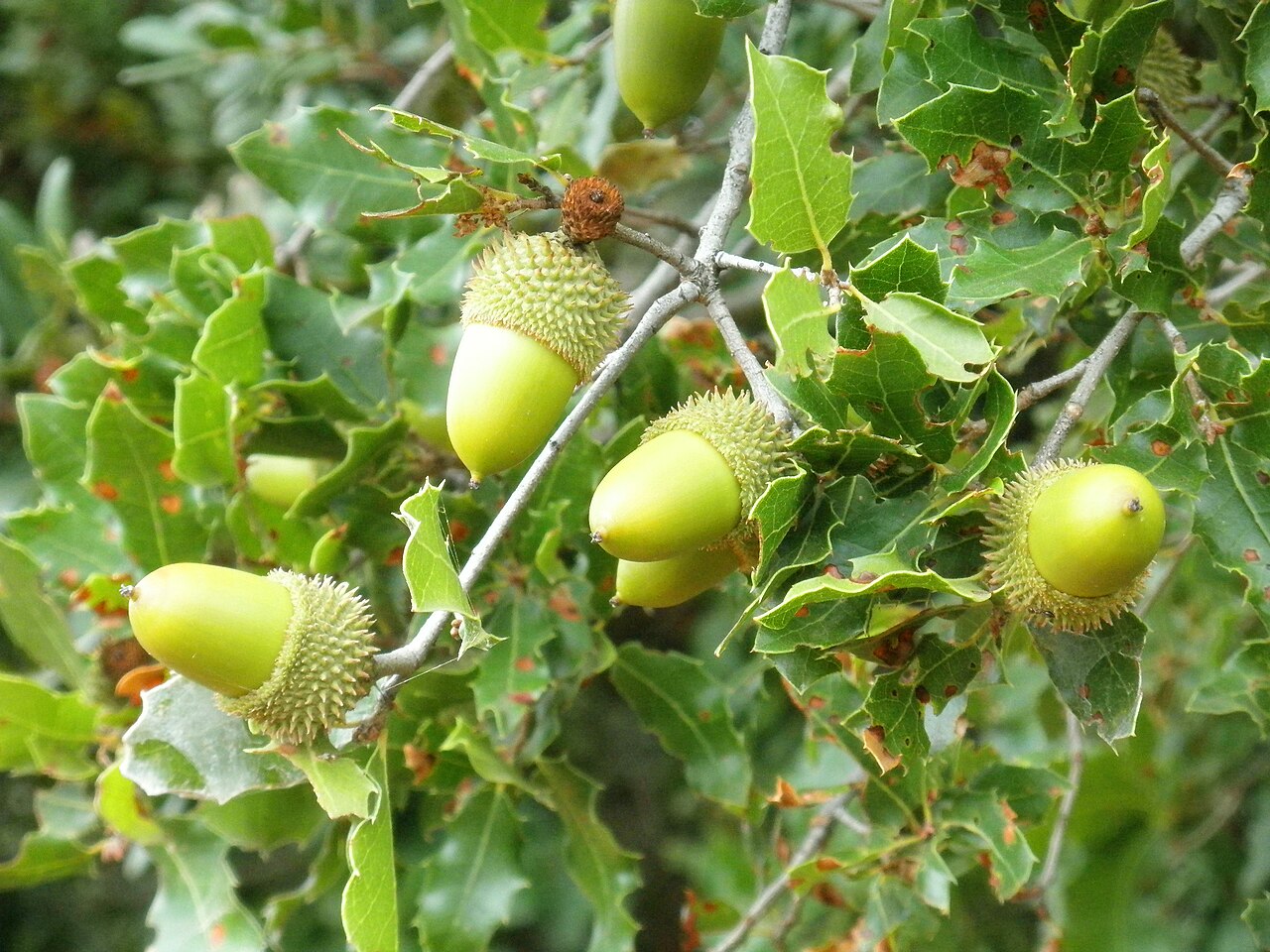
Kermes oak
 4
4 2
2 5
5Will it grow where I live?
Kermes oak is hardy to zone 6, which covers nearly all of Central Europe and the British Isles; only harsh upland sites (Alps, high ridges) call for winter protection.
Or check it for your location right here:
Profile
- Family
- Fagaceae
- Habit
- Shrub
- Height
- 3.2 m
- Spread
- 4 m
- Growth
- medium
- Lifespan
- 200 years
- First yield
- after 12 years
- Yield per plant
- up to 20 kg a year
- Hardiness
- zone 6–9
- Shade tolerance
- partial shade
- Soil
- Sand, Silt, Loam
- Soil moisture
- very dry – very wet
- pH
- 6 – 8
- Synonyms
- Q. pseudococcifera, Stech-Eiche, Kermes-Eiche
Flowering & harvest
| J | F | M | A | M | J | J | A | S | O | N | D | |
|---|---|---|---|---|---|---|---|---|---|---|---|---|
| Flowering | ||||||||||||
| Fruit harvest |
Uses
Origin & habitat
Europe - Mediterranean.
The cultivated land is a fertile area cultivated by farmers for centuries, providing ideal conditions for growing various crops and raising livestock. Managing cultivated land requires significant labor and expertise but remains a crucial resource for food and the country's economy.
⚠️ Hazards
The seeds are rich in tannin, a substance that can be mildly toxic if one manages to chew and swallow such a bitter seed.
Frequently asked questions
Kermes oak: how big does it get?
Kermes oak (Quercus coccifera) grows as a Shrub and reaches roughly 3.2 m in height when mature, with a spread of about 4 m. Growth is medium.
Kermes oak: what site does it need?
Kermes oak tolerates partial shade. Suitable soils are Sand, Silt, Loam. Soil moisture should be in the range very dry – very wet. The pH may lie between 6 and 8.
Kermes oak: is it hardy?
Kermes oak is listed as hardy in zone 6–9 and survives normal winters outdoors there.
Kermes oak: will it grow in Central Europe?
Kermes oak is hardy to zone 6, which covers nearly all of Central Europe and the British Isles; only harsh upland sites (Alps, high ridges) call for winter protection.
Kermes oak: when does it flower?
In a temperate northern-hemisphere climate it flowers from April to May.
Kermes oak: when is it harvested?
In a temperate northern-hemisphere climate the fruit ripens in November.
Kermes oak: when does it start cropping, and how much?
Kermes oak first crops after 12 years. A mature plant gives up to 20 kg a year. Figures assume a good site; variety, soil and climate shift them considerably.
Kermes oak: is it poisonous?
Individual parts of Kermes oak are noted as mildly problematic — the plant does not count as poisonous. With wild plants, never rely on a database alone, only on a confident identification.
Kermes oak: what is it used for?
Rated on a scale up to 10: Edible 4/10, Medicinal 2/10, Other uses 5/10.
Plan this plant into your own garden
Permaplans plans your garden to scale on the map — with a site check, harvest calendar and over 1,000 plants. Free for iPhone, Android, Mac, Windows & Linux.
Will this plant grow where you live? → Check your site
Community experience
No first-hand reports for this plant yet.
Growing it? Write in the app what works for you – your post will show up here.
💬 Get the app and join in