
 7
7 5
5 7
7Will it grow where I live?
Coral oleaster is hardy to zone 3 – that covers all of Central Europe and the British Isles, and every USDA zone from 3 upwards.
Or check it for your location right here:
Profile
- Family
- Elaeagnaceae
- Habit
- Shrub
- Height
- 4.5 m
- Spread
- 5 m
- Growth
- fast
- Lifespan
- 120 years
- First yield
- after 5 years
- Yield per plant
- up to 10 kg a year
- Yield in cultivation
- up to 5 t/ha
- Energy yield
- 450 kcal per m² a year
- Hardiness
- zone 3–8
- Shade tolerance
- light shade
- Soil
- Sand, Silt, Loam
- Soil moisture
- very dry – very moist
- pH
- 5 – 7.5
- Synonyms
- Goumi, Ölweide
Flowering & harvest
| J | F | M | A | M | J | J | A | S | O | N | D | |
|---|---|---|---|---|---|---|---|---|---|---|---|---|
| Flowering | ||||||||||||
| Fruit harvest |
Varieties (6)
6 varieties of Coral oleaster are listed in the Permaplans variety finder — each with its own page: taste, ripening time, disease resistance, parentage and use.
- AmberAutumn olive with amber-coloured, sweet-tart berries.
- Brilliant Rose Large pinkish-red berries with excellent flavour and high lycopene.
- FortunellaFruiting silverberry from the Pointilla series.
- GarnetLarge-fruited, self-fertile autumn olive with heavy yields.
- Newgate
- RubyRed-fruited autumn olive, a good pollenizer.
Uses
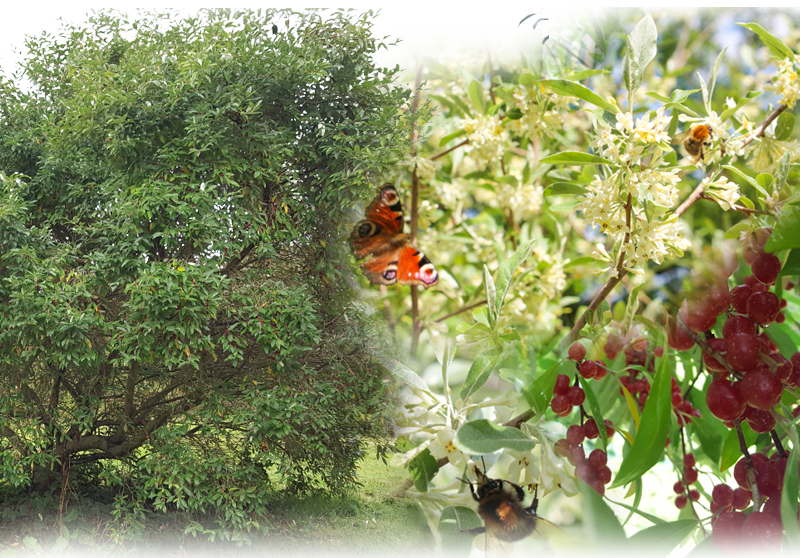
Edible: The fruits are round, pea-sized drupes of five to ten millimetres, dark red when fully ripe and covered in silvery stellate scales. They ripen from September and stay on the shrub into November; cropping is usually very heavy. Unripe they taste harsh and astringent, fully ripe tart-sour to pleasantly sweet — cultivar choice matters more here than with most wild fruits. Around 20 mg vitamin C per 100 g, up to 12 per cent total sugar and 1.5 per cent fruit acid are documented, alongside protein, phosphorus, potassium and oils. Processed they give mixed-fruit jams, juices, fruit leather and liqueurs; the flowers too can be steeped for aromatic liqueurs. Harvest is by picking; with cultivars, shaking cut branches also works.
Medicinal: Flowers: astringent, cardiac, and stimulant properties Seeds: beneficial for coughs, oil for lung issues Fruit: abundant in minerals, vitamins (especially ACE), flavonoids, bioactive compounds, and essential fatty acids; boosts heart health, possesses anti-cancer attributes
Other uses: The chief secondary use of autumn olive is its soil work: through symbiosis with nitrogen-fixing actinomycetes it enriches even lean, sandy raw soils and makes them usable for more demanding neighbours — which is why permaculture plantings set it among fruit trees as a nurse shrub and cut it back later. As an undemanding pioneer it suits screening plantings, free-growing hedges, banks and roadside greenery; drought and salt tolerance make it interesting for difficult sites. In larger gardens it also works as a specimen, with intensely fragrant bloom in late April and silvery foliage. Its wood is only moderately durable and spiral-grained but serves for turning and yields fuel and biomass.
Growing
Site: Full sun gives the best fruit set, light shade is still tolerated. Almost any free-draining soil will do; it dislikes shallow calcareous ground. Its distinguishing feature is the symbiosis of its roots with nitrogen-fixing actinomycetes: it thrives on very poor raw soils and improves the site for neighbouring plants — in permaculture it is placed among fruit trees for exactly that. Established plants are drought- and salt-tolerant, so usable near roads. A broadly spreading shrub of about four metres, barely thorny and without suckers; allow three to four metres. Restraint is advisable near valuable dry grassland and xeric habitats: birds carry the seed far, and the added nitrogen changes such sites. Care: Pruning is unnecessary, though hard cutting back is tolerated; remove dead branches as the opportunity arises. Do not feed — it supplies itself through the root nodule symbiosis. No diseases or pests are known. Check the cultivar: several in the trade are self-sterile, among them Fortunella and Sweet'N-Tart, in which case a second, simultaneously flowering shrub is needed. In extreme winters frost damage into the wood can occur.
Propagation
The species can be raised from seed: stones are washed out of the ripe fruit, stratified and then sown in a sheltered outdoor bed or an unheated frame. Seedlings come out variable, which is immaterial for hedges and pioneer plantings. To keep a particular fruit quality, propagate vegetatively: softwood cuttings in June or July root reliably, hardwood cuttings in winter are the simpler alternative. Pollination matters — several commercial cultivars are self-sterile, among them 'Fortunella' and 'Sweet'N-Tart'; they need a second shrub flowering at the same time. Self-fertile selections such as 'Garnet' manage alone but also crop more heavily in company.
Value for wildlife
Autumn olive comes from East Asia and is not native to Central Europe, so no reliable species counts exist for its value to local insects. What is documented is that its flowers carry abundant nectar and are worked by both honeybees and wild bees, making it a productive bee forage plant. Birds readily take the numerous red fruits, which aids its spread and has caused serious naturalisation problems in North America. Through root nodules it lives in symbiosis with the actinomycete Frankia and fixes atmospheric nitrogen, to the benefit of neighbouring plants.
Notable
Special features: drought+(sea)wind+pruning tolerant, very aromatic flowers that are very popular with (wild+)bees and butterflies, improves the soil and increases the yields of surrounding plants by 10%, prefers sandier, alkaline, nutrient-poor soils; one source states up to 40kg of fruit per bush.
Origin & habitat
East Asia: Japan, north-eastern China, Korea and the Himalaya, where autumn olive occupies open woodland, woodland edges and hill country. It was introduced to North America in the 19th and 20th centuries for reclaiming mined land and for erosion control and has naturalised across much of the eastern and central United States; there it counts as invasive, because bird dispersal and nitrogen fixation let it overgrow open, nutrient-poor sites quickly and alter their nutrient balance. In Central Europe it is planted as a fruiting and pioneer shrub and escapes only occasionally so far; it is not on the EU list of invasive alien species of Union concern.
In its homeland autumn olive grows in open to denser woodland and along woodland margins of lowlands and hills. As a pioneer it is geared to open, disturbed ground: its roots live in symbiosis with nitrogen-fixing actinomycetes, visible as small brown nodules, so it thrives even on very poor raw soils and improves the site for its neighbours. It is light-hungry, tolerates light shade, takes a great deal of drought and salt, and does particularly well on loose, sandy soils. It avoids wet ground and shallow calcareous sites.
Frequently asked questions
Coral oleaster: how big does it get?
Coral oleaster (Elaeagnus umbellata) grows as a Shrub and reaches roughly 4.5 m in height when mature, with a spread of about 5 m. Growth is fast.
Coral oleaster: what site does it need?
Coral oleaster tolerates light shade. Suitable soils are Sand, Silt, Loam. Soil moisture should be in the range very dry – very moist. The pH may lie between 5 and 7.5.
Coral oleaster: is it hardy?
Coral oleaster is listed as hardy in zone 3–8 and survives normal winters outdoors there.
Coral oleaster: will it grow in Central Europe?
Coral oleaster is hardy to zone 3 – that covers all of Central Europe and the British Isles, and every USDA zone from 3 upwards.
Coral oleaster: when does it flower?
In a temperate northern-hemisphere climate it flowers in May.
Coral oleaster: when is it harvested?
In a temperate northern-hemisphere climate the fruit ripens in September.
Coral oleaster: when does it start cropping, and how much?
Coral oleaster first crops after 5 years. A mature plant gives up to 10 kg a year, in cultivation up to 5 t per hectare. Figures assume a good site; variety, soil and climate shift them considerably.
Coral oleaster: is it poisonous?
No toxicity is recorded for Coral oleaster. With wild plants, never rely on a database alone — only on a confident identification.
Coral oleaster: what is it used for?
Rated on a scale up to 10: Edible 7/10, Medicinal 5/10, Other uses 7/10.
Which Coral oleaster varieties are there?
The Permaplans variety finder lists 6 varieties of Coral oleaster, including Amber, Brilliant Rose, Fortunella, Garnet, Newgate, Ruby. Each variety has its own page with taste, ripening time, disease resistance and parentage.
Plan this plant into your own garden
Permaplans plans your garden to scale on the map — with a site check, harvest calendar and over 1,000 plants. Free for iPhone, Android, Mac, Windows & Linux.
Will this plant grow where you live? → Check your site
Community experience
What Permaplans users wrote about this plant – taken from the app as is. 2 posts.
This was recommended through the app, and it looked good, but unfortunately it classified as invasive in the US.
Thank you for your hint. That's interesting. I am often questioning invasive markers whether a plant is bad for ecosystems or it is just changing the old-known picture. This one here feeds at least bees and birds and humans and it isn't dominating the land area as much as corn fields.. so which one is more invasive :D however it is good to be aware of your impact by planting. :)
Growing it? Write in the app what works for you – your post will show up here.
💬 Get the app and join in