
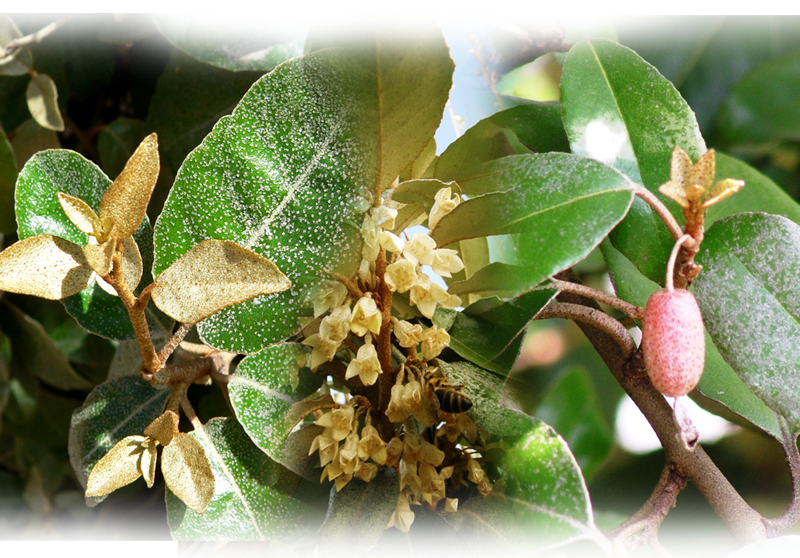
Ebbinge's silverberry
 5
5 5
5 9
9Will it grow where I live?
Ebbinge's silverberry is hardy to zone 6, which covers nearly all of Central Europe and the British Isles; only harsh upland sites (Alps, high ridges) call for winter protection.
Or check it for your location right here:
Profile
- Family
- Elaeagnaceae
- Habit
- Shrub
- Height
- 4.5 m
- Spread
- 5 m
- Growth
- medium
- Lifespan
- 40 years
- First yield
- after 5 years
- Yield per plant
- up to 5 kg a year
- Yield in cultivation
- up to 0.5 t/ha
- Hardiness
- zone 6–9
- Shade tolerance
- full shade
- Soil
- Sand, Silt, Loam
- Soil moisture
- very dry – very moist
- pH
- 6 – 7.5
- Synonyms
- Winter-Ölweide
Flowering & harvest
| J | F | M | A | M | J | J | A | S | O | N | D | |
|---|---|---|---|---|---|---|---|---|---|---|---|---|
| Flowering | ||||||||||||
| Fruit harvest |
Varieties (1)
1 varieties of Ebbinge's silverberry are listed in the Permaplans variety finder — each with its own page: taste, ripening time, disease resistance, parentage and use.
Uses
Edible: The fruit is approximately 20 mm long and 13 mm wide, containing a large seed. When fully ripe, it has a rich flavor with a slight acidity. To be fully ripe, they should be deep red and very soft; otherwise, they taste astringent. The taste improves if the fruits are stored for one to two days after harvesting. The fruit ripens over a period of about 6 weeks from early to mid-April to May. The seeds can be eaten raw or cooked and vaguely resemble peanuts.
Medicinal: The fruit of many members of this genus is a rich source of vitamins and minerals, especially vitamins A, C, and E, flavonoids, and other bioactive compounds. It also contains essential fatty acids, which is unusual for a fruit. Studies indicate that it can reduce the risk of cancer and inhibit or even reverse the growth of cancer cells.
Other uses: Plants can be grown as hedges in exposed locations, tolerating maritime conditions. They provide good wind protection, resist salt winds, and withstand regular pruning. Due to their vigorous growth, they grow faster than E. macrophylla. By binding atmospheric nitrogen, they enhance the growth of neighboring plants. They can be planted in an existing row of trees to fill empty spaces and cover the lower parts of the trees.
Growing
Site: Ebbinge's silverberry is first of all a hedging shrub — evergreen, two and a half to three metres in height and width, densely branched and notably tolerant of clipping. Salt and wind do not trouble it, which makes it useful along roads, near coasts and in windy corners where other evergreens scorch. It fixes atmospheric nitrogen in root nodules and is therefore a good neighbour for soft fruit and fruit trees. Two peculiarities belong in the plan: the flowers open in October and November and are intensely, sweetly scented — directly beneath a bedroom window some find that overpowering. And the fruits ripen in April and May, and crush on paving. Hardiness reaches only about minus fifteen degrees; trickier than the cold is the combination of frozen ground and winter sun on evergreen foliage, which makes a fully exposed east or south-east position unwise in harsh areas. Care: Clip twice a year — once after flowering in late winter, once after the midsummer flush; the hedge will also take cutting back into old wood. On variegated cultivars such as Gilt Edge or Limelight, wholly green shoots come through regularly; they grow more vigorously than the rest and must be removed at the base at once, or they take over the plant within a few years. Do not feed it; it brings its own nitrogen. The commonest cause of loss in Central Europe is winter drought: water on frost-free days in February and March, and give young plants a fleece or shade net through their first winters against the low sun. Diseases are rare; leaf spots appear on heavy wet soils, and the only remedy there is a better-drained position. Harvest in May, when the fruits are deep red and soft.
Propagation
Ebbinge's silverberry cannot be raised true from seed: it is a hybrid, its seedlings come out uneven and lose the habit and leaf markings of the cultivar. Cuttings are therefore the usual route. Take semi-ripe cuttings in August and September, halve the leaves to cut transpiration, and insert them under polythene or mist with bottom heat; hardwood cuttings in late autumn also work but need patience — rooting drags on for months. Low shoots can be layered in spring and severed after a year, which needs no equipment and is the simplest route with a single plant. Anyone who does want to sow should clean the flesh off the seed and give it around three months of cold stratification, preceded by a warm phase for hard-coated seed; germination is uneven and spreads over more than a year.
Value for wildlife
The ecological value of Ebbinge's silverberry lies almost entirely in its timing. It flowers in October and November, when hardly anything else in the garden is open, and its small, strongly scented tubular flowers are taken on mild autumn days by honeybees, late bumblebee queens, hoverflies and flies — a nectar source in a gap that is otherwise hard to fill. The fruits ripen in April and May, again at a time without competition, and are eaten by blackbirds and thrushes. Then there is the structure: as a dense evergreen it gives winter cover from wind and birds of prey, and in spring it carries the earliest nests of blackbird, dunnock and wren. No reliable figures exist for wild bee or caterpillar species using it; as a non-native garden hybrid it has no specialised associates. Through nitrogen fixation it also improves the soil for its neighbours. It is no substitute for a native flowering hedge, but it fills that hedge's off-season.
Notable
Special features: drought+(sea)wind+pruning+shade-tolerant a cross between E. pungens x E. macrophylla; Good varieties: 'Limelight' & 'Gilt Edge'; E. cordifolia is said to fruit better according to PFAF, but is not sold anywhere; improves the soil+increases yields of surrounding plants by 10%, requires genetically different partner for pollination
Origin & habitat
A garden hybrid with no natural range. Ebbinge's silverberry arose in 1929 in The Hague, when Simon Doorenbos, head of the municipal parks department, sowed seed from oleasters planted next to one another; he named the cross between Elaeagnus macrophylla and Elaeagnus pungens after the nurseryman J. W. E. Ebbinge. Its botanically correct name today is Elaeagnus x submacrophylla, because that name had already been published in 1909 — in the trade E. x ebbingei persists stubbornly. The parent species come from East Asia: E. macrophylla from the coasts of Korea and Japan, E. pungens from Japan and China. The hybrid is now planted throughout western and central Europe, and in mild coastal regions it occasionally escapes from plantings.
Ebbinge's silverberry has no natural ecosystem — it arose in a nursery and grows wild nowhere. It inherits its requirements from its parents, both shrubs of coastal thickets and open woodland in East Asia: Elaeagnus macrophylla grows on cliffs, in dune scrub and coastal forest in Korea and Japan, Elaeagnus pungens in thickets, at woodland edges and on waste ground in Japan and China. That is where the qualities prized in gardens come from: salt tolerance, wind resistance, frugality on poor free-draining soils, and the ability to fix atmospheric nitrogen through root nodules housing Frankia actinobacteria. In Central Europe it remains tied to gardens, parks and roadside planting.
Frequently asked questions
Ebbinge's silverberry: how big does it get?
Ebbinge's silverberry (Elaeagnus x ebbingei) grows as a Shrub and reaches roughly 4.5 m in height when mature, with a spread of about 5 m. Growth is medium.
Ebbinge's silverberry: what site does it need?
Ebbinge's silverberry tolerates full shade. Suitable soils are Sand, Silt, Loam. Soil moisture should be in the range very dry – very moist. The pH may lie between 6 and 7.5.
Ebbinge's silverberry: is it hardy?
Ebbinge's silverberry is listed as hardy in zone 6–9 and survives normal winters outdoors there.
Ebbinge's silverberry: will it grow in Central Europe?
Ebbinge's silverberry is hardy to zone 6, which covers nearly all of Central Europe and the British Isles; only harsh upland sites (Alps, high ridges) call for winter protection.
Ebbinge's silverberry: when does it flower?
In a temperate northern-hemisphere climate it flowers in November.
Ebbinge's silverberry: when is it harvested?
In a temperate northern-hemisphere climate the fruit ripens in May.
Ebbinge's silverberry: when does it start cropping, and how much?
Ebbinge's silverberry first crops after 5 years. A mature plant gives up to 5 kg a year, in cultivation up to 0.5 t per hectare. Figures assume a good site; variety, soil and climate shift them considerably.
Ebbinge's silverberry: is it poisonous?
No toxicity is recorded for Ebbinge's silverberry. With wild plants, never rely on a database alone — only on a confident identification.
Ebbinge's silverberry: what is it used for?
Rated on a scale up to 10: Edible 5/10, Medicinal 5/10, Other uses 9/10.
Which Ebbinge's silverberry varieties are there?
The Permaplans variety finder lists 1 varieties of Ebbinge's silverberry, including Gilt Edge. Each variety has its own page with taste, ripening time, disease resistance and parentage.
Plan this plant into your own garden
Permaplans plans your garden to scale on the map — with a site check, harvest calendar and over 1,000 plants. Free for iPhone, Android, Mac, Windows & Linux.
Will this plant grow where you live? → Check your site
Community experience
No first-hand reports for this plant yet.
Growing it? Write in the app what works for you – your post will show up here.
💬 Get the app and join in