
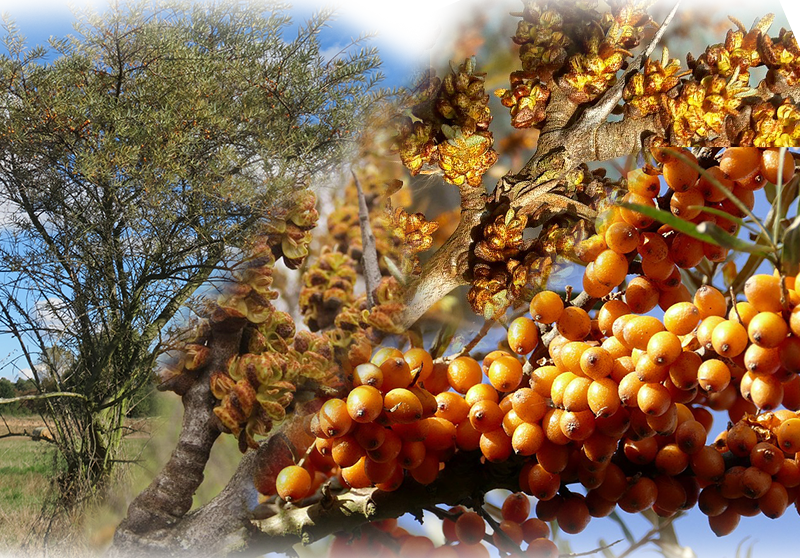
Sea buckthorn
 7
7 7
7 8
8Will it grow where I live?
Sea buckthorn is hardy to zone 3 – that covers all of Central Europe and the British Isles, and every USDA zone from 3 upwards.
Or check it for your location right here:
Profile
- Family
- Elaeagnaceae
- Habit
- Shrub
- Height
- 6 m
- Spread
- 6 m
- Growth
- medium
- Lifespan
- 35 years
- First yield
- after 4 years
- Yield in cultivation
- up to 5 t/ha
- Energy yield
- 40 kcal per m² a year
- Hardiness
- zone 3–7
- Shade tolerance
- full sun
- Soil
- Sand, Silt, Loam
- Soil moisture
- very dry – very wet
- pH
- 6 – 8
Flowering & harvest
| J | F | M | A | M | J | J | A | S | O | N | D | |
|---|---|---|---|---|---|---|---|---|---|---|---|---|
| Flowering | ||||||||||||
| Fruit harvest |
Varieties (13)
13 varieties of Sea buckthorn are listed in the Permaplans variety finder — each with its own page: taste, ripening time, disease resistance, parentage and use.
- Askola Juicy, high-yielding variety with exceptionally high vitamin C content.
- Botanicheskaya Early, high-yielding Russian variety with large, juicy berries.
- Chuiskaya Russian Altai variety with large, sweet-tart berries and low thorniness.
- Dorana Aromatic variety with a somewhat milder, more balanced flavour profile.
- Frugana Early-ripening variety with comparatively mild, less acidic flavour.
- Habego Late-ripening variety with large berries and robust aroma.
- Hergo High-yielding German standard variety with intensely tart, aromatic pulp.
- Hikul Low-growing male dwarf variety – compact pollinator and ornamental shrub.
- Leikora
- Orange Energy Russian variety sold under a trade name, with large, easy-to-harvest berries.
- Pollmix Purely male pollinator variety – bears no fruit but ensures fruit set of the female varieties.
- SirolaSweet, nearly thornless sea buckthorn for easy harvesting.
- Trofimovskaya Robust Russian variety with large berries and good winter hardiness.
Uses
Edible: Fruit can be consumed raw or cooked and is a good source of vitamin C and vitamin A. While some may find them too sour when raw, children generally enjoy them. Fruit is commonly juiced for its vitamins and pleasant aroma. It is known for its health benefits and is often mixed with other fruits for juice production. Certain species and varieties have a high oil content of up to 9.2%. The small fruits, about 6-8 mm in diameter, are abundantly produced along the stems. They lose some of their sourness after frost or when cooked. Ripe fruits are available from late September and typically remain on the plants throughout winter unless eaten by birds.
Medicinal: Anodyne, antidote, diuretic, and fever reducer. The root juice effectively counteracts arsenic poisoning and has a historical use in cancer treatment. Root extracts show antitumor properties, while a tea from boiled roots acts as a diuretic.
Other uses: Beyond its fruit, sea buckthorn is above all a pioneer shrub with practical uses. Through its root nodules it fixes atmospheric nitrogen in symbiosis with actinomycetes and so enriches raw, nutrient-poor ground; together with its far-reaching, suckering root system this makes it the standard plant for stabilising embankments, dunes, railway banks and spoil heaps. On former mining land and raw soils it is one of the few woody plants that will establish without ground preparation. As a hedge, its strong thorns and dense branching build an impenetrable barrier within a few years, one that needs little cutting but is also hard to keep within bounds. The seeds contain twelve to thirteen per cent of a slow-drying oil; the vitamin-rich juice is processed in cosmetics. The fruit yields a yellow dye, the bark and roots a darker one. The foliage was formerly used as sheep fodder.
Growing
Sea buckthorn lives in symbiosis with nitrogen-fixing actinomycetes, visible as nodule-like structures on the roots — nitrogen fertiliser is therefore unnecessary, and the symbiosis develops best on well-aerated sandy soils. It demands full sun and tolerates neither shade nor heavy, compacted or waterlogged ground. The main roots reach down some three metres, and the shrub throws abundant shallow suckers that emerge up to ten metres from the parent, so a single plant soon becomes a thicket and a root barrier is advisable. Pruning decides the crop: leaves and fruit form only on the previous year's growth, so unpruned bushes go bare and die back inside and carry fruit only at the periphery. Regular renewal is therefore essential.
Propagation
Because sea buckthorn is dioecious, the method of propagation determines the crop: seedlings reveal their sex only after years, so fruit growing relies entirely on vegetative propagation — hardwood and softwood cuttings, root cuttings, or the abundant suckers, which can be severed and moved. Buy named female cultivars plus at least one male as pollen donor; one male serves roughly six to eight females and should stand upwind, since pollination is by wind. Sowing matters only in breeding and requires a cold period over winter.
Value for wildlife
Sea buckthorn is wind-pollinated and correspondingly unimportant for flower visitors — its inconspicuous flowers open before the leaves and offer no nectar. Its value lies in fruit and structure: the orange berries hang into winter and are an important food source for thrushes, blackbirds and passing migrants at a time when little else is available. The thorny, densely branched thicket gives small birds almost inaccessible nesting cover. Ecologically notable too is its nitrogen fixation through root symbiosis: sea buckthorn prepares raw ground and creates conditions for later species — on coastal dunes and river gravels it is a classic pioneer.
Notable
Special features: drought, salt, and sea wind tolerant; forms runners!; at least 1 male to 6 female plants; fruit ripens from mid-summer to late autumn, depending on the variety; fruits hang all winter; a symbiosis with bacteria producing vitamin B12 is said to develop on the outer skin of the fruit; Hippophae salicifolia is better suited for heavier soils.
Origin & habitat
Eurasia: coasts and mountains from western Europe to Central Asia. Sea buckthorn occupies a widely spread range reaching from the Atlantic, North Sea and Baltic coasts across the Alps and Carpathians into Siberia, Mongolia and the Himalaya. Within it the shrub favours two very different habitats: the dunes and cliffs of sea coasts, and the gravel and shingle flats of mountain rivers. In Germany the natural occurrences lie on the Baltic coast and the North Sea islands as well as in Alpine valleys; inland it appears as a planted or escaped species. Breeding work was carried out mainly in Russia, the origin of most large-fruited cultivars.
Sea buckthorn is a pioneer of open, lime-rich raw soils with two clearly separated strongholds: the dunes, shingle ridges and cliffs of sea coasts, and the gravel and shingle beds of mountain rivers and their shifting reaches. Both are sites that are reworked regularly and carry almost no humus. That is exactly what it is built for: nitrogen fixation through its root nodules makes it independent of soil fertility, deep roots reach water, and suckers colonise freshly torn-open ground. It is decidedly light-demanding and salt-tolerant, but will not take shade. That also describes its fate: where succession continues, it is overgrown by willows, birches and pines and disappears. Lasting stands exist only where wind, waves or floods keep the ground open again and again.
⚠️ Hazards
Thorns, Staining The shoots of sea buckthorn carry strong, sharp thorns that go through thin gloves and regularly cause puncture wounds during harvest and pruning; stout gloves and arm protection are advisable. The juice stains skin, clothing and pale paving a strong orange, and washes out of textiles only with difficulty.
Frequently asked questions
Sea buckthorn: how big does it get?
Sea buckthorn (Hippophae rhamnoides) grows as a Shrub and reaches roughly 6 m in height when mature, with a spread of about 6 m. Growth is medium.
Sea buckthorn: what site does it need?
Sea buckthorn tolerates full sun. Suitable soils are Sand, Silt, Loam. Soil moisture should be in the range very dry – very wet. The pH may lie between 6 and 8.
Sea buckthorn: is it hardy?
Sea buckthorn is listed as hardy in zone 3–7 and survives normal winters outdoors there.
Sea buckthorn: will it grow in Central Europe?
Sea buckthorn is hardy to zone 3 – that covers all of Central Europe and the British Isles, and every USDA zone from 3 upwards.
Sea buckthorn: when does it flower?
In a temperate northern-hemisphere climate it flowers in April.
Sea buckthorn: when is it harvested?
In a temperate northern-hemisphere climate the fruit ripens in October.
Sea buckthorn: when does it start cropping, and how much?
Sea buckthorn first crops after 4 years. In cultivation, up to 5 t per hectare is typical. Figures assume a good site; variety, soil and climate shift them considerably.
Sea buckthorn: is it poisonous?
No toxicity is recorded for Sea buckthorn. With wild plants, never rely on a database alone — only on a confident identification.
Sea buckthorn: what is it used for?
Rated on a scale up to 10: Edible 7/10, Medicinal 7/10, Other uses 8/10.
Which Sea buckthorn varieties are there?
The Permaplans variety finder lists 13 varieties of Sea buckthorn, including Askola, Botanicheskaya, Chuiskaya, Dorana, Frugana, Habego, Hergo, Hikul, Leikora, Orange Energy, Pollmix, Sirola and 1 more. Each variety has its own page with taste, ripening time, disease resistance and parentage.
Plan this plant into your own garden
Permaplans plans your garden to scale on the map — with a site check, harvest calendar and over 1,000 plants. Free for iPhone, Android, Mac, Windows & Linux.
Will this plant grow where you live? → Check your site
Community experience
What Permaplans users wrote about this plant – taken from the app as is. 2 posts.
Super leckere Frucht und klasse Gehölz. Industrielle Ernte und Verarbeitung stört die Dornen wahrscheinlich nicht, aber als Selbstversorger sind sie noch anstrengend, um der Pflanze viel abzugewinnen
schmeckt wie Maracuja, super sauer, aber sehr lecker!
Growing it? Write in the app what works for you – your post will show up here.
💬 Get the app and join in