
Fig
 9
9 7
7 4
4Will it grow where I live?
Fig is hardy to zone 6, which covers nearly all of Central Europe and the British Isles; only harsh upland sites (Alps, high ridges) call for winter protection. It also needs warm summers – in Central Europe that means wine-growing regions, cities or a sheltered south-facing wall.
Or check it for your location right here:
Profile
- Family
- Moraceae
- Habit
- Tree
- Height
- 6 m
- Spread
- 6 m
- Growth
- medium
- Lifespan
- 40 years
- First yield
- after 3 years
- Productive years
- 17 years
- Yield per plant
- up to 100 kg a year
- Yield in cultivation
- up to 15 t/ha
- Energy yield
- 500 kcal per m² a year
- Hardiness
- zone 6–11
- Shade tolerance
- full sun
- Soil
- Sand, Silt, Loam, Clay
- Soil moisture
- dry – very moist
- pH
- 6 – 7.5
- Planned in gardens
- 7×
Flowering & harvest
| J | F | M | A | M | J | J | A | S | O | N | D | |
|---|---|---|---|---|---|---|---|---|---|---|---|---|
| Fruit harvest |
Varieties (23)
23 varieties of Fig are listed in the Permaplans variety finder — each with its own page: taste, ripening time, disease resistance, parentage and use.
- Adriatic Green-skinned cultivar with vivid strawberry-red flesh, base of classic fig paste.
- Black Mission Dark purple California classic with rich, syrupy flavour, superb fresh or dried.
- Bornholm Exceptionally cold-hardy Danish island cultivar, adapted to frost and damp in the north.
- Brown Turkey Hardy, dependable garden standard for cool climates with two crops a year.
- Brunswick Large, cold-tolerant fig with a strong breba crop for northern gardens.
- Bursa Large, dark purple Turkish commercial cultivar with deep red, juicy flesh.
- Celeste Small, honey-sweet sugar fig, extremely cold hardy and reliable in the US Southeast.
- Conadria Robust, disease-resistant US-bred cultivar with pale skin, good fresh or dried.
- Dalmatie Very large, green-skinned fig with strawberry-red flesh, good for cooler climates.
- Dauphine Large French fig producing two crops.
- Desert King San Pedro fig with a large, reliable breba crop, ideal for cool coastal climates.
- Kadota Green-yellow, syrup-sweet Italian cultivar, backbone of the canning and drying industry.
- Little Miss Figgy
- LSU Gold Large, golden-yellow US-bred cultivar with red-amber flesh for hot, humid summers.
- Madeleine des Deux Saisons French two-season cultivar with abundant breba and main crop, sweet and aromatic.
- Osborn Prolific Dark brown, very sweet cultivar that ripens reliably even in cool summers.
- Panachee Striking green-yellow striped novelty fig with raspberry-red, juicy-sweet flesh.
- Pastiliere Early, dark red French cultivar with very sweet flesh, good for cooler locations.
- PerrettaSweet table fig.
- Ronde de Bordeaux Very sweet small dark fig - cold-hardy and early.
- Rouge de Bordeaux Dark, honey-sweet fig from Bordeaux.
- Violette de Bordeaux Small, jet-black gourmet fig with intense berry flavour, compact and cold hardy.
- White MarseillePale, sweet and cold-hardy fig.
Uses
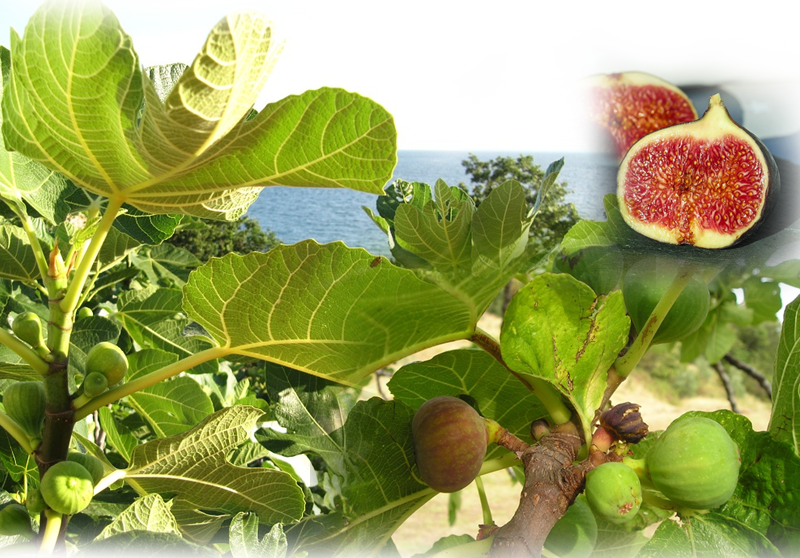
Edible: Fruit can be consumed raw or cooked and is sweet, juicy, and exquisite when fully ripe, almost melting in the mouth. Dried fruit is a valuable commodity, with figs being pear-shaped and up to 5 cm in diameter. The latex from the juice is useful for curdling plant milk, and a nutritional analysis is provided.
Medicinal: The gum resin extracted from the root has medicinal properties such as anthelmintic, antispasmodic, expectorant, and nervine. It is utilized for treating asthma, whooping cough, gas colic, pneumonia, and bronchitis in children. The plant's leaves have carminative and diaphoretic effects. Studies have explored its possible contraceptive properties.
Other uses: Fig wood is light, soft and porous and has little role as timber, though between the 13th and 15th centuries it was valued for the wooden panels of panel painting. The milky sap held in all green parts of the plant is of more practical interest: it contains the protein-splitting enzyme ficin and is traditionally used to curdle milk and plant-based milk alternatives. Heavily roasted dried figs were once processed into a coffee additive, fig coffee, now only rarely offered. Note that the sap of leaves and shoots contains psoralen and bergapten; ripe fruits are free of both.
Growing
Site: The fig needs warmth and above all shelter from bare frost; north of the Alps it succeeds only in a wine-growing climate or on urban heat islands, against a south wall, in a courtyard or trained on a trellis. It roots shallowly and widely and competes for water near beds; confining the roots, for instance with a buried tub, keeps that in check and improves fruit set at the same time. Ripe fruit drops, leaves sticky marks on paving and draws wasps, so a seat directly beneath it is unwise. The milky sap of leaves and shoots irritates skin, which is a nuisance along narrow paths. Care: Poor soil suits it, wet and heavy soil does not, since there it grows lushly and sets little fruit. Give nitrogen sparingly: too much lowers frost hardiness and delays ripening. Cultivars such as 'Brown Turkey', 'Ronde de Bordeaux' or 'Brunswick' take about -15 °C; below that the wood dies back and the crop is lost, because the fig bears on one-year-old wood. It usually reshoots from the rootstock. For winter protection use a 10 to 15 cm layer of leaves over the root zone and tie the branches together wrapped in jute, never plastic; the lowest 50 cm matter most. A light cut back in March encourages side shoots.
Propagation
The fig is so easily propagated vegetatively that little else is worth the effort. Hardwood cuttings are the usual route: well-ripened one- to two-year-old shoots, 25 to 30 cm long and no more than 1.5 cm thick, cut in late winter and inserted in free-draining medium, root within a few weeks given bottom heat; two- and three-year-old wood and thicker branch sections also take. Layering and detached root suckers work equally well, the latter being available anyway on plants that have died back. All these routes give plants true to type, which matters because Central Europe depends on parthenocarpic cultivars. Seedlings, by contrast, are a genetic mixture and largely produce fruitless caprifigs; sowing is left to breeders. Set young plants out in spring, about 10 cm deeper than they stood in the pot.
Value for wildlife
In its native range the fig maintains one of the closest plant-insect relationships known: the flowers sit inside the urn-shaped receptacle and are pollinated solely by the fig wasp, an insect only a few millimetres long that shuttles between caprifigs and edible figs and completes its own life cycle in the process. That wasp is absent from Central Europe, which is why almost only parthenocarpic cultivars of the Adriatic type are grown here, setting fruit without any pollination. For the regional insect fauna the fig therefore offers very little; there are practically no regular flower visitors, and the fig leaf moth appears only sporadically. What does get used is the ripe fruit, taken by blackbirds, starlings and wasps.
Notable
Special features: one of the oldest cultivated plants - finds near Jericho ~11,400 years old, predating arable farming; in central Europe only parthenocarpic cultivars of the Adriatic type, since the fig wasp as sole pollinator is absent here; bears on one-year-old wood -> dieback costs the whole crop; hardy to zone 6, but fruit-bearing shoots die back earlier; needs a site sheltered from wind+cold; confine the shallow roots horizontally
Origin & habitat
South-west Asia and the Mediterranean. The wild form of the fig is not known with certainty; its home is presumed to lie on the southern shore of the Caspian Sea and in the Pontic Mountains, yet genetic work on mitochondrial DNA suggests the species is native throughout the Mediterranean basin. Today it occurs across that whole region and has widely escaped from cultivation; commercial production centres on Turkey, Egypt, Algeria, Morocco and Iran. North of the Alps it persists on mild winter sites: along the Rhine, Moselle, Main and Elbe, in the Breisgau, on the Bergstrasse, in the Ruhr and the Dresden Elbe valley, naturalised figs grow on walls, railway embankments and urban wasteland. It has also established itself on Heligoland and the Danish Baltic islands.
The fig occupies dry, sun-exposed sites on deep but freely draining ground, from sea level to around 1,700 m. Its affinity for rock is characteristic: it roots in crevices, scree and old masonry, where a far-reaching root system taps moisture from depth, and it copes with nutrient-poor substrates while doing so. Waterlogging and persistently wet soil suit it badly, salt in the soil rather well, which explains its occurrence near coasts. In the semi-arid mountain regions of Iran a cold-tolerant mountain form grows on open dry slopes.
⚠️ Hazards
The juice and unripe fruits are toxic and can lead to significant eye irritation.
Frequently asked questions
Fig: how big does it get?
Fig (Ficus carica) grows as a Tree and reaches roughly 6 m in height when mature, with a spread of about 6 m. Growth is medium.
Fig: what site does it need?
Fig tolerates full sun. Suitable soils are Sand, Silt, Loam, Clay. Soil moisture should be in the range dry – very moist. The pH may lie between 6 and 7.5.
Fig: is it hardy?
Fig is listed as hardy in zone 6–11 and survives normal winters outdoors there.
Fig: will it grow in Central Europe?
Fig is hardy to zone 6, which covers nearly all of Central Europe and the British Isles; only harsh upland sites (Alps, high ridges) call for winter protection. It also needs warm summers – in Central Europe that means wine-growing regions, cities or a sheltered south-facing wall.
Fig: when is it harvested?
In a temperate northern-hemisphere climate the fruit ripens from July to October.
Fig: when does it start cropping, and how much?
Fig first crops after 3 years. A mature plant gives up to 100 kg a year, in cultivation up to 15 t per hectare. The productive period lasts about 17 years, within a lifespan of around 40 years. Figures assume a good site; variety, soil and climate shift them considerably.
Fig: is it poisonous?
Individual parts of Fig are noted as mildly problematic — the plant does not count as poisonous. With wild plants, never rely on a database alone, only on a confident identification.
Fig: what is it used for?
Rated on a scale up to 10: Edible 9/10, Medicinal 7/10, Other uses 4/10.
Which Fig varieties are there?
The Permaplans variety finder lists 23 varieties of Fig, including Adriatic, Black Mission, Bornholm, Brown Turkey, Brunswick, Bursa, Celeste, Conadria, Dalmatie, Dauphine, Desert King, Kadota and 11 more. Each variety has its own page with taste, ripening time, disease resistance and parentage.
Plan this plant into your own garden
Permaplans plans your garden to scale on the map — with a site check, harvest calendar and over 1,000 plants. Free for iPhone, Android, Mac, Windows & Linux.
Will this plant grow where you live? → Check your site
Community experience
No first-hand reports for this plant yet.
Growing it? Write in the app what works for you – your post will show up here.
💬 Get the app and join in