
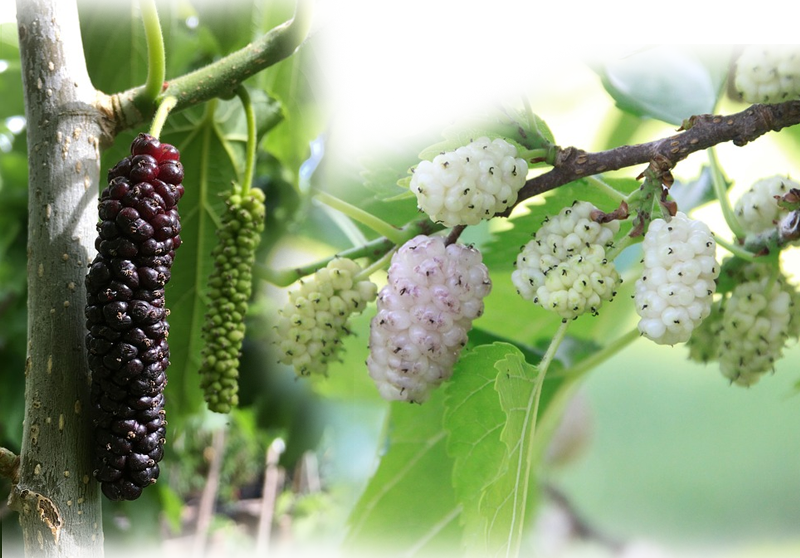
White mulberry
 9
9 7
7 9
9Will it grow where I live?
White mulberry is hardy to zone 5 – that covers all of Central Europe and the British Isles, and every USDA zone from 5 upwards.
Or check it for your location right here:
Profile
- Family
- Moraceae
- Habit
- Tree
- Height
- 16.5 m
- Spread
- 10 m
- Growth
- fast
- Lifespan
- 160 years
- First yield
- after 7 years
- Productive years
- 150 years
- Yield per plant
- up to 80 kg a year
- Yield in cultivation
- up to 10 t/ha
- Energy yield
- 150 kcal per m² a year
- Hardiness
- zone 5–9
- Shade tolerance
- partial shade
- Soil
- Sand, Silt, Loam
- Soil moisture
- dry – very moist
- pH
- 7 – 8.5
- Synonyms
- Maulbeere
Flowering & harvest
| J | F | M | A | M | J | J | A | S | O | N | D | |
|---|---|---|---|---|---|---|---|---|---|---|---|---|
| Flowering | ||||||||||||
| Fruit harvest |
Varieties (14)
14 varieties of White mulberry are listed in the Permaplans variety finder — each with its own page: taste, ripening time, disease resistance, parentage and use.
- Gerardi Dwarf True dwarf mulberry for pots and small gardens with a long harvest window.
- Hunza BlackDark-fruited mulberry from the Hunza region.
- Illinois Everbearing Long-fruiting, large-fruited hybrid mulberry from the USA.
- Kokuso 21 Cold-hardy Korean mulberry.
- Morettiana Italian selection with large, aromatic black fruit.
- Oscar Early, heavy-bearing hybrid with large, dark fruit.
- Pakistan Famous long-fruited mulberry with dark-red berries up to 8 cm long.
- Pendula Weeping ornamental mulberry with a cascading canopy, often grafted fruitless.
- SiciliaSweet mulberry of Italian origin.
- Sweet Lavender Rare mulberry with lavender-pink fruit and a mild, sweet taste.
- Tehama White-fruited giant mulberry with honey-sweet, very long berries.
- Unryu Ornamental mulberry with dramatically contorted branches and edible fruit.
- Wellington Robust tall white mulberry with sweet black fruit and dense shade.
- World's Best Large-fruited selection with juicy-sweet, very long black berries.
Uses
Edible: The fresh mulberry fruit has a mild sweetness but is generally bland, with approximately 1.5% protein, 0.5% fat, 8% carbohydrates, and 0.7% malic acid content. A specific 'Pendulum' variety of the fruit, tasted in July 1994, exhibited a pleasing taste. Upon drying, the fruit gains a more intense flavor and can be a viable alternative to raisins, reaching lengths of up to 25 mm. In times of scarcity, the young leaves and shoots of the mulberry tree can be cooked and consumed as food. These leaves are a good source of carotene and calcium. Protein supplements derived from young mulberry leaves can enhance low-protein diets. Dried leaves of the tree contain various nutrients like protein, magnesium, sugars, phosphorus, potassium, calcium, aluminum, iron, silica, sulfur, and tannin. The inner bark of the mulberry tree can be processed by roasting and grinding into a meal, serving as a thickening agent in soups or bread-making. It is believed that the tree produces edible manna. Additionally, the young shoots can be brewed as a tea alternative. The real yield of a mulberry per unit area is in the leaf, not the fruit. A well-managed stand, cut several times a year at head height, produces 25 to 30 t of leaf dry matter per hectare at 18 to 25 per cent crude protein — depending on the source, two to three times the protein yield soy achieves on the same ground, at 75 to 85 per cent digestibility. Dried as leaf meal it replaces part of the soybean meal in poultry and pig rations; for people, dried mulberry leaf is mainly tea and a soup seasoning. On top of that, the mulberry does it on far less water: it is markedly drought-tolerant and still green when soy on the same site would long since have forced its seed. In southern Europe the leaf is therefore the more interesting harvest — and the reason to keep the trees low and cuttable rather than letting them run up.
Medicinal: The white mulberry has a long history of use in Chinese medicine and is utilized in different forms. Its leaves have antibacterial and astringent qualities, beneficial for colds, flu, and eye infections. The stems possess antirheumatic and antispasmodic properties, effective in treating rheumatic pain. The fruit enhances kidney energy, aiding in conditions like urinary incontinence and insomnia. The root bark serves as an antiasthmatic remedy for asthma and coughs. Additionally, the plant exhibits antibacterial and fungicidal properties.
Other uses: The mulberry tree is highly versatile, offering various uses. Its fibers are utilized for weaving, while the trunk bark is valuable for papermaking in China and Europe. Twigs serve as binding material and for crafting baskets. A brown dye can be derived from the trunk, and the leaves contain 10% tannin. The 'Tartarica' variety thrives in colder climates and is commonly planted as a windbreak in Russia. Mulberry wood shows promise as a source of ethanol and is prized for its flexibility in producing sports equipment like tennis rackets and cricket bats. Additionally, it is employed in boat construction, furniture making, and agricultural tools, while also serving as a medium-quality firewood.
Growing
Site: Warm and in full sun, preferably on calcareous, free-draining ground. Everything else is decided by what lies beneath the crown: the fruit drops in quantity as it ripens, and in dark-fruited forms the juice stains paving, terraces and garden furniture so lastingly that it barely comes out. The tree belongs over grass or a bed, never over seating and paths. The abundance of fruit also draws numerous birds — they share the harvest and are at the same time the reason the species spreads. Care: In their first winter young plants need frost protection. Grown as a tree it needs no pruning; to keep it smaller, shorten the new growth to about 20 cm at the end of June. Branches over 5 cm across are better left uncut, as the wounds callus poorly. Grown as a hedge, timing decides the crop: only a cut during or after flowering allows fruit — the usual spring trim removes every flower bud. To harvest, spread nets or cloths beneath and shake.
Propagation
The species is easily raised from seed. The ripe seeds are washed out of the fruit; they remain viable in cool moist storage for two to three years. After storage they are stratified and sown at a soil temperature of about 20 °C — the germination rate is high. Seedlings do not come true to type, so cultivars are grafted; summer cuttings also root. Anyone growing mulberry as a hedge must watch the timing of the cut: trimming in spring as with an ordinary clipped hedge removes the flower buds and yields nothing — precisely the failing of the old mulberry hedges from the era of domestic silk production. Only a cut during or after flowering allows a worthwhile crop from a hedge.
Value for wildlife
For central European insect life the white mulberry is of limited value: it is a neophyte from East Asia, and reliable figures for wild bees, butterflies or beetles are not available here. Its flowers are inconspicuous monoecious or dioecious catkins that appear in May and are wind-pollinated — as a nectar or pollen source they play no part. Its documented contribution lies in the fruit: the sorosis ripens from late June into July in great quantity and is taken readily by birds, which is also how the tree spreads. As a source of leaves it is the food plant of the silkworm, the very reason it was planted in Europe at all. Clipped mulberry hedges additionally provide cover and nesting space.
Notable
Special features: heat-loving and pest-resistant; can be kept at a height of 1-3m by pruning; cuttings bear fruit in the second year; there are many varieties that often remain much smaller, including Morus alba with red and black fruits; grapes growing in mulberry trees remain healthy and fungus-free; leaves 20t/ha silkworm breeding (cultivated for parachutes in WWII);
Origin & habitat
Northern and central China; cultivated in warmer regions worldwide. The original range of the white mulberry lies in northern and central China, including Henan and Shaanxi; its ancient cultivated range extends across Korea, northern India and the Himalaya. In China the tree has been grown for some 4,500 years, in Greece from about 550 AD and in Sicily from the twelfth century. It reached Central Europe around 1700, at that time solely as a source of leaves for silkworm rearing. Today it is naturalised in southern and parts of central Europe. After millennia of human dispersal, separating the natural from the cultivated range is scarcely possible.
Within its original range the white mulberry grows in open hillside forest and in river valleys, along woodland edges, river banks and in mountain thickets, usually scattered through deciduous mixed woodland. It is therefore not a tree of closed stands but of half-open transitional ground with sufficient soil moisture. In the Himalaya it ascends to around 1,200 m. It favours fertile, loamy, well-drained soils with a pH between 5.0 and 7.0; it avoids dry slopes and shallow soils, where water becomes the limiting factor. In cultivation it proves considerably more adaptable and copes with calcareous and poorer soils as well, provided the site is warm and in full sun.
⚠️ Hazards
All parts of the plant carry a milky sap. Unripe fruit and the sap can cause gastrointestinal upset and should not be eaten; only fully ripe fruit is harmless. The juice of dark-fruited forms stains heavily and is very hard to remove from clothing. Ripe fruit keeps only one to two days and then moulds quickly, so it must be processed at once.
Frequently asked questions
White mulberry: how big does it get?
White mulberry (Morus alba) grows as a Tree and reaches roughly 16.5 m in height when mature, with a spread of about 10 m. Growth is fast.
White mulberry: what site does it need?
White mulberry tolerates partial shade. Suitable soils are Sand, Silt, Loam. Soil moisture should be in the range dry – very moist. The pH may lie between 7 and 8.5.
White mulberry: is it hardy?
White mulberry is listed as hardy in zone 5–9 and survives normal winters outdoors there.
White mulberry: will it grow in Central Europe?
White mulberry is hardy to zone 5 – that covers all of Central Europe and the British Isles, and every USDA zone from 5 upwards.
White mulberry: when does it flower?
In a temperate northern-hemisphere climate it flowers in May.
White mulberry: when is it harvested?
In a temperate northern-hemisphere climate the fruit ripens in July.
White mulberry: when does it start cropping, and how much?
White mulberry first crops after 7 years. A mature plant gives up to 80 kg a year, in cultivation up to 10 t per hectare. The productive period lasts about 150 years, within a lifespan of around 160 years. Figures assume a good site; variety, soil and climate shift them considerably.
White mulberry: is it poisonous?
No toxicity is recorded for White mulberry. With wild plants, never rely on a database alone — only on a confident identification.
White mulberry: what is it used for?
Rated on a scale up to 10: Edible 9/10, Medicinal 7/10, Other uses 9/10.
Which White mulberry varieties are there?
The Permaplans variety finder lists 14 varieties of White mulberry, including Gerardi Dwarf, Hunza Black, Illinois Everbearing, Kokuso 21, Morettiana, Oscar, Pakistan, Pendula, Sicilia, Sweet Lavender, Tehama, Unryu and 2 more. Each variety has its own page with taste, ripening time, disease resistance and parentage.
Plan this plant into your own garden
Permaplans plans your garden to scale on the map — with a site check, harvest calendar and over 1,000 plants. Free for iPhone, Android, Mac, Windows & Linux.
Will this plant grow where you live? → Check your site
Community experience
No first-hand reports for this plant yet.
Growing it? Write in the app what works for you – your post will show up here.
💬 Get the app and join in