
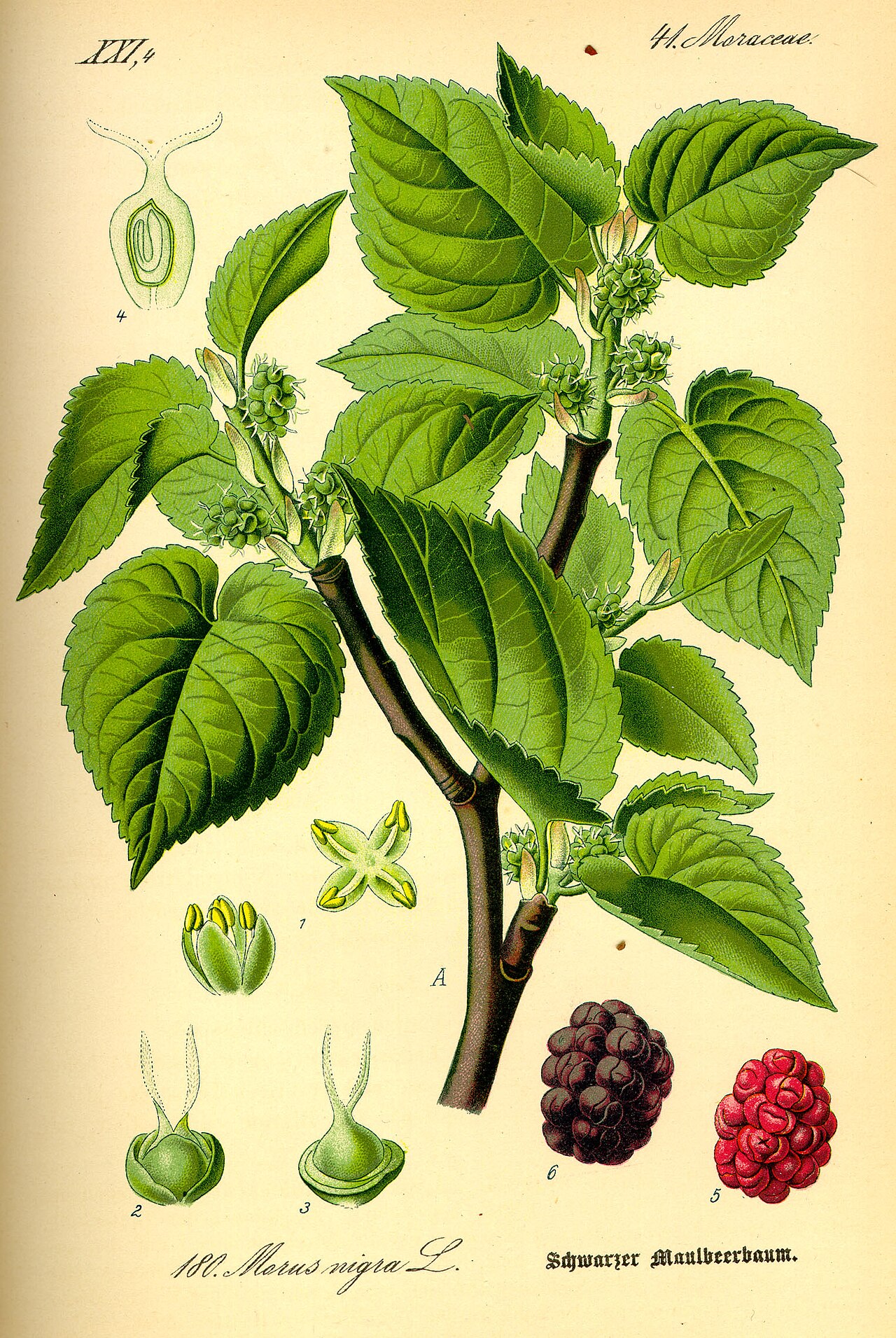
Black mulberry
 8
8 1
1 1
1Will it grow where I live?
Black mulberry is hardy to zone 5 – that covers all of Central Europe and the British Isles, and every USDA zone from 5 upwards.
Or check it for your location right here:
Profile
- Family
- Moraceae
- Habit
- Tree
- Height
- 10 m
- Spread
- 15 m
- Growth
- medium
- Lifespan
- 200 years
- First yield
- after 5 years
- Productive years
- 300 years
- Hardiness
- zone 5–9
- Shade tolerance
- light shade
- Soil
- Sand, Silt, Clay
- Soil moisture
- dry – moist
- pH
- 5.5 – 7.5
- Synonyms
- Common Mulberry, Mulberry
Flowering & harvest
| J | F | M | A | M | J | J | A | S | O | N | D | |
|---|---|---|---|---|---|---|---|---|---|---|---|---|
| Flowering | ||||||||||||
| Fruit harvest |
Varieties (7)
7 varieties of Black mulberry are listed in the Permaplans variety finder — each with its own page: taste, ripening time, disease resistance, parentage and use.
- Black Beauty Compact, container-friendly black mulberry with early fruiting and sweet-tart berries.
- Chelsea Historic English mulberry with unusually large, aromatic fruit and early ripening.
- Cianfaglione Aromatic Italian black mulberry.
- Jerusalem Near-East selection of the true black mulberry with large, dark, very juicy fruit.
- Large Black Selection prized for its notably large, juicy black fruit for fresh eating.
- Noir of Spain Mediterranean black mulberry with large, highly aromatic fruit and warmth-loving growth.
- Wellington Robust, productive black mulberry with a long picking season and vigorous growth.
Uses
Edible: The long-stalked aggregate fruits are 1 to 3 cm long and purple to blackish violet. Unlike the white mulberry they do not ripen all at once but successively from mid-July to the end of September. In flavour they are clearly superior to the white mulberry: aromatic, pleasantly spicy, sweet-sour and very juicy. Fully ripe they are eaten raw or dried; processed they make jam, jelly, syrup, compote and wine. The juice stains strongly, which is welcome in processing but stubborn on clothes and hands. Regional selections from Central Asia reach fruit lengths of up to 6 cm ('Black Persian', 'Black Tabor'), while the Slovak cultivars 'Bo 11' and 'Bo 12' reach 2.5 to 3.5 cm at 4 to 6 g. In Albania the fruit is distilled into a spirit tinted slightly green with mulberry leaves; around Pukanec in Slovakia the fruit is known in translation as vineyard strawberries and is made into jam, dried fruit and liqueur.
Medicinal: For centuries European pharmacies prepared Sirupus Mori from the ripe fruit of the black mulberry, a deep red syrup used diluted as a gargle for sore throats and inflamed oral mucosa, and at the same time for colouring and flavouring other medicines; it remained in the pharmacopoeias into the 20th century. The fruit was traditionally held to be cooling and, in quantity, mildly laxative, while unripe fruit was considered strongly purgative. The root bark was historically given as a vermifuge, a use that is obsolete today. All of this is traditional and without proof of efficacy by present-day standards; the syrup's effect probably rested essentially on its sugar content and tannins. The black mulberry should not be confused with the white mulberry, whose leaves play a separate and far more extensive role in Traditional Chinese Medicine.
Other uses: Besides the fruit, the black mulberry offers several secondary uses. The strongly staining juice has long served as a food colouring, among other things for deepening the colour of wine and liqueurs. The bast of the young bark yields cordage and tying material, and the rods can be used for basketry. The leaves serve as livestock fodder and are fed to silkworms, though they rank behind the white mulberry there because the larvae grow more slowly on them. The wood is tough and elastic and was used for turnery, tool handles and barrel hoops, but has no economic significance today. Because of its dense rounded crown and deep shade the mulberry is a classic farmyard and shade tree in its growing regions, a place to sit and work through the summer.
Growing
Site: Warmth is decisive - a fully sunny, sheltered spot against a south wall or in a vine-growing area, on deep, free-draining soil without waterlogging. In harsh sites it dies back regularly. The key planning point is the fruit: its juice stains deep violet and is practically impossible to wash out. Neither terrace, pale paving, seating area, drying line nor parking space belongs beneath this tree; birds carry the staining droppings into the surroundings as well. Over meadow, bed or wildflower area the fruit fall is no problem. The tree is self-fertile and needs no partner. With its dense rounded crown it casts deep shade and needs corresponding distance from beds and boundaries. Care: Young trees need a trunk guard and a mulch layer over the root zone for the first winters; shoots killed by late frost should only be cut back in May, once it is clear what is shooting again. Do not fertilise late in the season, or the unripened wood will suffer frost damage. Prune sparingly and only in late summer or late winter, because mulberry bleeds heavily; large wounds close poorly. Diseases and pests are hardly an issue. The fruit does not ripen all at once but successively from mid-July to the end of September and must therefore be picked over several weeks - most easily by shaking onto a cloth spread below. Fully ripe fruit drops of its own accord and keeps only a few days.
Propagation
The black mulberry is traditionally propagated almost entirely by vegetative means. A study of more than 250 old trees found no genetic variation at all, pointing to centuries of purely vegetative transmission. Hardwood cuttings are the most reliable route: cut strong, well-ripened one-year shoots to 20 to 30 cm in late autumn or winter and insert them at an angle in spring, deep enough that only one bud shows. Layers and root suckers can also be used. Cultivars are grafted onto seedling rootstocks of Morus alba or Morus nigra. Seed raising is possible - the seed needs roughly six to eight weeks of moist cold stratification - but yields uneven, often poorer-fruiting trees and takes many years to first crop. At 2n = 308 the species is the most highly polyploid seed plant known, which makes seed propagation even less predictable.
Value for wildlife
The value of the black mulberry for native wildlife lies almost entirely in its fruit. It is a neophyte from Western Asia for which no reliable figures on wild bee, caterpillar or beetle species exist in Central Europe, and it plays no role as a caterpillar host for native moths. The inconspicuous greenish flowers lack petals, sit in axillary catkins and are largely wind-pollinated, so the offer for pollinators stays small as well. The fruit, by contrast, is taken readily by blackbirds, thrushes, starlings and warblers, and because it ripens over several weeks the supply is drawn out. Wasps and ants use fallen fruit. The dense crown provides cover and nesting sites. Anyone specifically wanting to support insects should add native flowering shrubs alongside.
Notable
Special features: Self-fertile; fruit ripens successively over weeks from mid-July, not all at once; juice stains extremely strongly and permanently - never plant over paving or a seating area; only sufficiently frost-hardy in vine-growing climates; fruit barely storable, process on the day of picking; propagation almost entirely vegetative, the stock is genetically uniform; 2n = 308, the highest known polyploidy among seed plants; lifespan over 100 years, individual trees several hundred; Like every mulberry, the black one is pronouncedly drought-tolerant once established and manages without irrigation in a Mediterranean climate. And as with the white mulberry, a good part of its value sits in the leaf: a high-quality, protein-rich fodder that can be cut at head height several times a year. Leaf yield does stay behind Morus alba, which was bred for exactly that — plant the white one for leaf mass, the black one for fruit.
Origin & habitat
Western Asia. The black mulberry originates from the region between the Caucasus, northern Iran and Central Asia; a genuine wild occurrence can hardly be delimited today because the species has been cultivated for millennia. By 1500 at the latest it was widely planted in southern Europe and is naturalised there as well as in Asia Minor and around the Mediterranean; it has also established itself in the south-eastern United States. In Central Europe it remains rare and restricted to the warmest sites. Remarkable old stands survive at Boboshtice in Albania, where several hundred trees grow, and around Pukanec in Slovakia.
The black mulberry is a tree of warm, summer-dry climates. It needs distinctly warmer sites than the white mulberry and only performs reliably in Central Europe where grapes ripen. It prefers fully sunny, sheltered positions on deep, free-draining, preferably calcareous soil; it will not tolerate waterlogging but copes well with summer drought. In its growing countries it usually stands as a single tree in house gardens, at village edges, in cemeteries and along vineyard margins, rarely in closed stands. It grows into a tree 5 to 12 m tall, up to 18 m in its homeland, with a dense rounded crown, and can live well over a hundred and in individual cases several hundred years.
⚠️ Hazards
Unripe fruit and milky sap, heavy staining Unripe fruit and the milky sap of all green parts contain irritant constituents that can cause nausea, abdominal pain and diarrhoea; on sensitive skin the sap may produce redness. The fruit juice stains skin, clothing and paving deep violet and is almost impossible to remove — wear gloves when picking and processing.
Frequently asked questions
Black mulberry: how big does it get?
Black mulberry (Morus nigra) grows as a Tree and reaches roughly 10 m in height when mature, with a spread of about 15 m. Growth is medium.
Black mulberry: what site does it need?
Black mulberry tolerates light shade. Suitable soils are Sand, Silt, Clay. Soil moisture should be in the range dry – moist. The pH may lie between 5.5 and 7.5.
Black mulberry: is it hardy?
Black mulberry is listed as hardy in zone 5–9 and survives normal winters outdoors there.
Black mulberry: will it grow in Central Europe?
Black mulberry is hardy to zone 5 – that covers all of Central Europe and the British Isles, and every USDA zone from 5 upwards.
Black mulberry: when does it flower?
In a temperate northern-hemisphere climate it flowers from May to June.
Black mulberry: when is it harvested?
In a temperate northern-hemisphere climate the fruit ripens from July to August.
Black mulberry: when does it start cropping, and how much?
Black mulberry first crops after 5 years. The productive period lasts about 300 years. Figures assume a good site; variety, soil and climate shift them considerably.
Black mulberry: is it poisonous?
No toxicity is recorded for Black mulberry. With wild plants, never rely on a database alone — only on a confident identification.
Black mulberry: what is it used for?
Rated on a scale up to 10: Edible 8/10, Medicinal 1/10, Other uses 1/10.
Which Black mulberry varieties are there?
The Permaplans variety finder lists 7 varieties of Black mulberry, including Black Beauty, Chelsea, Cianfaglione, Jerusalem, Large Black, Noir of Spain, Wellington. Each variety has its own page with taste, ripening time, disease resistance and parentage.
Plan this plant into your own garden
Permaplans plans your garden to scale on the map — with a site check, harvest calendar and over 1,000 plants. Free for iPhone, Android, Mac, Windows & Linux.
Will this plant grow where you live? → Check your site
Community experience
No first-hand reports for this plant yet.
Growing it? Write in the app what works for you – your post will show up here.
💬 Get the app and join in