
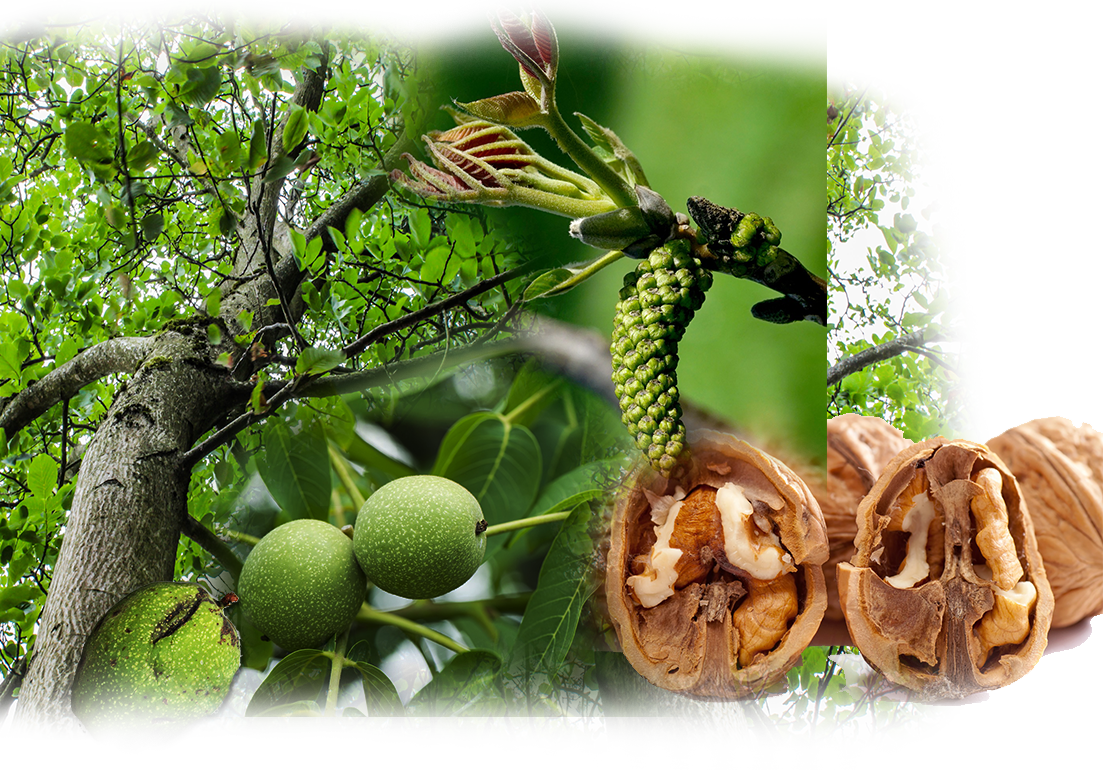
Walnut
 9
9 8
8 9
9Will it grow where I live?
Walnut is hardy to zone 6, which covers nearly all of Central Europe and the British Isles; only harsh upland sites (Alps, high ridges) call for winter protection.
Or check it for your location right here:
Profile
- Family
- Juglandaceae
- Habit
- Tree
- Height
- 25 m
- Spread
- 25 m
- Growth
- fast
- Lifespan
- 150 years
- First yield
- after 8 years
- Yield per plant
- up to 60 kg a year
- Yield in cultivation
- up to 1.8 t/ha
- Energy yield
- 1300 kcal per m² a year
- Hardiness
- zone 6–9
- Shade tolerance
- full sun
- Soil
- Sand, Silt, Loam, Clay
- Soil moisture
- dry – very moist
- pH
- 5 – 8.5
- Synonyms
- Walnussbaum
- Planned in gardens
- 8×
Flowering & harvest
| J | F | M | A | M | J | J | A | S | O | N | D | |
|---|---|---|---|---|---|---|---|---|---|---|---|---|
| Flowering | ||||||||||||
| Fruit harvest | ||||||||||||
| Leaf harvest |
Varieties (26)
26 varieties of Walnut are listed in the Permaplans variety finder — each with its own page: taste, ripening time, disease resistance, parentage and use.
- Broadview Hardy, self-fertile garden variety with early cropping and good frost tolerance.
- Chandler World's most widely planted commercial walnut: light kernel, late leafing, high lateral-bearing yields.
- Czerniowicki 1
- Esterhazy II Large-fruited heritage variety with strikingly large, decorative nuts.
- Europa
- Fernette Sister variety of Fernor and an ideal pollen donor for Chandler and Fernor.
- Fernor Modern INRA variety combining late leafing with high lateral-bearing productivity.
- Franquette French benchmark variety with very late leafing and a fine, aromatic kernel.
- Geisenheim 139 Reliable German selection with late leafing and a large kernel.
- Geisenheim 26 German selection with late leafing, proven for Central European sites.
- Hartley Classic Californian commercial variety with a well-sealed shell and attractive kernel.
- Kardinal
- Koszycki
- Lange van Lod Robust Dutch cultivar with elongated nuts
- Lara Early-bearing, productive French cultivar
- Marbot Early Perigord variety, traditionally prized for harvesting young fresh nuts.
- Mars
- Mayette Traditional AOC Noix de Grenoble variety with a fine, high-quality kernel.
- Milotai 10 Hungarian standard variety with late leafing and a large, light kernel.
- Parisienne Vigorous AOC Grenoble variety with a large nut and late leafing.
- Red Morawian
- Ronde de Montignac Round Perigord variety, valued as a reliable pollen donor for Franquette.
- Rote Donaunuss Walnut with red-brown seed coat
- Seifersdorfer Frost-hardy German heritage variety with late leafing, proven in home gardens.
- Serr Early, vigorous variety with large nuts for warm growing regions.
- Weinsberg 1 Productive German selection with late leafing for commercial and garden growing.
Uses
Edible: Pickled fruit, raw and germinated seeds – 1.8 tons per hectare, equivalent to around 1,290 calories per square meter. Oil can be obtained from the seeds. The tree sap is useful, and the leaves can be used for tea or as a pepper seasoning.
Medicinal: Walnut leaves and the green husk have long been used in European folk medicine. They contain tannins and juglone and were traditionally applied externally in washes and compresses for weeping rashes and eczema; as an infusion the leaves were regarded as an astringent. The kernel itself is not a medicine, but is nutritionally notable: 40 to 65 percent fat, of which around 70 percent are unsaturated fatty acids with a high proportion of linoleic and linolenic acid, plus almost 15 percent protein, potassium, calcium, phosphorus and iron at a very low sodium content.
Other uses: Dyeing: Catkins and fruit skin turn yellow, while nutshell and leaves become brown. Nut oil and wood polish extracted from the kernel are used to fill imperfections. Fruit skin is dried for wood painting, and leaves serve as insect repellents. The bark, rich in tannin, also acts as a tooth cleaner. The wood is heavy, hard, durable, and quick to dry.
Growing
The walnut needs space and depth: at least 120 centimetres of rootable, fertile, calcareous to moderately acid loam at pH 6.0 to 8.0, fresh to alternately moist but never waterlogged. It does best where summers are dry and hot and winters only moderately severe. The wood is sensitive to cold and late frosts destroy the flowers, so late-leafing cultivars such as Mars or Geisenheim 26 are the safe choice on frost-prone sites. A mature tree claims eight to ten metres square. Although the walnut is self-fertile, male and female flowers often open at different times, so a second cultivar secures the crop. No pruning is needed beyond the planting cut; any work belongs in late summer, because the tree bleeds heavily in spring. Wet summers bring leaf blotch and bacterial blight, and the walnut husk fly has been spreading since 2009.
Propagation
Seed-grown walnuts first fruit after twelve to fifteen years and do not come true — what nut a seedling will eventually bear cannot be predicted. Sowing is therefore worthwhile only for raising rootstocks, or when deliberately selecting new types as was once done in traditional orchards. The nuts are heeled in during autumn and overwinter cold and moist before germinating in spring; they must be protected from mice, squirrels and crows. Cultivars are propagated by scion grafting or patch budding, usually under glass with controlled warmth, since the walnut unites poorly in the open. Rootstocks are one- to two-year-old Juglans regia seedlings. Tissue culture of adult cultivars is now possible as well.
Value for wildlife
Provides pollen and nectar for various insects, especially during spring flowering. The leaves, rich in tannins, are less attractive as food for many insects. The fruits serve as food for birds and small mammals. Its dense crown offers shelter and nesting sites for birds. The fallen leaves and chemical compounds in the soil affect surrounding vegetation and indirectly influence local wildlife.
Notable
Special features: One crop was able to completely supply itself with the walnut tree. Half-ripe nuts and early summer leaves contain 1% vitamin C! The leaves are very rich in tannins and are allelopathic, meaning they compost slowly and are avoided by insects. The leaves only shade the trees in early summer. Scandinavian walnuts only bloom from June onwards, meaning there is no risk of late frost. They prefer warmth and wind protection. They have a very good ratio of omega 3:6 fatty acids, ~2.1% in German forests; 1500 kWh/m²; 4.1 kWh/kg.
Origin & habitat
South-eastern Europe to Western Asia. The natural range of the common walnut is taken to be the Balkans and Western Asia; the occurrences from the Caucasus to western China, by contrast, may go back to human activity. It is the only walnut species native to Europe. Remarkable are the walnut wild-fruit forests of Kyrgyzstan around Arslanbob, regarded as the largest continuous stands of the species and discussed as an ice-age relict. The species reached Central Europe through Roman cultivation and later through monastery gardens; today it is widespread here and escapes regularly, because crows and squirrels carry off the nuts and bury them and so take over its spread.
The walnut is a tree of positions with warm summers and mild winters on deep, moist, nutrient- and base-rich soil. In its native range it grows in open mixed deciduous woodland of the mountain forelands and in stream valleys, where water and fine soil collect; in Kyrgyzstan it even forms closed walnut forests there. It avoids waterlogging, heavy clay and acid raw soils as much as frost pockets, since its new growth is vulnerable to late frost. Light-demanding, it develops a broad, deeply shading crown when free-standing and cannot hold its own in closed forest. In Central Europe its real habitat is therefore the cultural landscape: farmsteads, traditional orchards, field margins and woodland edges in warm valley and basin positions.
⚠️ Hazards
The leaves and green husk contain juglone, a compound that can cause skin irritation in some people and inhibits the growth of other plants. Walnut leaves are toxic to horses and may cause hoof inflammation. Walnuts are common allergens capable of triggering severe allergic reactions. Pruning in spring causes heavy sap flow, which keeps wounds open and may increase risk of infection.
Frequently asked questions
Walnut: how big does it get?
Walnut (Juglans regia) grows as a Tree and reaches roughly 25 m in height when mature, with a spread of about 25 m. Growth is fast.
Walnut: what site does it need?
Walnut tolerates full sun. Suitable soils are Sand, Silt, Loam, Clay. Soil moisture should be in the range dry – very moist. The pH may lie between 5 and 8.5.
Walnut: is it hardy?
Walnut is listed as hardy in zone 6–9 and survives normal winters outdoors there.
Walnut: will it grow in Central Europe?
Walnut is hardy to zone 6, which covers nearly all of Central Europe and the British Isles; only harsh upland sites (Alps, high ridges) call for winter protection.
Walnut: when does it flower?
In a temperate northern-hemisphere climate it flowers in May.
Walnut: when is it harvested?
In a temperate northern-hemisphere climate the fruit ripens in October.
Walnut: when does it start cropping, and how much?
Walnut first crops after 8 years. A mature plant gives up to 60 kg a year, in cultivation up to 1.8 t per hectare. Figures assume a good site; variety, soil and climate shift them considerably.
Walnut: is it poisonous?
No toxicity is recorded for Walnut. With wild plants, never rely on a database alone — only on a confident identification.
Walnut: what is it used for?
Rated on a scale up to 10: Edible 9/10, Medicinal 8/10, Other uses 9/10.
Which Walnut varieties are there?
The Permaplans variety finder lists 26 varieties of Walnut, including Broadview, Chandler, Czerniowicki 1, Esterhazy II, Europa, Fernette, Fernor, Franquette, Geisenheim 139, Geisenheim 26, Hartley, Kardinal and 14 more. Each variety has its own page with taste, ripening time, disease resistance and parentage.
Plan this plant into your own garden
Permaplans plans your garden to scale on the map — with a site check, harvest calendar and over 1,000 plants. Free for iPhone, Android, Mac, Windows & Linux.
Will this plant grow where you live? → Check your site
Community experience
No first-hand reports for this plant yet.
Growing it? Write in the app what works for you – your post will show up here.
💬 Get the app and join in