
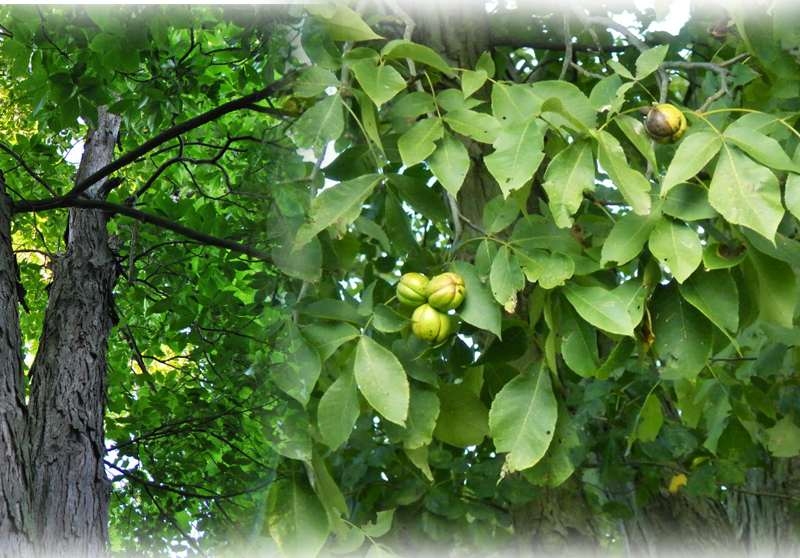
Shagbark hickory
 8
8 3
3 5
5Will it grow where I live?
Shagbark hickory is hardy to zone 5 – that covers all of Central Europe and the British Isles, and every USDA zone from 5 upwards.
Or check it for your location right here:
Profile
- Family
- Juglandaceae
- Habit
- Tree
- Height
- 30 m
- Spread
- 15 m
- Growth
- very slow
- Lifespan
- 350 years
- First yield
- after 40 years
- Productive years
- 100–350 years
- Yield per plant
- up to 30 kg a year
- Hardiness
- zone 5–8
- Shade tolerance
- full sun
- Soil
- Sand, Silt, Loam
- Soil moisture
- dry – very moist
- pH
- 5.5 – 7.5
- Synonyms
- Schuppenrinden-Hickory
Flowering & harvest
| J | F | M | A | M | J | J | A | S | O | N | D | |
|---|---|---|---|---|---|---|---|---|---|---|---|---|
| Flowering | ||||||||||||
| Fruit harvest |
Varieties (8)
8 varieties of Shagbark hickory are listed in the Permaplans variety finder — each with its own page: taste, ripening time, disease resistance, parentage and use.
- Abundance Heavy-cropping shagbark selection, as the name suggests.
- Grainger Large, easy-cracking nut from Tennessee that falls free of the husk.
- Neilson Cold-tolerant Canadian selection with medium-to-large, well-cracking nuts.
- Porter Cracking-contest winner with an exceptional kernel yield up to 47%.
- Silvis 303 Ohio selection recommended for high-quality, abundant nut crops.
- Weschcke Very thin-shelled, cold-hardy selection extending shagbark into zone 4.
- Wilcox Medium-sized, tasty nut that cracks cleanly into halves.
- Yoder #1 Early, heavy-cropping Ohio selection often ranked among the best shagbarks.
Uses
Edible: The nuts of shagbark hickory are reckoned the best-flavoured of the genus — sweet, oily and without the tannic note of walnut. They sit in a thick, four-parted green husk that splits along preformed seams at maturity, and beneath that in a hard, angular shell harder to crack than a walnut's, though thinner-shelled selections exist. The kernels are eaten raw or roasted, worked into pastries, cakes and bread, or ground to thicken soups. Crushed kernels yield a nut milk that once served as a fat substitute. Harvest is in late autumn; stored cool and dry the nuts keep up to two years. A speciality of its own is hickory syrup: it is made not from tree sap but by boiling the toasted shaggy bark, the extract then being reduced with sugar — a smoky, caramel flavour with nothing in common with maple syrup.
Medicinal: Stemless thistle is seldom utilized in contemporary herbal medicine. Formerly renowned for its aphrodisiac properties, the plant is now sporadically employed in addressing various health issues such as digestive spasms, gallbladder and liver disorders, dropsy, urinary retention, and skin conditions like acne and eczema. The root, known for its antibiotic and therapeutic qualities, can be decocted for external application on wounds or as an antiseptic gargle. However, caution is advised due to potential laxative and emetic effects when consumed in large amounts. Harvested in autumn, the root is dried for future use, possessing properties such as antispasmodic, carminative, diaphoretic, diuretic, antipyretic, and purgative effects.
Other uses: The wood of shagbark hickory is exceptional: fine-fibred, tough, elastic, heavy and very hard, with a combination of hardness and flexibility no European hardwood matches. It is the classic material for anything that must take impact and bending — tool handles, wheel spokes, baseball and golf clubs, drumsticks, bows, skis and sports equipment — and for furniture and basketry. As firewood it burns well and gives out much heat, and it yields a high-grade charcoal; the aromatic chips are the standard for smoking meat in the United States. The inner bark gives a yellow dye. Characteristic, and the source of its name, is the bark, which in age peels away from the trunk in long plates standing free at both ends — behind these shags bats, above all the Indiana bat, find their preferred summer roosts.
Growing
Site: Shagbark hickory is a forest tree of over 40 metres and a metre in trunk diameter, living up to 350 years — it belongs on open ground, not in a domestic garden. The deep taproot makes it storm-firm and leaves room for shallow-rooted neighbours, but it also makes the tree all but impossible to move: buy small or sow directly where it is to stand. Like all walnut relatives it produces juglone, though less than black walnut; sensitive neighbours such as tomato, pepper and apple are better kept out of the crown zone. Fruit fall needs thought: the thick, hard-shelled nuts drop from a great height in October and are a genuine hazard to gutters, car paint and ankles above paths, terraces and parking. For a crop a second tree is needed, since pollen shed and stigma receptivity are offset in time. Care: The tree demands patience above all. For its first three years it puts everything into the taproot and appears to stand still above ground; brisk height growth sets in only from about the tenth year, first nuts fall after ten to fifteen years, sooner on grafted plants. Young plants need a vole basket, protection against deer and hares, and even watering through their first summers, after which the taproot sees the tree through on its own. Prune little, and if so in summer — like all walnut relatives it bleeds heavily from late-winter cuts. Diseases play no part in Central Europe so far. Harvest in October as soon as the green husks split along their four seams; squirrels and jays take a generous share, so collect daily if you want any. The real limitation is climate: the short Central European growing season is often not enough to fill the kernel.
Propagation
Seeds need a period of cold stratification and are ideally planted right after reaching maturity in a cool environment. It is recommended to keep stored seeds slightly moist before planting, ensuring they are not overly wet. For optimal growth, only 1 or 2 seeds should be planted in each deep pot, with weaker seedlings being removed. If transplantation is necessary, it should be done promptly using deep pots to accommodate the taproot. The plants should be relocated to their permanent spot as soon as possible, preferably in the initial summer, and shielded from the cold during the first winter. Alternatively, seeds can be directly sown in the designated area, provided protection from rodents and cold temperatures is ensured (using a modified plastic bottle with wire mesh to deter mice is effective).
Value for wildlife
The wildlife value of shagbark hickory lies almost entirely in its homeland. There it is a caterpillar food plant for numerous large moths, among them the luna moth and the regal moth, its nuts are a staple for grey squirrels, chipmunks, blue jays and wild turkeys, and behind the bark that gives it its name, peeling away in long standing plates, bats — above all the endangered Indiana bat — find their preferred summer roosts. Little of that survives the crossing to Central Europe: as a non-native without its accompanying fauna it has no caterpillar following here, and it is wind-pollinated, so yields no nectar. What remains is solid enough: the oil-rich nuts are taken by squirrels and jays, the deep taproot allows underplanting, and old trees with their coarsely shagged bark develop crevices and hiding places matched among native species only by veteran oaks. Its contribution grows with the age of the tree, not with the area it covers.
Notable
Special features: Requires deep soil; the tree can be tapped for maple syrup, like maple. The wood is very heavy and has a high calorific value. It can be repeatedly topped for its hard wood, which is also famous for smoking meat.
Origin & habitat
Eastern North America. The range covers nearly the whole eastern United States, with the Mississippi basin forming its western limit: from southeastern Minnesota and southern Quebec through southeastern Nebraska south to east Texas and Louisiana. A separate occurrence lies in the highlands of northeastern Mexico. There the shagbark hickory is a character tree of the oak-hickory forests, the community that replaces beech-maple woodland on the middling sites of the east. It has been cultivated in Europe since 1911 and is found here almost exclusively in botanical gardens, arboreta and collections; it has not naturalised.
In its homeland shagbark hickory grows on two very different site types: on deep, moist, fertile soils of river valleys and bottomlands, where it reaches its largest dimensions, and on dry slopes and ridges, where it stays smaller but remains competitive. Its associates there are white oak, sugar maple, other hickories and American elm. The basis of this range is an exceptionally long taproot that the tree builds in its first three years before putting on any appreciable height — it reaches water at depth and makes the tree storm-firm, but costs all growth at the start. Hardiness is no concern: the species survives down to minus 46 degrees.
Frequently asked questions
Shagbark hickory: how big does it get?
Shagbark hickory (Carya ovata) grows as a Tree and reaches roughly 30 m in height when mature, with a spread of about 15 m. Growth is very slow.
Shagbark hickory: what site does it need?
Shagbark hickory tolerates full sun. Suitable soils are Sand, Silt, Loam. Soil moisture should be in the range dry – very moist. The pH may lie between 5.5 and 7.5.
Shagbark hickory: is it hardy?
Shagbark hickory is listed as hardy in zone 5–8 and survives normal winters outdoors there.
Shagbark hickory: will it grow in Central Europe?
Shagbark hickory is hardy to zone 5 – that covers all of Central Europe and the British Isles, and every USDA zone from 5 upwards.
Shagbark hickory: when does it flower?
In a temperate northern-hemisphere climate it flowers in May.
Shagbark hickory: when is it harvested?
In a temperate northern-hemisphere climate the fruit ripens in October.
Shagbark hickory: when does it start cropping, and how much?
Shagbark hickory first crops after 40 years. A mature plant gives up to 30 kg a year. The productive period lasts about 100–350 years. Figures assume a good site; variety, soil and climate shift them considerably.
Shagbark hickory: is it poisonous?
No toxicity is recorded for Shagbark hickory. With wild plants, never rely on a database alone — only on a confident identification.
Shagbark hickory: what is it used for?
Rated on a scale up to 10: Edible 8/10, Medicinal 3/10, Other uses 5/10.
Which Shagbark hickory varieties are there?
The Permaplans variety finder lists 8 varieties of Shagbark hickory, including Abundance, Grainger, Neilson, Porter, Silvis 303, Weschcke, Wilcox, Yoder #1. Each variety has its own page with taste, ripening time, disease resistance and parentage.
Plan this plant into your own garden
Permaplans plans your garden to scale on the map — with a site check, harvest calendar and over 1,000 plants. Free for iPhone, Android, Mac, Windows & Linux.
Will this plant grow where you live? → Check your site
Community experience
No first-hand reports for this plant yet.
Growing it? Write in the app what works for you – your post will show up here.
💬 Get the app and join in