
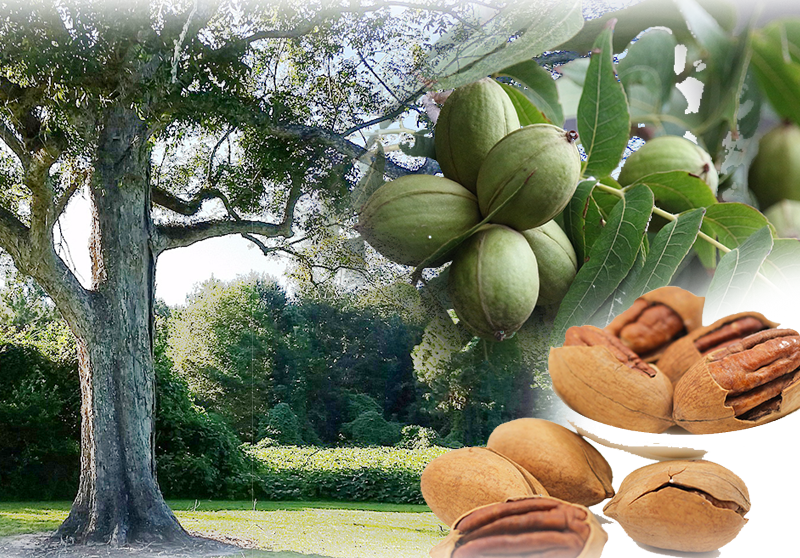
Pecan nut
 9
9 2
2 3
3Will it grow where I live?
Pecan nut is hardy to zone 5 – that covers all of Central Europe and the British Isles, and every USDA zone from 5 upwards. It also needs warm summers – in Central Europe that means wine-growing regions, cities or a sheltered south-facing wall.
Or check it for your location right here:
Profile
- Family
- Juglandaceae
- Habit
- Tree
- Height
- 40 m
- Spread
- 20 m
- Growth
- medium
- Lifespan
- 1000 years
- First yield
- after 6 years
- Full yield
- after 30 years
- Productive years
- 80 years
- Yield per plant
- up to 55 kg a year
- Yield in cultivation
- up to 1 t/ha
- Energy yield
- 700 kcal per m² a year
- Hardiness
- zone 5–10
- Shade tolerance
- full sun
- Soil
- Sand, Silt, Loam
- Soil moisture
- semi-dry – very wet
- pH
- 4.5 – 7
- Synonyms
- Carya pecan, Juglans illinoensis
Flowering & harvest
| J | F | M | A | M | J | J | A | S | O | N | D | |
|---|---|---|---|---|---|---|---|---|---|---|---|---|
| Flowering | ||||||||||||
| Fruit harvest |
Varieties (3)
3 varieties of Pecan nut are listed in the Permaplans variety finder — each with its own page: taste, ripening time, disease resistance, parentage and use.
Uses
Edible: Pecans are drupes with a fleshy, inedible green husk that splits along four preformed seams as the fruit ripens. The nut itself is elongated and cylindrical, pointed at one end, thinner-shelled than a walnut and closer in appearance to a large hazelnut; 60 to 175 nuts make a kilogram. The kernel is about 71 per cent fat, with 15 per cent carbohydrate and 9.2 per cent protein, plus generous potassium, phosphorus, magnesium and calcium. It tastes milder and sweeter than walnut and carries far less tannin; it is eaten raw, chopped over fruit salads and desserts, or baked into pies and ice cream. The high fat content means kernels turn rancid quickly — store them cool and airtight.
Medicinal: Bark (astringent) - decoction (for tuberculosis); Leaves (astringent) - powdered (rubbed on the skin to treat skin fungus).
Other uses: Pecan timber is coarse-grained, hard and heavy but also brittle and not especially strong — it is rated below the other hickories, which are prized for tool handles and bow staves. It is used for wagon parts, farm implements and above all as firewood; in the southern United States hickory chips are the standard for smoking meat. More interesting for garden planning is the tree's role as structure: the broad, open crown lets enough light through for underplanting, and the deep taproot leaves room for shallow-rooted neighbours. The pinnate foliage breaks down slowly and yields plenty of autumn mulch. The empty shells make a durable, slowly rotting path covering.
Growing
Site: In Central Europe the pecan is a borderline case — it needs 180 to 220 frost-free days to fill the kernel, and that is exactly where most locations fail. It is worth planting only in the warmest wine-growing districts; elsewhere it stays a handsome but nutless tree. It wants light to medium, deep soils on the acid side, between pH 5.5 and 6.0, and forms a pronounced taproot that makes transplanting difficult — plant small rather than buying large. At 20 to 30 metres tall and 10 to 15 wide it is a tree for open ground, not for a domestic garden. Like all walnut relatives it produces juglone, though far less than black walnut; even so, sensitive neighbours such as tomato, pepper and apple are better kept out from under the canopy. The trees are functionally dioecious because pollen shed and stigma receptivity are offset in time: a second tree of a different cultivar is a precondition for any crop. Care: The wood is damaged below -20 °C, so young trees need trunk protection for the first few years and a position free of late frost. Rain and high humidity encourage fungal attack; an open, well-ventilated site is the most effective guard against pecan scab. Prune little and early — build a clean crown in the first years, then take only dead wood and competing leaders. Young trees need even watering; older ones ride out dry spells on their taproot. First nuts fall after four to six years, and a full crop is not to be expected before the tenth season. Harvest in October by shaking, once the green husks split. In its homeland the pecan weevil hollows out the kernels; in Europe it is so far not an issue.
Propagation
Seedling pecans vary widely in yield and nut quality and take considerably longer to bear — seedlings therefore serve mainly as rootstocks. The nuts must be stratified moist and cool and must not dry out between harvest and sowing. True-to-type trees come from scion grafting with one-year-old shoots in February or March, usually by whip or cleft graft; in the United States trees are also field-grafted onto established seedlings and patch-budded as with walnut. For Central European conditions, grafts of the North American 'Northern pecan' cultivars are the most promising choice because they cope with a shorter growing season; the classic southern cultivars do not ripen here.
Value for wildlife
The pecan is wind-pollinated. Its long male catkins shed pollen in abundance but offer no nectar and no forage that bees will work; the USDA report on crop pollination accordingly rates it as unattractive in every bee column. As a North American newcomer it also has no caterpillar or beetle species tied to it in Central Europe. Its value to wildlife lies entirely in size and fruit: a mature tree of 20 to 30 metres with a broad, open crown is a perch, a nest tree and in time a cavity tree, and the nuts are taken and carried off by squirrels, jays and other corvids. In its homeland a substantial part of the forest fauna lives off hickory mast years; in a European garden what remains of that is mostly competition for the harvest.
Notable
Notable: needs 180-220 frost-free days, productive in Central Europe only in the warmest sites; wood damaged below -20°C; requires pH 5.5-6.0; functionally dioecious (dichogamous) -> second cultivar essential; first crop after 4-6 yrs, full yield from 10 yrs; 60-175 nuts/kg; kernel ~71% fat+15% carbohydrate+9.2% protein; orchard spacing 12x12 to 17x17m; choose 'Northern pecan' cultivars for Central Europe; kernels turn rancid fast;
Origin & habitat
Southern North America: the Mississippi valley from Illinois and Iowa south to Louisiana, and west through Texas into northern Mexico. Its centre is the valley of the Mississippi and its tributaries, to which the epithet illinoinensis refers. The pecan is grown chiefly in the southern United States, which produce some 95,000 tonnes a year; total US production runs between 120,000 and 140,000 tonnes. Other producing countries are Mexico, Australia, Israel, southern China, India and, on a small scale, Sicily and Spain. In Central Europe it goes no further than enthusiast planting in the warmest districts.
Moist, fertile floodplain soils along rivers and creeks, often in periodically flooded bottomland hardwood forest together with American elm, ash, cottonwood and overcup oak. The pecan is a classic floodplain tree: it tolerates temporary inundation but demands deep, well-aerated soil on the slightly acid side, and forms a strong taproot that carries it through summer drought. The climate of its range is hot with summer rainfall and a long growing season of 180 to 220 days — the short Central European season is the real reason the tree grows here but rarely fills its kernels.
Frequently asked questions
Pecan nut: how big does it get?
Pecan nut (Carya illinoinensis) grows as a Tree and reaches roughly 40 m in height when mature, with a spread of about 20 m. Growth is medium.
Pecan nut: what site does it need?
Pecan nut tolerates full sun. Suitable soils are Sand, Silt, Loam. Soil moisture should be in the range semi-dry – very wet. The pH may lie between 4.5 and 7.
Pecan nut: is it hardy?
Pecan nut is listed as hardy in zone 5–10 and survives normal winters outdoors there.
Pecan nut: will it grow in Central Europe?
Pecan nut is hardy to zone 5 – that covers all of Central Europe and the British Isles, and every USDA zone from 5 upwards. It also needs warm summers – in Central Europe that means wine-growing regions, cities or a sheltered south-facing wall.
Pecan nut: when does it flower?
In a temperate northern-hemisphere climate it flowers in May.
Pecan nut: when is it harvested?
In a temperate northern-hemisphere climate the fruit ripens in October.
Pecan nut: when does it start cropping, and how much?
Pecan nut first crops after 6 years. Full yield comes after 30 years. A mature plant gives up to 55 kg a year, in cultivation up to 1 t per hectare. The productive period lasts about 80 years, within a lifespan of around 1000 years. Figures assume a good site; variety, soil and climate shift them considerably.
Pecan nut: is it poisonous?
No toxicity is recorded for Pecan nut. With wild plants, never rely on a database alone — only on a confident identification.
Pecan nut: what is it used for?
Rated on a scale up to 10: Edible 9/10, Medicinal 2/10, Other uses 3/10.
Which Pecan nut varieties are there?
The Permaplans variety finder lists 3 varieties of Pecan nut, including Burton, Carlson 3, Warren 346. Each variety has its own page with taste, ripening time, disease resistance and parentage.
Plan this plant into your own garden
Permaplans plans your garden to scale on the map — with a site check, harvest calendar and over 1,000 plants. Free for iPhone, Android, Mac, Windows & Linux.
Will this plant grow where you live? → Check your site
Community experience
No first-hand reports for this plant yet.
Growing it? Write in the app what works for you – your post will show up here.
💬 Get the app and join in