
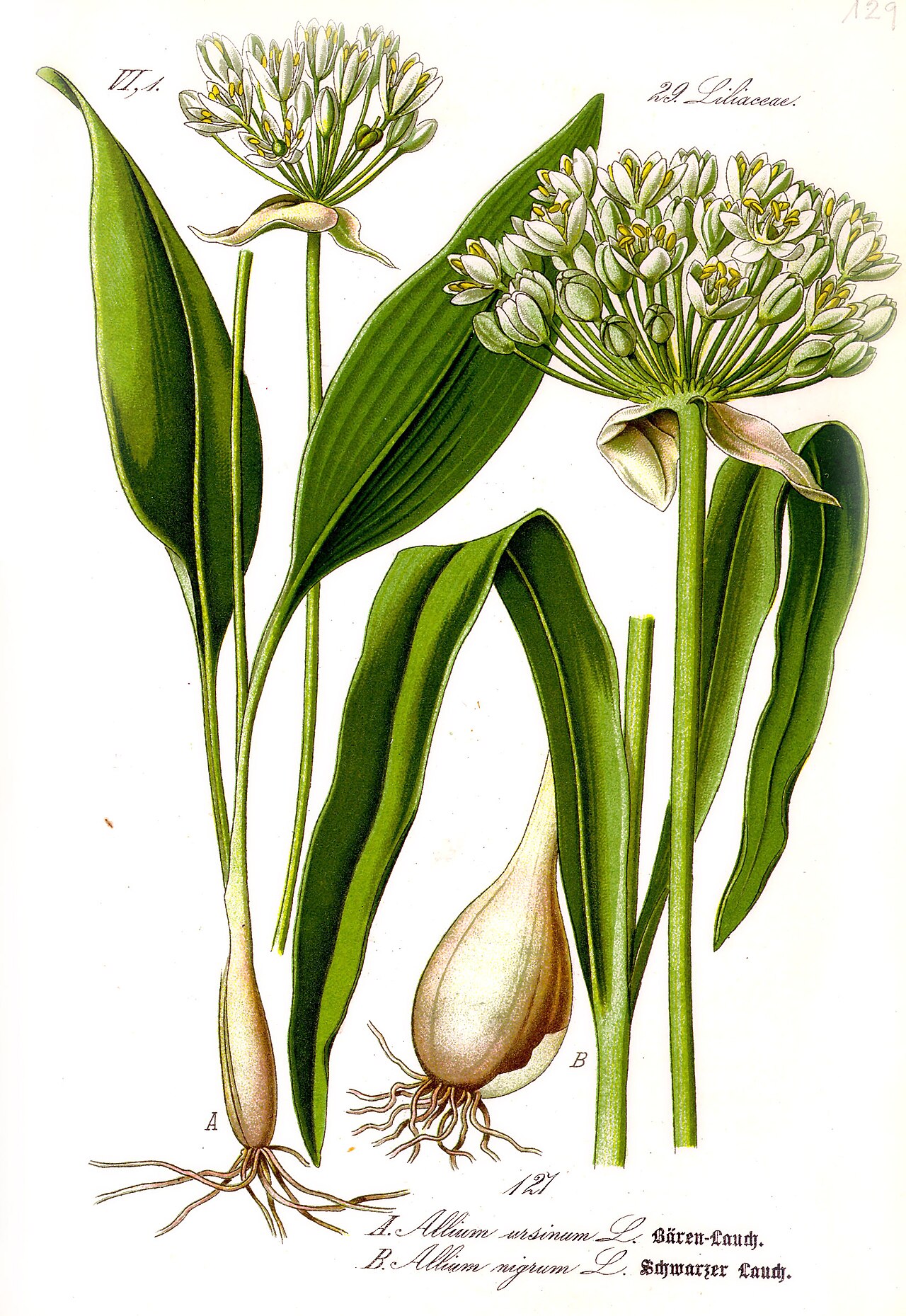
Wild garlic
 7
7 5
5 3
3Will it grow where I live?
Wild garlic is hardy to zone 4 – that covers all of Central Europe and the British Isles, and every USDA zone from 4 upwards.
Or check it for your location right here:
Profile
- Family
- Alliaceae
- Habit
- perennial
- Height
- 0.3 m
- Spread
- 1.5 m
- Growth
- medium
- Lifespan
- 10 years
- First yield
- after 1 year
- Hardiness
- zone 4–7
- Shade tolerance
- full shade
- Soil
- Sand, Silt, Loam, Clay
- Soil moisture
- semi-dry – very wet
- pH
- 5.6 – 7.6
Uses
Edible: Ramsons is the first strong-flavoured green of the year. Mainly the leaves with their stalks are harvested, from March until flowering begins; after that they turn tough and the flavour drops off. It tastes sharp and intensely of garlic but leaves less odour behind. The decisive point for the kitchen: heat destroys the aroma, so it is used raw or added only at the end — in pesto, herb butter, dips, salads, quark or stirred into finished soup. It keeps through lacto-fermentation, freezing, or preserved in oil and butter; drying is not worth it. The flower buds can be pickled like capers, the open flowers are an edible garnish, and the bulbs can be used in autumn like garlic. All parts are edible. When gathering, only one rule counts: every single leaf must smell of garlic.
Medicinal: Ramsons is one of the few wild herbs where folk use has been partly confirmed: extracts have demonstrated antibacterial, digestive and platelet-aggregation-inhibiting effects, and comparative studies credit it with a stronger blood-pressure-lowering action than garlic. The active compounds are alliin and methiin, converted to allicin when the plant is cut, together with flavonoids and saponins; fresh leaves contain around 0.005 per cent allicin, dried leaves about 0.07 per cent. To be recorded as tradition: in the Middle Ages ramsons went by the name "herba salutaris", Pliny and Dioscorides described it, and Charlemagne listed it in the Capitulare de villis. In folk medicine it counted as a remedy for digestive complaints and as a spring cleanser; the widespread tale that bears restored their strength on it after hibernation belongs in the same context. There is no evidence of efficacy for any of that.
Growing
Site: Ramsons wants shade or half shade under deciduous trees, humus-rich, permanently moist soil and to be left alone — under fruit trees, on the north side of a hedge or in a forest garden it is in the right place. What matters is what it does to the area: it spreads by seed and daughter bulbs and after a few years forms closed carpets that crowd out weaker perennials; if that is unwanted, give it a bounded area or a container sunk flush with the soil. Never plant it directly beside lily of the valley, autumn crocus or lords-and-ladies — harvesting will otherwise inevitably mix the leaves. Keep it away from small-animal runs and pasture. As underplanting it gives dense spring cover, keeps deep-rooting weeds out and dies back in time before summer crops need the space. Care: No fertiliser; the leaf litter of the trees above is its food supply and stays where it falls. The area is neither mown nor hoed until the foliage yellows and dies back of its own accord in June — clearing earlier weakens the bulbs for the following year. Individual leaves are picked from March until shortly before flowering, never the whole clump and never more than about a third of a stand. To slow the spread, cut off the seed heads before they ripen in June. Diseases hardly matter; rust fungi appear occasionally, and the larvae of two hoverfly species mine the leaves and stalks without endangering the stand. Water during dry spells before die-back, or the stand yellows prematurely.
Propagation
Ramsons can be propagated from seed and from daughter bulbs; seed is the natural route, bulbs the faster one. The seed needs cold and needs the winter: sow fresh after ripening in June or July, directly in place and covered only shallowly; germination follows between late winter and spring. Dried seed bought in the trade germinates markedly worse and often needs two winters. In the first year only a narrow, grass-like leaf appears; harvesting is possible from the third or fourth year at the earliest. Bulbs are moved either after die-back in summer or in early spring while still green, about five centimetres deep, and establish reliably. Young plants settle in noticeably better close to existing stands than on open ground.
Value for wildlife
The wildlife value of ramsons lies less in species numbers than in mass and timing. The fragrant white flower heads appear in April and May, when little else is flowering in woodland, and are visited by flies, hoverflies, beetles and bees; nectar value is rated moderate, pollen value low. Only two wild bee species are recorded, one of them a specialist — it is not a bee pasture in the proper sense. Five hoverfly species are closely bound to it, however, including two whose larvae mine exclusively in the leaves and leaf stalks and cannot exist without ramsons stands. It is not a caterpillar food plant. Its real contribution is the carpet itself: in spring it covers large areas, keeps the ground moist and shaded, offers cover to small animals, and on dying back in summer turns quickly into easily decomposed litter that feeds humus build-up.
Notable
Special: Named for the bear — said to have restored its strength on the plant after hibernation; recorded in the Middle Ages as 'herba salutaris' and listed in Charlemagne's Capitulare de villis; Eberbach near Frankfurt has held a four-week ramsons festival since 2000, which made the plant popular again in Germany; folk names Ramsen, wood garlic, witch onion; you smell it before you see it.
Origin & habitat
Europe and western Asia. The range covers almost all of Europe apart from the Mediterranean and the Hungarian plain and extends east through Asia Minor to the Caucasus; north into southern and lowland Scandinavia, west to Ireland and Great Britain, south to Italy. In Germany the emphasis lies in the south, becoming distinctly rarer northwards. In elevation it runs from the lowlands to about 1900 metres, in Bavaria to around 1400. Within the range the distribution is strongly fragmented: ramsons does not occupy the landscape but individual suitable patches of woodland — and there often in extensive pure stands.
Ramsons is a plant of shady, moist, humus-rich deciduous woodland, above all floodplain forest and beech woods over limestone. Typical stands are mixed maple, ash, oak and elm woods on deep, loose, nutrient-rich soils with a good water supply. It indicates nutrient- and nitrogen-rich ground and at the same time an oceanic climate. As a spring geophyte it uses the window of light before the trees come into leaf and dies back completely by midsummer; during that period it often forms closed carpets that leave little room for weaker herbaceous species. It avoids dry, shallow or strongly acid soils.
⚠️ Hazards
Risk of confusion with highly toxic species, toxic to dogs and cats, toxic to grazing livestock Ramsons leaves resemble those of lily of the valley, autumn crocus and lords-and-ladies, all of which are highly toxic; confusion while gathering has repeatedly caused severe poisoning and, in the case of autumn crocus, fatal poisoning. The reliable test is smell, and on every single leaf as it is crushed — not on the hand that has just handled ramsons. Ramsons leaves are matt on the underside and rise singly from the ground on their own stalk, while lily of the valley leaves are glossy beneath and stand in twos or threes on a shared shoot. Allium species are toxic to dogs, cats, horses and ruminants and damage their red blood cells.
Frequently asked questions
Wild garlic: how big does it get?
Wild garlic (Allium ursinum) grows as a perennial and reaches roughly 0.3 m in height when mature, with a spread of about 1.5 m. Growth is medium.
Wild garlic: what site does it need?
Wild garlic tolerates full shade. Suitable soils are Sand, Silt, Loam, Clay. Soil moisture should be in the range semi-dry – very wet. The pH may lie between 5.6 and 7.6.
Wild garlic: is it hardy?
Wild garlic is listed as hardy in zone 4–7 and survives normal winters outdoors there.
Wild garlic: will it grow in Central Europe?
Wild garlic is hardy to zone 4 – that covers all of Central Europe and the British Isles, and every USDA zone from 4 upwards.
Wild garlic: is it poisonous?
No toxicity is recorded for Wild garlic. With wild plants, never rely on a database alone — only on a confident identification.
Wild garlic: what is it used for?
Rated on a scale up to 10: Edible 7/10, Medicinal 5/10, Other uses 3/10.
Plan this plant into your own garden
Permaplans plans your garden to scale on the map — with a site check, harvest calendar and over 1,000 plants. Free for iPhone, Android, Mac, Windows & Linux.
Will this plant grow where you live? → Check your site
Community experience
No first-hand reports for this plant yet.
Growing it? Write in the app what works for you – your post will show up here.
💬 Get the app and join in