
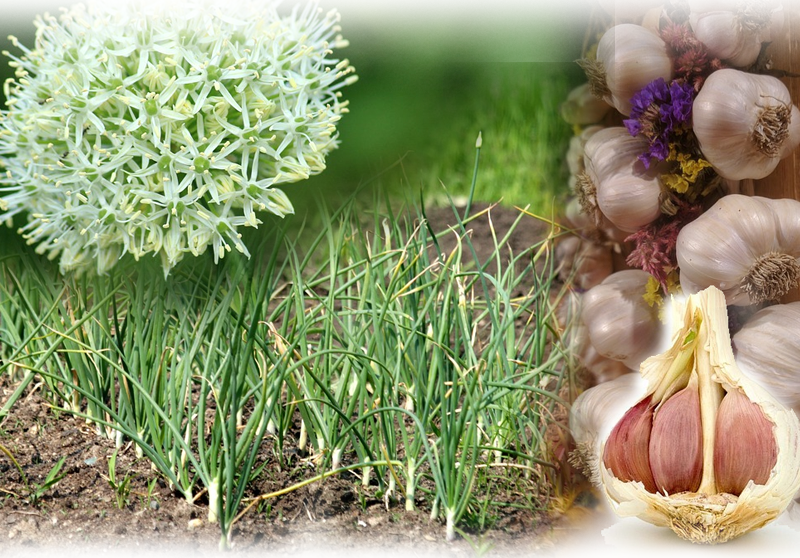
Garlic
 8
8 9
9 6
6Will it grow where I live?
Garlic is hardy to zone 7: lowlands, river valleys and cities across Central Europe are fine, harsher continental or upland sites need winter protection or a container.
Or check it for your location right here:
Profile
- Family
- Alliaceae
- Habit
- perennial
- Height
- 0.6 m
- Spread
- 0.2 m
- Growth
- medium
- Lifespan
- 5 years
- First yield
- after 2 years
- Full yield
- after 2 years
- Productive years
- 2 years
- Yield per plant
- up to 0 kg a year
- Yield in cultivation
- up to 10 t/ha
- Energy yield
- 1500 kcal per m² a year
- Hardiness
- zone 7–10
- Shade tolerance
- light shade
- Soil
- Sand, Silt, Loam
- Soil moisture
- very dry – very moist
- pH
- 6 – 7.5
- Planned in gardens
- 3×
Flowering & harvest
| J | F | M | A | M | J | J | A | S | O | N | D | |
|---|---|---|---|---|---|---|---|---|---|---|---|---|
| Flowering | ||||||||||||
| Fruit harvest |
Uses
Edible: Garlic is a common ingredient in Southern European cuisine, utilized in both raw and cooked forms for its nutritional value and health benefits. Its intense flavor means it is typically used sparingly to enhance the taste of salads and cooked dishes. Garlic bulbs can grow up to 6 cm in diameter, while the leaves can also be consumed raw or cooked, commonly diced and added to salads. In some regions, garlic is cultivated for its milder-flavored leaves in mild winters. Additionally, the flower stalks serve as a seasoning and are occasionally available in Chinese stores, with germinated seeds being a potential salad ingredient.
Medicinal: Onion sap has historically served as a natural way to reduce appetite. Onions, known for their health benefits, are rich in sulfur compounds that contribute to their distinct taste. Eating onions regularly may aid in reducing cholesterol levels, improving digestion, and promoting heart health.
Other uses: Onion juice serves as a natural insect repellent due to its potent smell, deterring insects from biting. It can also soothe insect bites when applied topically. For an insecticide solution, mix minced garlic and grated soap in boiling water, then cool the mixture. This decoction effectively controls insects upon application. Additionally, onion juice doubles as an adhesive for glasswork, facilitating precise cutting. It can also mend glass and porcelain surfaces. Extracts from the plant act as a fungicide, combating rot and fungal diseases in tomatoes and potatoes. Placing garlic cloves near stored fruit helps delay spoilage.
Growing
Site: Full sun on free-draining, humus-rich and rather loose soil - waterlogging will inevitably rot the bulb, and heavy clay needs sand and compost worked in first. The key planning point is rotation: no allium may have stood on the same ground for at least four years. Otherwise white rot and stem eelworm persist in the soil, the sclerotia of white rot for up to twenty years; once infected, a bed is permanently lost to the onion family. Garlic inhibits the growth of legumes and therefore does not belong next to beans and peas; as a neighbour to strawberries, carrots, tomatoes and roses it is considered beneficial, because its smell keeps aphids and mites away. The bed is occupied from October to July - that has to go into the bed plan. Care: Plant from October to early November, individual cloves tip upwards about 3 to 5 cm deep, 10 to 15 cm apart in rows 25 to 30 cm apart. Winter cold is not a danger but a condition: without several weeks below 10 degrees the plant later forms a single round bulb instead of a divided head. Spring planting is possible but gives smaller heads. Feed sparingly with compost in spring, never with fresh manure. On hardneck garlic, snap out the emerging flower scape as soon as it curls - this noticeably increases bulb size, and the scapes are a delicacy. Stop watering once the foliage begins to yellow. Harvest when a third to half the leaves have turned, usually in July; then dry for two to three weeks in airy shade and store cool, dry and dark.
Propagation
Garlic is propagated almost exclusively by vegetative means, since under cultivation it hardly ever sets viable seed. The usual route is by cloves: select the largest, healthy heads from your own crop, split them only immediately before planting and use only the strong outer cloves, as the small inner ones produce weak plants. One clove becomes a whole head in a season. Anyone building up their own planting stock should buy in certified eelworm-free material every few years, because stem eelworm and viruses accumulate through the cloves and gradually depress yield. The second route is the bulbils that hardneck garlic forms on its scape: sown shallowly in autumn like seed, they produce an undivided round bulb in the first year that grows into a full head in the second or third. This takes longer but yields healthy, disease-free planting stock.
Value for wildlife
As a cultivated plant garlic is of limited but not negligible value to native wildlife. The reason lies in cultivation itself: it is lifted in July, long before it could flower, and on hardneck types the scape is removed as well. If individual plants are left standing, spherical umbels of whitish to pink flowers open from June to September, yielding nectar generously and pollen moderately. In Central Europe only one wild bee species has so far been recorded regularly at them, the mining bee Andrena bimaculata; honeybees and bumblebees visit as well. Garlic plays no role as a caterpillar host and none for birds. Its real contribution in the garden is indirect: planted among strawberries, carrots and roses, its smell deters aphids, mites and voles and thereby replaces interventions that would harm beneficial insects.
Notable
Special features: inhibits legume growth; decomposes in moist soil; extended storage diminishes antibacterial properties and enhances odor; optimal preservation in olive oil or cool, dry conditions; unsuitable for individuals with low blood pressure, fever, pancreatic, or kidney ailments; more cold-resistant: A. tuberosum.
Origin & habitat
Central Asia. Garlic has been cultivated for millennia and has no confirmed wild populations; its area of origin is taken to be the mountains of Central Asia between the Tian Shan and the Pamir, that is present-day Kyrgyzstan, Tajikistan, Uzbekistan and adjoining north-western China. Allium longicuspis is regarded as its closest wild relative and probable ancestor. From there garlic reached the Near East, Egypt and the Mediterranean early on - it is documented from ancient Egypt, from Mesopotamia and from Greek and Roman cooking. Today it is grown worldwide, with China by far the largest producer; within Europe the main growing areas are Spain, Italy and France. In Central Europe it occasionally escapes but does not persist.
As a purely cultivated plant garlic has no natural habitat of its own; its requirements follow from the sites of its wild relatives. Those grow in the continental mountains of Central Asia on stony, sun-baked slopes and scree at altitudes between roughly 1000 and 2500 m. The climate there is markedly continental: cold snowy winters, a short moist spring and a hot dry summer. That annual rhythm is still built into the crop - garlic needs a cold period in winter to form cloves at all, makes its growth through the cool moist spring, and wants dry conditions while ripening in high summer. Wet, heavy and shaded positions contradict its origin and lead to bulb rot.
⚠️ Hazards
Skin irritation on contact, interaction with anticoagulants, toxic to dogs and cats, storage in oil Raw garlic can cause contact dermatitis on the skin; if crushed garlic is left in place as a poultice for a longer period, burns are possible too. The sulphur compounds are responsible, diallyl disulfide above all. Taken internally on an empty stomach it irritates the mucous membranes. Medically significant is its inhibition of platelet aggregation: in medicinal doses garlic strengthens the effect of anticoagulants such as warfarin, aspirin and clopidogrel; a gap of about seven to ten days before surgery is recommended. With HIV protease inhibitors it can lower drug levels. Garlic and all alliums are toxic to dogs and cats, causing anaemia through destruction of red blood cells. Fresh garlic in oil belongs in the fridge and should be used within a few weeks: oil excludes air, and in this oxygen-free, low-acid environment Clostridium botulinum can multiply at room temperature. Commercial garlic-in-oil products must therefore be acidified. Dried or roasted garlic is not affected.
Frequently asked questions
Garlic: how big does it get?
Garlic (Allium sativum) grows as a perennial and reaches roughly 0.6 m in height when mature, with a spread of about 0.2 m. Growth is medium.
Garlic: what site does it need?
Garlic tolerates light shade. Suitable soils are Sand, Silt, Loam. Soil moisture should be in the range very dry – very moist. The pH may lie between 6 and 7.5.
Garlic: is it hardy?
Garlic is listed as hardy in zone 7–10 and survives normal winters outdoors there.
Garlic: will it grow in Central Europe?
Garlic is hardy to zone 7: lowlands, river valleys and cities across Central Europe are fine, harsher continental or upland sites need winter protection or a container.
Garlic: when does it flower?
In a temperate northern-hemisphere climate it flowers in June.
Garlic: when is it harvested?
In a temperate northern-hemisphere climate the fruit ripens in July.
Garlic: when does it start cropping, and how much?
Garlic first crops after 2 years. Full yield comes after 2 years. A mature plant gives up to 0 kg a year, in cultivation up to 10 t per hectare. The productive period lasts about 2 years, within a lifespan of around 5 years. Figures assume a good site; variety, soil and climate shift them considerably.
Garlic: is it poisonous?
No toxicity is recorded for Garlic. With wild plants, never rely on a database alone — only on a confident identification.
Garlic: what is it used for?
Rated on a scale up to 10: Edible 8/10, Medicinal 9/10, Other uses 6/10.
Plan this plant into your own garden
Permaplans plans your garden to scale on the map — with a site check, harvest calendar and over 1,000 plants. Free for iPhone, Android, Mac, Windows & Linux.
Will this plant grow where you live? → Check your site
Community experience
What Permaplans users wrote about this plant – taken from the app as is. 1 post.
I love garlic! My uncle chews a clove eden he feels he's getting sick. I can't do that (to spicy- hurts my stomach) so I slice it on to buttered bread and make sure to chew well so I get the spiciness on my tongue. You stink,😅 but your body will fight the germs better. We also spray it on plants to fight diseases. I haven't planted any yet, but plan on doing so.
Growing it? Write in the app what works for you – your post will show up here.
💬 Get the app and join in