
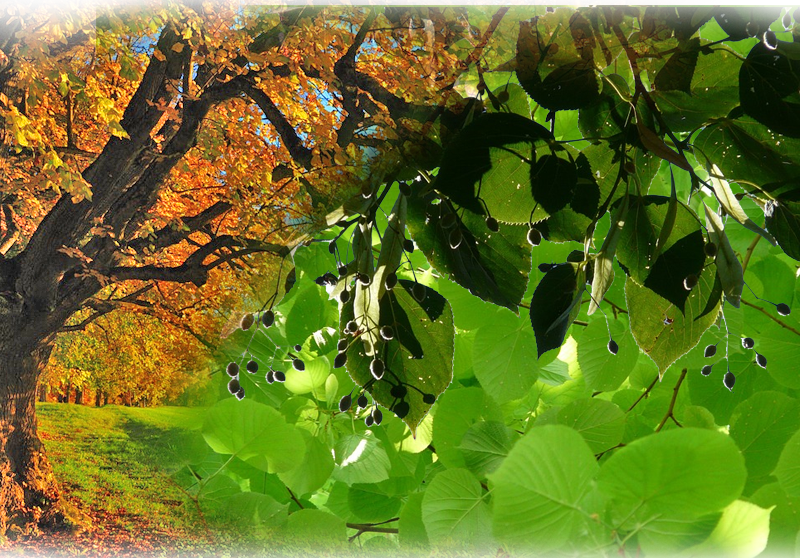
Small-leaved linden
 6
6 8
8 8
8Will it grow where I live?
Small-leaved linden is hardy to zone 3 – that covers all of Central Europe and the British Isles, and every USDA zone from 3 upwards.
Or check it for your location right here:
Profile
- Family
- Malvaceae
- Habit
- Tree
- Height
- 31.5 m
- Spread
- 12 m
- Growth
- medium
- Lifespan
- 900 years
- First yield
- after 15 years
- Hardiness
- zone 3–8
- Shade tolerance
- partial shade
- Soil
- Sand, Silt, Loam
- Soil moisture
- semi-dry – very moist
- pH
- 5.5 – 7.5
- Synonyms
- Linde
Flowering & harvest
| J | F | M | A | M | J | J | A | S | O | N | D | |
|---|---|---|---|---|---|---|---|---|---|---|---|---|
| Flowering | ||||||||||||
| Fruit harvest | ||||||||||||
| Leaf harvest |
Uses
Edible: Young leaves can be consumed raw and are great for adding to salads or sandwiches due to their mild flavor and slightly slimy texture. These leaves are typically found on the young shoots at the tree's base from spring to early fall. Ground flowers and unripe fruit can be used to create a chocolate substitute, although commercialization attempts have been unsuccessful due to the paste's quick decomposition. The flowers are commonly brewed into a sweet and fragrant herbal tea. It's important to note the toxicity warnings mentioned earlier. In spring, the juice can be harvested, offering a sweet beverage or can be concentrated into a syrup.
Medicinal: Linden blossoms are commonly used as a natural remedy for various health issues, especially to promote sweating. A tea brewed from fresh or dried blossoms offers several medicinal benefits such as antispasmodic, diaphoretic, expectorant, antihypertensive, laxative, and sedative properties. Internally, linden blossom tea is utilized to address indigestion, high blood pressure, arteriosclerosis, hysteria, nervous vomiting, and palpitations. These blossoms are harvested commercially and can be found in health food stores. It is recommended to harvest linden blossoms when they are freshly opened to avoid the development of narcotic properties over time. Additionally, charcoal derived from the wood is used to alleviate stomach or digestive issues, while a powdered form is applied to burns or sores.
Other uses: A fiber obtained from the inner bark is utilized in creating various items such as mats, shoes, baskets, rope, and fabric. This fiber is sourced from tree trunks with a diameter ranging from 15 to 30 cm. Additionally, it can be employed in paper production. The process involves harvesting the stems during spring or summer, steaming them to facilitate fiber removal after stripping off the leaves. By boiling the fibers with lye for 2 hours and subsequently grinding them in a ball mill, the outer bark is separated from the inner bark through peeling or scraping. The resulting paper has a beige hue. The wood, known for its softness, white color, and ease of carving, is particularly suitable for crafting household items and small, short-lived objects. Charcoal serves as a drawing medium.
Growing
The small-leaved lime has moderate to high demands on soil nutrients and base status. It thrives on medium-deep to deep, loose, mineral-rich soils, on better loess loams with lime in the subsoil, on glacial marl and on alternately moist clay marls; it tolerates moderate stagnant and ground moisture better than beech. Base-poor sands and silicate soils, lime-poor waterlogged soils and pronouncedly wet sites are unsuitable. Sun and partial shade both suit it, and mature trees cast dense shade themselves. It takes hard pruning exceptionally well, resprouting readily from the stool and from dormant buds, which is why it can be trained as a pollard, a hedge or in coppice-with-standards — the basis of the historic village and dancing limes. Young trees transplant without difficulty.
Propagation
A large share of the nutlets is empty — before sowing it is worth cutting a few open to see whether they contain a seed at all. The small-leaved lime has deep, double dormancy: freshly harvested seed whose coat has not yet hardened, sown at once in late summer, germinates the following spring, while fully ripened seed needs several weeks of warmth followed by three to five months of cold-moist stratification, and even then often lies over a second year. Vegetative propagation is far more reliable: layered shoots root within one to two years, rooted stool shoots can be detached, and cultivars are grafted onto seedling stock in winter.
Value for wildlife
The small-leaved lime flowers late, in June and July, filling the midsummer forage gap. A single mature tree can carry up to 60,000 flowers, and its nectar is unusually concentrated at 30 to 74 percent sugar. Most of it is secreted in the evening and at night, so moths visit as regularly as honeybees and bumblebees; pollen, by contrast, is offered only sparingly. The greater value lies in the foliage: around 75 species of moths and butterflies feed on lime leaves, eleven of them exclusively, alongside some five wood-dependent beetle species. Old limes develop cavities and then host broods of tits, nuthatches and great spotted woodpeckers, while hawfinches and chaffinches take the nutlets. The old claim that lime nectar poisons bumblebees is now considered refuted.
Notable
Special features: prefers a similarly moist, shady location as beech trees; center of sociability, tree of the people; famous for bast: [Peel off bark in May → into 10cm wide strips → in cold water → until pure bast peels off → sun-dry] Yields up to 2.5 kg honey + 45 kg bast per tree; <1% of German forests; 1500 kWh/rm; 4.2 kWh/kg
Origin & habitat
Europe and western Siberia. The small-leaved lime occupies most of western, central and eastern Europe; it is absent from Spain and southern Scandinavia and extends east across the Crimea and the Caucasus into western Siberia. Its ecological optimum lies in the Baltic states. In Germany the main occurrences are on the north German upland margin, in the Lower Rhine area west of Cologne, and in the Vogelsberg and Westerwald. It is a tree of lowlands and lower hill country, but reaches 600 metres in the Bavarian Forest and 1,300 metres in the Alps. It gains importance where winters are hard and summers warm and dry, because beech competes less strongly there.
In Central Europe the small-leaved lime occurs scattered in oak-hornbeam woodland with warm summers, on moist, usually deep soils, most frequently in the Galio-Carpinetum; it also appears in ravine and scree-slope woodland, in acid oak woodland and in floodplain forest. It is markedly shade-tolerant and by Landolt's indicator values counts as a species of rather nutrient-poor, moist sites of slightly acid to neutral reaction in a subcontinental climate. In the northern Alps it climbs to 1360 m, in the central Alps to 1500 m, and in the Caucasus it grows between 1400 and 2000 m. It rarely forms pure stands but shapes whole woodlands as a component species; historically it was managed as coppice and coppice-with-standards.
⚠️ Hazards
If the flowers for making tea are too old, they can lead to symptoms of narcotic intoxication. It's crucial to use fresh flowers to maintain the tea's quality.
Frequently asked questions
Small-leaved linden: how big does it get?
Small-leaved linden (Tilia cordata) grows as a Tree and reaches roughly 31.5 m in height when mature, with a spread of about 12 m. Growth is medium.
Small-leaved linden: what site does it need?
Small-leaved linden tolerates partial shade. Suitable soils are Sand, Silt, Loam. Soil moisture should be in the range semi-dry – very moist. The pH may lie between 5.5 and 7.5.
Small-leaved linden: is it hardy?
Small-leaved linden is listed as hardy in zone 3–8 and survives normal winters outdoors there.
Small-leaved linden: will it grow in Central Europe?
Small-leaved linden is hardy to zone 3 – that covers all of Central Europe and the British Isles, and every USDA zone from 3 upwards.
Small-leaved linden: when does it flower?
In a temperate northern-hemisphere climate it flowers in July.
Small-leaved linden: when is it harvested?
In a temperate northern-hemisphere climate the fruit ripens in November.
Small-leaved linden: is it poisonous?
Individual parts of Small-leaved linden are noted as mildly problematic — the plant does not count as poisonous. With wild plants, never rely on a database alone, only on a confident identification.
Small-leaved linden: what is it used for?
Rated on a scale up to 10: Edible 6/10, Medicinal 8/10, Other uses 8/10.
Plan this plant into your own garden
Permaplans plans your garden to scale on the map — with a site check, harvest calendar and over 1,000 plants. Free for iPhone, Android, Mac, Windows & Linux.
Will this plant grow where you live? → Check your site
Community experience
No first-hand reports for this plant yet.
Growing it? Write in the app what works for you – your post will show up here.
💬 Get the app and join in