
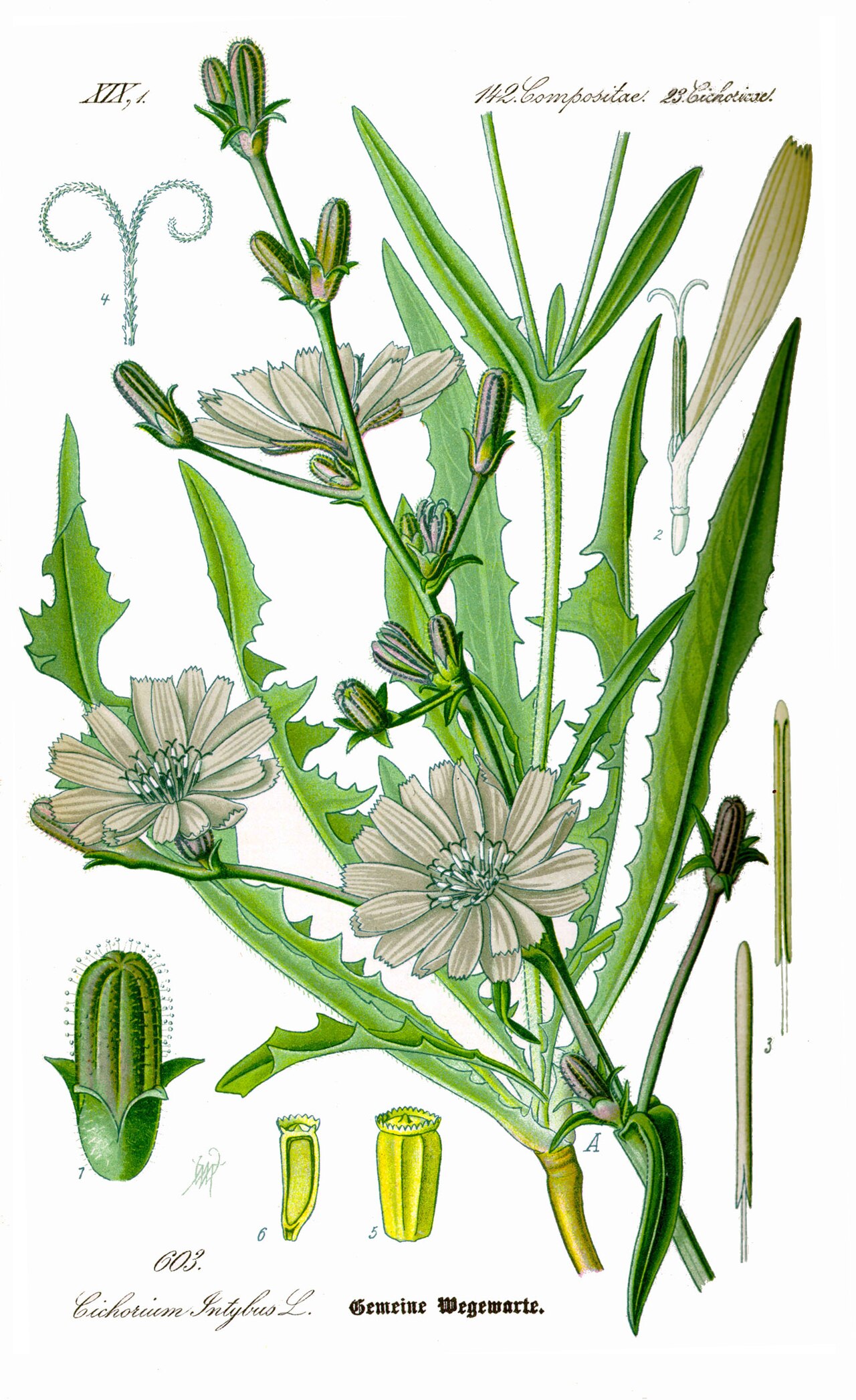
Chicory
 7
7 6
6 5
5Will it grow where I live?
Chicory is hardy to zone 3 – that covers all of Central Europe and the British Isles, and every USDA zone from 3 upwards.
Or check it for your location right here:
Profile
- Family
- Asteraceae
- Habit
- perennial
- Height
- 0.9 m
- Spread
- 0.4 m
- Growth
- slow
- Lifespan
- 5 years
- First yield
- after 2 years
- Hardiness
- zone 3–9
- Shade tolerance
- light shade
- Soil
- Sand, Silt, Loam
- Soil moisture
- semi-dry – very moist
- pH
- 6 – 8
Flowering & harvest
| J | F | M | A | M | J | J | A | S | O | N | D | |
|---|---|---|---|---|---|---|---|---|---|---|---|---|
| Flowering | ||||||||||||
| Leaf harvest |
Uses
Edible: Ancestor of Belgian endive, radicchio and sugarloaf — all cultivated forms of the same species. The wild leaves are usable as salad or greens from March to May, after which they turn steadily more bitter; the bitter compound lactucopicrin is not a defect but the actual point, since it stimulates bile flow and digestion. Brief blanching softens it. The fleshy taproot is lifted in its second year in October and November, washed, sliced, dried, roasted dark and ground: this gives chicory coffee, the definitive coffee substitute of the war and post-war years and now finding a following again as a caffeine-free brew. The same root supplies inulin, a prebiotic fibre extracted industrially as a sugar and fat replacer. For chicons, lift the roots in autumn, trim them to 15 to 20 cm and force them in the dark at 15 °C in moist sand — the pale shoots stand after three to four weeks. The bright blue ray florets are edible and make an attractive salad garnish, though they only last until midday.
Other uses: Agriculture has long put chicory to deliberate use. Forage varieties such as "Puna" or "Chico" are standard in permanent pasture mixtures in New Zealand and increasingly in Europe: they supply mineral-rich, highly digestible forage, stay green through dry spells when the grasses have stopped, and their sesquiterpene lactones demonstrably act against gastrointestinal parasites in sheep and cattle — deworming through the feed. Industrially the root is the world's most important source of inulin, used as a prebiotic fibre and as a sugar and fat replacer in food. The dried, roasted root is sold as chicory coffee.
Growing
Undemanding, as long as the site is sunny and the soil is not wet. It prefers calcareous, rather lean, deep loam and loess soils at pH 6 to 8, but copes on almost any free-draining ground — only waterlogging and shade are out. Do not feed it; on rich soil it goes soft, flops and falls short of its root performance. What matters is deep, undisturbed soil: the taproot only pays off if it can go down, which is why the site should not be tilled again after sowing. The plant is biennial to short-lived perennial — it flowers from the second year and then usually persists three to five years, but self-seeds reliably. Cutting back after the first flush brings a second flowering. To harvest the root, dig in the autumn of the second year. Hardy to -25 °C, drought-tolerant, practically pest-free. In agroforestry it goes into the understorey mix at 2 to 4 kg of seed per hectare.
Propagation
By seed only. Direct-sow in place in April or August, 1 to 2 cm deep; germination at 15 to 20 °C within one to two weeks. Raising and transplanting is possible but pointless — the taproot resents it and the plant stays stunted. So always sow direct, or at worst into deep tree tubes. One square metre of flowering chicory yields seed for years; harvest it ripe, and it stays viable for about five years. In the garden it self-seeds anyway, and the seedlings appear wherever the soil is open.
Value for wildlife
From July to October the blue heads supply nectar and pollen at a time when little else is flowering in the farmed landscape. Honeybees, bumblebees, hoverflies and several specialist solitary bee species use them intensively; because the flowers only stay open until midday, the morning rush is correspondingly heavy. In winter goldfinches, linnets and greenfinches take the seed. The leaf rosette and the woody stems offer overwintering shelter for insects, which is why the stand should be left standing through winter.
Notable
Drives a fleshy taproot that reaches 1.5 m in undisturbed soil and, in individual cases, over 2 m. That makes it one of the few herbaceous species able to punch through compaction pans, draw nutrients and water from the subsoil, and leave behind vertical macropores when it dies — pathways for water to infiltrate and for following roots to descend. Soil loosening without machinery. In agroforestry and alley-cropping systems it is therefore a standard partner in the herb layer between tree rows: its deep root barely competes with the shallow roots of the trees, it stays green in dry spells when grasses have long since yellowed, and it delivers forage rich in minerals and tannins along the way. Then there is the long flowering period from July to October. The bright blue heads open early in the morning and close again around midday — a dependable source for bees and hoverflies in a season when the agricultural landscape has little left to offer.
Origin & habitat
Native to Europe, temperate Asia and North Africa; spread worldwide with arable farming and naturalised in North and South America, Australia and New Zealand, where it is sometimes classed as an arable weed. Common and widespread throughout Central Europe from the lowlands to about 1,500 m.
Dry to moderately moist, calcareous, rather lean loam and loess soils in full sun: roadsides, embankments, gravel areas, semi-dry grassland, fallows, railway banks and field margins. Tolerates compaction and salt, which makes it one of the characteristic roadside plants; avoids shade and waterlogging.
⚠️ Hazards
Skin irritation on contact, cross-allergy, caution with gallbladder disease The milky sap can cause contact dermatitis in sensitive people, and cross-allergies occur within the daisy family. With gallstones or an obstruction of the bile ducts, the strongly cholagogue root should not be used in medicinal doses. Large amounts of inulin — litres of chicory coffee, say — can cause flatulence.
Frequently asked questions
Chicory: how big does it get?
Chicory (Cichorium intybus) grows as a perennial and reaches roughly 0.9 m in height when mature, with a spread of about 0.4 m. Growth is slow.
Chicory: what site does it need?
Chicory tolerates light shade. Suitable soils are Sand, Silt, Loam. Soil moisture should be in the range semi-dry – very moist. The pH may lie between 6 and 8.
Chicory: is it hardy?
Chicory is listed as hardy in zone 3–9 and survives normal winters outdoors there.
Chicory: will it grow in Central Europe?
Chicory is hardy to zone 3 – that covers all of Central Europe and the British Isles, and every USDA zone from 3 upwards.
Chicory: when does it flower?
In a temperate northern-hemisphere climate it flowers from July to October.
Chicory: is it poisonous?
No toxicity is recorded for Chicory. With wild plants, never rely on a database alone — only on a confident identification.
Chicory: what is it used for?
Rated on a scale up to 10: Edible 7/10, Medicinal 6/10, Other uses 5/10.
Plan this plant into your own garden
Permaplans plans your garden to scale on the map — with a site check, harvest calendar and over 1,000 plants. Free for iPhone, Android, Mac, Windows & Linux.
Will this plant grow where you live? → Check your site
Community experience
No first-hand reports for this plant yet.
Growing it? Write in the app what works for you – your post will show up here.
💬 Get the app and join in