Permaplans
English
DeutschEspañolFrançais
Young forest garden with fruit trees, berry bushes, herbs and ground cover in layers

Permaplans › Forest garden › How to plant

How to Plant a Forest Garden: Step by Step

A forest garden grows over many years, but you plan it in a single winter. The decisions you make before you break ground (where the big trees go, how far apart they stand, what ends up in their shade) still matter twenty years later. This guide takes you in eight steps from an empty plot to planting day, in the order that has proven itself in practice.

8 stepsfrom site survey to planting
Oct to Marplanting time for bare-root trees and shrubs
from 200 m²for a small forest garden with several trees
20 yearshow far ahead your plan should think

Forest garden planning: the order is what counts

The most common mistake with a forest garden is not the wrong plant, it is the wrong order. If you start with your favourite variety and build everything else around it, ten years later you find the walnut shading the vegetable patch and no hedge where the wind comes from. That is why this guide works from the outside in and from big to small: first the place, then the framework, then the main trees, and only after that everything that grows beneath them.

If you first want to understand what a forest garden is and which layers it has, start with Forest garden: structure, layers and benefits.

1

Map and observe your land

Before anything is planted, put everything that is already there on a plan: the property boundary, buildings, existing trees and hedges, paths, driveways, utility lines, the compost heap, the spot where rainwater comes off the roof. The neighbourhood counts too. A tall house on the south side of the neighbouring plot casts a winter shadow that reaches far into your garden.

Then: observe. Ideally for a whole year, at least for one season. Where does water stand after heavy rain? Where does the frost linger longest in May? Which direction does the wind come from? Which corners get sun in June, and which in December? Note these observations on your plan, so they are right in front of you when you place the trees.

In Permaplans: Your garden sits GPS-accurate on the aerial image, and for all 16 German federal states, Austria and Switzerland also on official aerial imagery. One tap on the parcel in the cadastral map takes over the property boundary, and surrounding buildings come in from OpenStreetMap with one tap. Contour lines and a wetness index show hollows and rises.
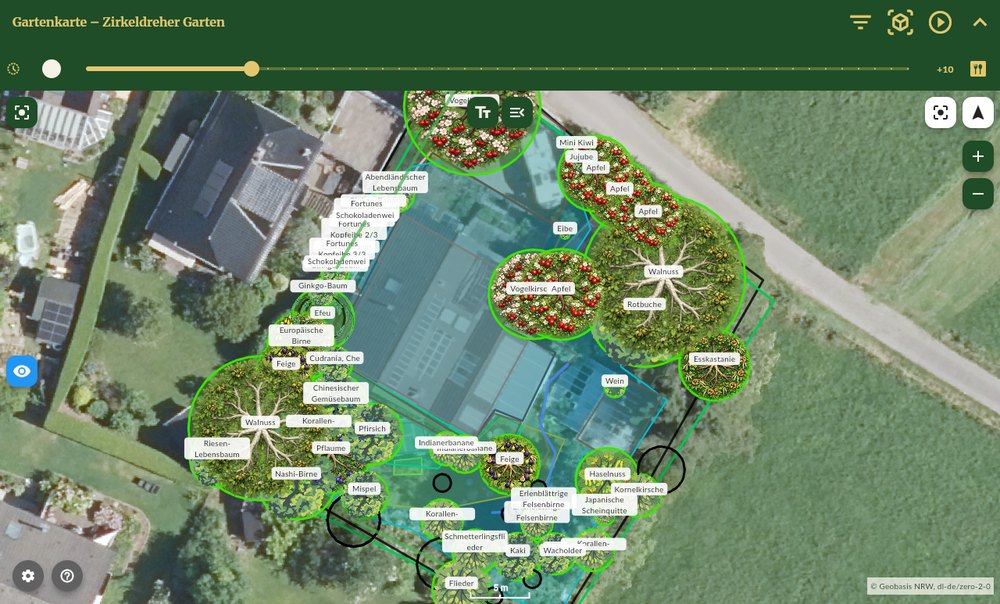
Planning map of the sample garden on the aerial image
The real planning map, live: an actual sample garden with boundary, paths, beds and 55 plants. Switch layers on and off, zoom in, tap on plants.
2

Check the site: climate, soil and water

Your site decides which species are even an option. What matters is not the region you live in, it is the exact spot in your garden. There are five things you should know:

  • Hardiness: the lowest winter temperatures, expressed as a hardiness zone. A sweet chestnut tolerates much less frost than a hazel.
  • Late frost: hollows and dips collect cold air. Early flowering species such as apricot or almond do not belong there.
  • Soil: sand, loam or clay, the pH, whether there is lime in it. A spade and a pH test strip are enough to start with.
  • Water: summer rainfall, groundwater, waterlogging. Walnuts like deep soils, alders like wet feet, sea buckthorn likes dry sand.
  • Light: from step 1. Where is full sun, where is partial shade, where is shade?

The result is not a wish list. It is a filter: it rules out the species that would only survive with you if you gave them a lot of care. Whatever passes this filter is "suited to the site", and those are exactly the plants that will give you the least work later on.

In Permaplans: For your coordinates, the app knows your climate zone, frost, heat sum and soil values. Every species in the plant encyclopedia shows a traffic light for whether it suits this site, and the Plant Finder filters more than 1,100 species by frost hardiness, soil, light, water and forest garden layer.
3

Design concept: set goals and zones

A forest garden for walnuts and firewood looks different from one for berries and salad. Before you choose species, write down what you want to harvest, how much time you have each week and what else the space should be used for (children, chickens, a place to sit).

The zones follow from that. Whatever you need almost every day (herbs, salad, berries for snacking) belongs close to the front door. Whatever you harvest once a year (nuts, wood, storage fruit) can stand far away. It sounds obvious, yet it decides whether a forest garden gets used or goes wild.

In Permaplans: Walking time from the entrance is calculated along your path network and divides the garden into zones following permaculture logic. The self-sufficiency balance works out in kilocalories and nutrients how much of your diet the garden will cover in five or twenty years.
4

Plan hedges, windbreaks and boundary distances

Before the trees you want to harvest from come the ones that protect everything else. A hedge on the weather side slows the wind, keeps moisture in the garden and gives a home to the birds and insects that will later keep pests in check. On a slope, plantings against erosion running across the gradient come first. A privacy screen towards the street, a quiet retreat, the paths: all of this sets the framework that everything else has to fit into.

Boundary distances are part of this. In Germany, Austria and Switzerland, neighbour law sets legal minimum distances that trees, shrubs and hedges must keep from the property boundary, usually graded by height (in Germany each federal state has its own rules). If you plant a walnut one metre from the boundary, you may have to fell it fifteen years later, or end up in a dispute with your neighbour. Outside these countries, check your local rules before planting near the boundary. You can find the distances for each region under Boundary distances for trees and hedges.

In Permaplans: In planting mode, a band along the property boundary shows how much distance the selected plant needs under the neighbour law of your region, in Germany, Austria and Switzerland.
5

Collect favourites, place the big trees first

Before anything goes on the plan, collect every plant you would like to have: big and small, walnut and currant, the fruit from your childhood and the one you tried on holiday. This list is your raw material. It is almost always longer than the space allows, and that is fine.

Then the big trees come first. I call them the stars. They get their place before anything else is planned, because everything underneath depends on their shade. Only then do you look at which of your other favourites still fit, and where. Sometimes this shows that one big tree is too many: if you give up the second walnut, there is light and space left for five berry bushes and a quince tree. Trade-offs like these are the real core of planning.

  • Plan with the mature size, not the planting size. A young walnut tree is two metres tall and as thin as a broomstick. In twenty years its crown can be ten metres across or more.
  • Tall to the north, low to the south. In the northern hemisphere the tallest layer would otherwise cast its shade over everything below that needs light.
  • Dense or at final spacing? Both work. Planting densely means thinning later, with a canopy that closes quickly and less grass. Planting at final spacing straight away means managing a lot of open ground at first. What matters is making a conscious choice and planning the thinning from the start.

The row of trees does not have to be a straight line. Most life happens where two habitats meet, so bays are worth more than straight edges, ideally as a sun trap: a horseshoe open to the south, tall at the back, low at the front, sheltered from the wind and warm. Why the edge gives you so much, and where its limit lies, is explained under The edge effect.

If you are short on space, use an apple or pear on a semi-vigorous rootstock as the tallest layer instead of the walnut. That can become a forest garden too, just a lower one. What counts is not height but density: a few fruit trees over a mown meadow are a traditional orchard, fruit trees over vegetable beds are a home garden. A forest garden only emerges when every layer under the trees is filled and hardly any open meadow is left. It then feels denser and wilder, more like a jungle than an orchard.

In Permaplans: You collect the plants you want as favourites in the app. With the future slider, every plant grows to its later size based on its data, so you see crowns that will get in each other's way in ten years before anything is planted. The shade simulation shows the shadows of buildings and trees over the course of the year.
Time slider in the sample garden: the plants grow over the years
The time slider, live: drag the sample garden from today up to 20 years ahead and see where the crowns touch and where gaps remain.
6

Plan the lower layers: shrubs, perennials, ground cover

Once the big trees are in place, go back to your list of favourites: which of them still fit, and where? Which areas stay sunny, which turn into partial shade, which will be under a canopy in ten years? There is no universal answer to this, because it depends on three things only you know:

  • Design concept: Should this spot mainly grow fruit for the winter, berries for snacking, herbs for the kitchen, feed for chickens, wood for the stove?
  • Feel of the space: Where do you want to walk through, where to sit, where should the view stay open, where can it get dense and wild?
  • Way of harvesting: What do you pick every day in passing, what do you harvest once a year with a ladder and a crate? The first belongs by the path, the second can stand further back.

Then there are helpers that yield little or nothing themselves but benefit everything else: nitrogen fixers such as alders, Elaeagnus (autumn olive, oleaster) or lupins, dynamic accumulators such as comfrey, ground covers that keep the soil covered. Whether you need them, and how many, again depends on your site. On rich garden soil, a nitrogen fixer can even do harm.

That is why you will deliberately not find ready-made planting lists here. A suggestion that works beautifully in one garden is wrong in the next: different soil, different light, different purpose. A proven approach is to build a small group of partners around each big tree, called a guild. How that works, which roles there are, and worked examples are covered under Plant guilds. What the individual layers are is explained in the overview of forest garden layers.

Which species suit which layer?

This is how you find your favourites for the different layers: choose your climate, and the search shows what fits from the plant database, grouped by layer, with edibility, medicinal value and other uses at a glance.

In Permaplans: The plant search filters by forest garden layer, climate, frost hardiness, soil, light, water and more than 30 other traits. Draw an area on the map, and Permaplans suggests species that fit its size and conditions.
7

Simulate growth: your forest garden in 20 years

A plan on paper shows the garden on planting day. That is exactly its problem: on planting day everything is small, sunny and far apart. The mistakes only show up later, when the sweet chestnut grows over the berry bushes after twelve years, two apple trees push their crowns into each other, or the path disappears under a hazel.

That is why a look into the future pays off before you plant. How big will each tree be in five, ten, twenty years? Where do crowns overlap? Where will shade fall that is sun today, and is there something there that needs light? Where are gaps left that you can fill with annuals, perennials or fast-growing nurse plants until the big trees are ready?

The rule of thumb: a forest garden moves. In year three it is a sunny perennial garden with small trees, in year fifteen a light, open woodland. What stands in the sun today will then be in partial shade. Good planning arranges the species so they can follow this change instead of growing against it.

In Permaplans: The future slider lets every plant grow at its own growth rate: one, five, ten or twenty years. The timeline sequence plays the development as an animation, and in the 2.5D view you walk through the garden at eye level as it will look in ten years. Try the time travel →
Future slider set to plus ten years, with the plants grown accordingly on the aerial image
Simulating garden growth: the same plan, ten years later. The crowns have grown according to species and growth rate.
8

Plant your forest garden: planting time, mulch and the first years

Plant between October and March, whenever the ground is not frozen. Bare-root trees and shrubs are only available during this window; they are cheaper than container plants and establish better. Planting in autumn has the advantage that the roots are already settled into the soil by spring.

  • Mulch instead of digging. Cover grass and perennial weeds with cardboard, then add wood chips, leaves or straw on top. It saves work and protects soil life.
  • Protect against voles. Where voles are around, every fruit tree needs a wire basket around its root ball. A single winter is enough to lose a young tree.
  • Water in the first summer. Rarely but deeply: better twenty litres once a week than a little every day.
  • Keep the grass short. In the first three years grass is the biggest competitor for water. A mulched tree circle one metre across makes a big difference.
  • Start small. Better one guild a year that establishes well than the whole plan at once, only for it to dry out in the first dry summer.
In Permaplans: Planned plants become plantings with a date. Notes, tasks and a photo gallery record what has taken, what needs replanting and how the garden changes over the years.

From experience

Common mistakes when planting a forest garden

Most of these mistakes do not show in the first year. They show in the tenth, when they are hard to correct.

Planted too close

Planned by planting size instead of mature size. After ten years the crowns grow into each other, and a tree that is just starting to bear has to go.

Tall trees in the south

The walnut on the southern boundary later shades the whole garden. Tall species belong to the north, low ones in the sun in front of them.

Boundary distance forgotten

Your neighbour can demand that a tree standing too close is cut back or removed, and depending on the region even years later.

Everything at once

A hundred plants in the first autumn, and in the first dry summer there is no time to water them all. Better one island at a time.

Underestimating grass

Young trees in an unmown meadow barely grow. The first years are a race for water, and the grass roots win it.

Only your favourite species

Exotic varieties that are at their limit in your climate. Site-suited species first, experiments as a bonus.

Frequently asked questions

Questions about planting a forest garden

How big does a forest garden need to be?

From about 200 square metres you can plant a small forest garden: several trees of different heights, with shrubs, perennials and ground cover underneath and hardly any open lawn left. From around 1,000 square metres there is room for a walnut or sweet chestnut without shading out everything else. On a smaller plot, a guild around a fruit tree brings forest garden elements into a home garden. That on its own is not yet a forest garden.

When is the best time to plant a forest garden?

Plan in summer and autumn, plant between October and March whenever the ground is not frozen. Bare-root trees and shrubs are only available during this window; they are cheaper than container plants and establish better. Autumn planting has the advantage that the roots are already in contact with the soil by spring.

When can I harvest from my forest garden for the first time?

Herbs, wild strawberries and rhubarb in the first or second year, berry bushes from the second or third. Fruit trees after three to eight years depending on the rootstock, nut trees grown from seed often only after ten years or more, grafted ones much sooner. You can fill the gaps of the early years with annuals and perennials. When each species ripens where you live is shown in the harvest calendar.

How much work is a forest garden?

In the first three to five years, more than a lawn: mulching, watering, holding back the grass, replanting. After that, much less than a vegetable garden, because nothing is dug over and nothing is resown every year. The work shifts from growing to pruning, harvesting and regulating.

Do I need a permit for a forest garden?

Not in a private garden. In Germany, Austria and Switzerland, however, neighbour law sets minimum distances from the neighbour's boundary, and allotment rules usually restrict tall trees. On agricultural land, dense tree planting can count as afforestation and may need a permit, and agroforestry subsidies come with their own rules. Check with your local agriculture or forestry authority first.

Can I convert an existing garden into a forest garden?

Yes, and it is often the easier route. Existing fruit trees become the main trees, with guilds built around them. The lawn is covered bit by bit with cardboard and mulch instead of being dug up. That way the forest garden grows together from individual islands.

Start your garden

Try it for free — right in your browser, no sign-up.

Open in the browserGet the app