
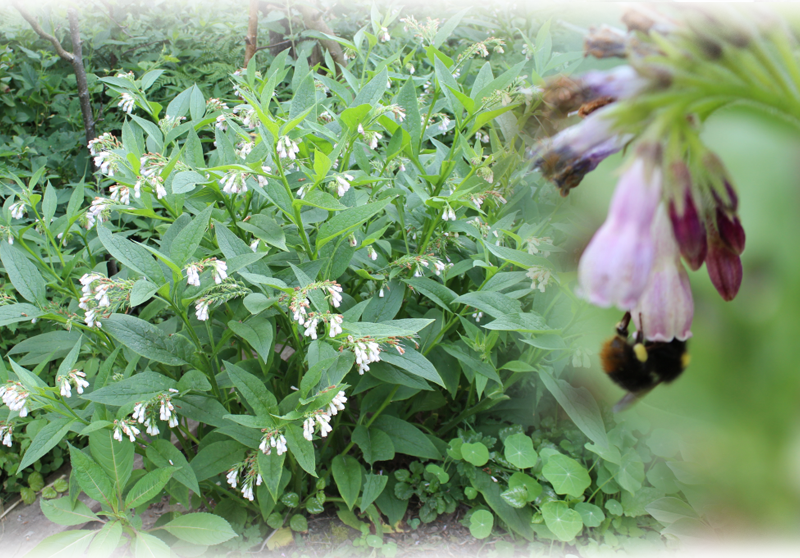
Comfrey
 6
6 9
9 9
9Will it grow where I live?
Comfrey is hardy to zone 5 – that covers all of Central Europe and the British Isles, and every USDA zone from 5 upwards.
Or check it for your location right here:
Profile
- Family
- Boraginaceae
- Habit
- perennial
- Height
- 1.2 m
- Spread
- 1.8 m
- Growth
- very fast
- Lifespan
- 20 years
- First yield
- after 1 year
- Hardiness
- zone 5–9
- Shade tolerance
- partial shade
- Soil
- Sand, Silt, Loam, Clay
- Soil moisture
- dry – very wet
- pH
- 5 – 8
- Synonyms
- Comfrey, Beinwurz
- Planned in gardens
- 6×
Flowering & harvest
| J | F | M | A | M | J | J | A | S | O | N | D | |
|---|---|---|---|---|---|---|---|---|---|---|---|---|
| Flowering |
Varieties (1)
1 varieties of Comfrey are listed in the Permaplans variety finder — each with its own page: taste, ripening time, disease resistance, parentage and use.
Uses
Edible: Young leaves can be consumed either raw or cooked, although their hairy and slimy texture may not be appealing to many. To reduce the hairiness, they can be finely chopped and added to salads. Young shoots can serve as a replacement for asparagus, and blanched stems are also utilized. Older leaves can be dried for tea consumption. The peeled roots, when crushed, can enhance the flavor of soups. Both leaves and roots, when dried, can be used to make tea. Roasted roots, including dandelion and chicory roots, are employed in making coffee.
Medicinal: Comfrey is a widely used herbal remedy with a well-established history in treating various conditions. Both the root and leaves are utilized, with the root being more potent. It can be used internally or applied topically as a poultice. The plant is effective in treating external issues like cuts, bruises, sprains, wounds, eczema, varicose veins, and fractures. Internally, it helps with lung problems, internal bleeding, and more. Comfrey contains allantoin, a healing agent that speeds up the recovery process. This compound is now artificially produced in pharmaceuticals for healing creams. The root and leaves have various properties such as pain relief, mild astringent, soothing, moisturizing, expectorant, cooling, and wound healing. Caution is advised, especially when using it internally. External use and teas made from the leaves are safe, but internal tablets or capsules are considered risky. Leaves are harvested in early summer before flowering, while roots are collected in autumn, both dried for future use. A homeopathic treatment is derived from fresh roots harvested pre-bloom, mainly used for bone fractures and eye injuries.
Other uses: The plant grows rapidly, yielding a significant amount of biomass. It can be harvested multiple times annually and utilized as immediate compost for crops such as potatoes. The dried leaves can be placed at the base of the potato trench or used as mulch in no-dig gardens. Additionally, the leaves can be soaked to create a liquid fertilizer, beneficial for potassium-demanding plants like tomatoes. They are also a beneficial component for composting. Historically, the gum obtained from the roots was employed in wool treatment prior to spinning.
Growing
Comfrey asks for little as long as it gets nutrients and moisture. It grows in sun or partial shade on sandy to loamy, base- and nutrient-rich soils that stay fresh to moist; calcareous substrates suit it particularly well, while drought does not. Its stout taproot reaches deep and draws on nutrients from layers closed to shallower-rooted crops, which is what makes it the classic mulch and liquid-feed plant, cut two or three times a season. Plant it with generous spacing, because the clumps grow wide and long-lived. Bear in mind how it spreads: every root fragment severed while digging will shoot again, so the position deserves thought before planting.
Propagation
Propagation runs through the root, almost without exception. One spade cut through the top few centimetres of the rootstock is enough: the parent plant reshoots, and every severed piece grows into a plant of its own. This works nearly year-round, most reliably in spring and autumn. That same trait makes a stand hard to undo — clearing one means catching every root fragment, or the comfrey is back the following year. So it is worth deciding before planting whether the position suits permanently. The species does set seed, but sowing is fiddly and will not come true for the usual Bocking cultivars; Bocking 14 does not self-seed in any case. For just a few plants, divide the clump in spring.
Value for wildlife
The nodding bell-shaped flowers of comfrey are built for long-tongued visitors and rank among the richest bumblebee forage there is; across its long flowering season some 22 wild bee species have been recorded, two of them specialists. Short-tongued bumblebees cannot reach the nectar and bite into the side of the flower instead — a break-in that honey bees then exploit. Six moth and butterfly species use it as a larval food plant, two of them closely tied to it, joined by the comfrey flea beetle, which lives on this genus alone. The dense clumps give ground-dwelling insects and amphibians cover.
Notable
Special features: highly tolerant to pruning, guards against nutrient leaching. The Bocking No. 4 type is especially flavorful; Bocking No. 14 does not spread on its own; propagation through root division is simple (can be done at any time); its taproot pulls nutrients from deep soil levels to its leaves, acting as immediate mineral compost for plants with shallow roots.
Origin & habitat
Eurasia: Europe to western Siberia and China. Common comfrey occupies a broad Eurasian range reaching from Spain and France across Central Europe to western Siberia and China, bounded to the north by Scandinavia and to the south by Italy and Romania. It is only scattered in southern Europe, while in the north it is frequently naturalised rather than original. It occurs in every Austrian province. In the Alps it climbs to about 1,100 metres in the Allgäu and 1,460 metres in the Prättigau; as a crop it was still grown at 2,000 metres in the Schnals valley. Its real centre of gravity, though, lies in the lowland and colline zones.
Comfrey belongs to wet and seasonally wet ground: damp meadows, fens, floodplain and carr woodland, ditches, streamsides and riverbanks are its typical habitats. It indicates nitrogen-rich, deep soils and roots down to 1.8 metres, which helps it through dry spells in summer. It favours base- and nutrient-rich, humic loams and clays in sun to partial shade; pure sand or gravel suits it only where moisture keeps coming. On the Landolt scale it sits at fluctuating wetness, partial shade, weakly acidic to neutral and nutrient-rich ground. For garden use one point matters above the rest: it copes badly with drought.
⚠️ Hazards
All parts of the plant, above all the root, contain pyrrolizidine alkaloids, which can damage the liver. Internal use is now regarded as outdated and is no longer recommended; cases of hepatic veno-occlusive disease are documented. Applied externally, only small amounts are absorbed through the skin, and four to six weeks of use per year is considered acceptable. Cultivars such as 'Harras' contain markedly fewer alkaloids. The same restriction applies to culinary use of the young leaves: regular consumption of larger quantities is not advisable.
Frequently asked questions
Comfrey: how big does it get?
Comfrey (Symphytum officinale) grows as a perennial and reaches roughly 1.2 m in height when mature, with a spread of about 1.8 m. Growth is very fast.
Comfrey: what site does it need?
Comfrey tolerates partial shade. Suitable soils are Sand, Silt, Loam, Clay. Soil moisture should be in the range dry – very wet. The pH may lie between 5 and 8.
Comfrey: is it hardy?
Comfrey is listed as hardy in zone 5–9 and survives normal winters outdoors there.
Comfrey: will it grow in Central Europe?
Comfrey is hardy to zone 5 – that covers all of Central Europe and the British Isles, and every USDA zone from 5 upwards.
Comfrey: when does it flower?
In a temperate northern-hemisphere climate it flowers from May to June.
Comfrey: is it poisonous?
Individual parts of Comfrey are noted as mildly problematic — the plant does not count as poisonous. With wild plants, never rely on a database alone, only on a confident identification.
Comfrey: what is it used for?
Rated on a scale up to 10: Edible 6/10, Medicinal 9/10, Other uses 9/10.
Which Comfrey varieties are there?
The Permaplans variety finder lists 1 varieties of Comfrey, including Bocking 4. Each variety has its own page with taste, ripening time, disease resistance and parentage.
Plan this plant into your own garden
Permaplans plans your garden to scale on the map — with a site check, harvest calendar and over 1,000 plants. Free for iPhone, Android, Mac, Windows & Linux.
Will this plant grow where you live? → Check your site
Community experience
No first-hand reports for this plant yet.
Growing it? Write in the app what works for you – your post will show up here.
💬 Get the app and join in