
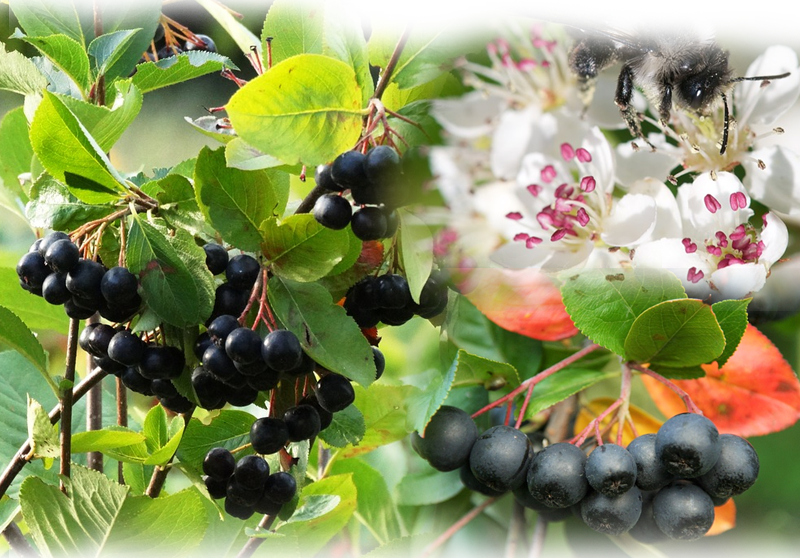
Black chokeberry
 7
7 8
8 3
3Will it grow where I live?
Black chokeberry is hardy to zone 4 – that covers all of Central Europe and the British Isles, and every USDA zone from 4 upwards.
Or check it for your location right here:
Profile
- Family
- Rosaceae
- Habit
- Shrub
- Height
- 2.2 m
- Spread
- 2 m
- Growth
- fast
- Lifespan
- 30 years
- First yield
- after 3 years
- Productive years
- 10 years
- Yield per plant
- up to 8 kg a year
- Yield in cultivation
- up to 15 t/ha
- Energy yield
- 700 kcal per m² a year
- Hardiness
- zone 4–8
- Shade tolerance
- partial shade
- Soil
- Sand, Silt, Loam
- Soil moisture
- dry – very moist
- pH
- 5 – 8
- Synonyms
- Aronia, Aronia-Beere
Flowering & harvest
| J | F | M | A | M | J | J | A | S | O | N | D | |
|---|---|---|---|---|---|---|---|---|---|---|---|---|
| Flowering | ||||||||||||
| Fruit harvest |
Varieties (3)
3 varieties of Black chokeberry are listed in the Permaplans variety finder — each with its own page: taste, ripening time, disease resistance, parentage and use.
Uses
Edible: Fruit - cooked. The fruit has a pleasant taste but is very astringent. It should be fully ripe before consumption and is best after one or two frosts. The fruit is suitable for making jelly when sugar is added and can also be dried to make pemmican. Due to its high pectin content, the fruit can be used to make jams to increase the pectin level, which is believed to protect the body from radiation. The fruit has a diameter of about 9 mm.
Other uses: The very dark red juice of the chokeberry matters as a natural food colouring: an addition of just 5 to 7 per cent gives pale juices a strong colour, and sparkling wine, aperitifs, liqueurs and dairy products such as yoghurt and cream desserts are tinted with it too. A kilogram of fresh material holds around 32 g of anthocyanin pigments, which makes the press residue especially suitable for extracting colour. The fruit also yields pectin, used as a setting agent for preserves and in the laboratory as a culture medium. Its long-lasting, brilliant wine- to dark-red autumn colour and dense habit mean the species is also planted as an ornamental and in field hedges.
Growing
Site: Chokeberry stays low at 1.5 to 2.5 m but throws suckers and spreads sideways over the years, so allow room or install a root barrier. Its juice stains remarkably strongly, a kilogram of fresh material holding around 32 g of anthocyanins; fallen fruit leaves permanent marks on pale paving. For birds it is one of the better shrubs: the fruit hangs well into winter, and the dense upright growth is readily used for nesting and perching. Some 29 wild bee species work the May flowers. Being light-demanding, it yields distinctly better in sun than in partial shade. Care: It is self-fertile, so a single bush gives a crop. Wood and buds are markedly frost-hardy, diseases and pests hardly matter, and it puts up with poor soil. Mineral fertiliser is needed only exceptionally, whereas additional irrigation has a noticeably favourable effect on yield. Since fruit is borne mainly on one-year-old shoots, prune as for currants to keep renewing the fruiting wood, starting in the fourth to sixth year. In larger plantings the shrubs stand 1.5 to 2 m apart in the row with 3 m between rows, which allows machine harvesting.
Propagation
The most reliable route is via the suckers: the species throws up new shoots from the roots, and these can be lifted with their roots during dormancy and set straight into their final position. Cuttings work just as well, as half-ripe, still green shoots root readily in summer and ripened hardwood cuttings succeed in winter. Layering is another straightforward option. Raising plants from seed is possible but rarely worthwhile in a garden, since seedlings come out variable and the seed needs a cold spell to germinate: sow freshly harvested seed directly outdoors and autumn and winter take care of that themselves. For a small-crowned standard, graft onto rowan.
Value for wildlife
Chokeberry flowers in May with white corymbs visited by some 29 wild bee species — mining, furrow and mason bees as well as early bumblebees — though nectar and pollen values are moderate and no species specialises on it. As a North American neophyte it has attracted few caterpillars in Central Europe. Its value for birds is considerably greater: the dark fruit hangs well into winter and is taken readily once other food runs short, while the dense upright shrub serves well as a nesting and perching site. Anyone whose priority is insects will still do better with native crab apple or hawthorn.
Notable
Special features: forms runners, drought-tolerant, prefers moist peat soil; originated from North America, spread to Europe through Russia; hybrid cross A. x prunifolia with numerous varieties such as 'Aron', 'Nero', 'Viking', 'Königshof',.. claims of up to 17kg of fruit per bush; easy to care for; can be grafted onto rowan; pruning measures from the 4th-6th year of growth;
Origin & habitat
Eastern North America. Black chokeberry is native to eastern North America, ranging from Newfoundland west to Ontario and Minnesota and south to Arkansas, Alabama and Georgia. Around 1900 the Späth nursery in Germany sent it to Russia for breeding work, where the nutritional value of the fruit was recognised and studied; the cultivars grown in Europe probably go back to Ivan Michurin's crossing experiments. After 1945 large plantations were established in Siberia as well as in eastern, northern and central Europe and in several Balkan countries. The species reached Central Europe via the Balkans in the 1950s and is now grown in Saxony and Lower Bavaria among other places, occurring as an escaped neophyte.
In its North American homeland black chokeberry favours moist, acidic soils in landscapes receiving 1,000 to 2,000 mm of annual rainfall: bog margins, swampy hollows and open pioneer woodland. In cultivation it proves markedly more adaptable, thriving on marginal sandy to loamy soils, on ground close to the water table as readily as on stony slopes, and coping there with fresh to dry conditions. It tends to avoid limy sites, where autumn colour turns red and yellow rather than wine-red. As a light-demanding shrub it needs sun to partial shade; wind and salt in the soil trouble it little.
Frequently asked questions
Black chokeberry: how big does it get?
Black chokeberry (Aronia melanocarpa) grows as a Shrub and reaches roughly 2.2 m in height when mature, with a spread of about 2 m. Growth is fast.
Black chokeberry: what site does it need?
Black chokeberry tolerates partial shade. Suitable soils are Sand, Silt, Loam. Soil moisture should be in the range dry – very moist. The pH may lie between 5 and 8.
Black chokeberry: is it hardy?
Black chokeberry is listed as hardy in zone 4–8 and survives normal winters outdoors there.
Black chokeberry: will it grow in Central Europe?
Black chokeberry is hardy to zone 4 – that covers all of Central Europe and the British Isles, and every USDA zone from 4 upwards.
Black chokeberry: when does it flower?
In a temperate northern-hemisphere climate it flowers in May.
Black chokeberry: when is it harvested?
In a temperate northern-hemisphere climate the fruit ripens in August.
Black chokeberry: when does it start cropping, and how much?
Black chokeberry first crops after 3 years. A mature plant gives up to 8 kg a year, in cultivation up to 15 t per hectare. The productive period lasts about 10 years, within a lifespan of around 30 years. Figures assume a good site; variety, soil and climate shift them considerably.
Black chokeberry: is it poisonous?
No toxicity is recorded for Black chokeberry. With wild plants, never rely on a database alone — only on a confident identification.
Black chokeberry: what is it used for?
Rated on a scale up to 10: Edible 7/10, Medicinal 8/10, Other uses 3/10.
Which Black chokeberry varieties are there?
The Permaplans variety finder lists 3 varieties of Black chokeberry, including Hugin, Nero, Viking. Each variety has its own page with taste, ripening time, disease resistance and parentage.
Plan this plant into your own garden
Permaplans plans your garden to scale on the map — with a site check, harvest calendar and over 1,000 plants. Free for iPhone, Android, Mac, Windows & Linux.
Will this plant grow where you live? → Check your site
Community experience
No first-hand reports for this plant yet.
Growing it? Write in the app what works for you – your post will show up here.
💬 Get the app and join in