
 9
9 4
4 4
4Will it grow where I live?
Mini kiwi is hardy to zone 4 – that covers all of Central Europe and the British Isles, and every USDA zone from 4 upwards.
Or check it for your location right here:
Profile
- Family
- Actinidiaceae
- Habit
- Climber
- Height
- 17.5 m
- Spread
- 2 m
- Growth
- very fast
- Lifespan
- 40 years
- First yield
- after 5 years
- Full yield
- after 11–16 years
- Productive years
- 30 years
- Yield per plant
- up to 50 kg a year
- Yield in cultivation
- up to 9 t/ha
- Energy yield
- 350 kcal per m² a year
- Hardiness
- zone 4–8
- Shade tolerance
- partial shade
- Soil
- Sand, Silt, Loam
- Soil moisture
- semi-dry – very wet
- pH
- 5.5 – 6.5
- Synonyms
- Mini-Kiwi, Minikiwi, Beerenkiwi, Kiwibeere
- Planned in gardens
- 4×
Flowering & harvest
| J | F | M | A | M | J | J | A | S | O | N | D | |
|---|---|---|---|---|---|---|---|---|---|---|---|---|
| Flowering | ||||||||||||
| Fruit harvest |
Varieties (52)
52 varieties of Mini kiwi are listed in the Permaplans variety finder — each with its own page: taste, ripening time, disease resistance, parentage and use.
- 74-49
- 74-8
- Ambrosia
- Ananas
- Ananaskaya
- Ananasnaya
- Bingo
- Cinderella
- Domino
- Fresh Jumbo
- Geneva Early-ripening, productive cultivar with sweet, aromatic fruit.
- Hardy Red
- Issai
- Julia
- Karavaievskaya Urozhainaya
- Kens Red
- Kievskaya Krupnoplodnaya
- Kiwai Rouge
- Kiwino
- Kokuwa
- Lucy
- Maki
- Mariered
- Meader
- Miss Green
- Molli
- National Arboretum
- Nostino
- Original
- Peterman
- Prince JumboLarge-fruited hardy kiwi with sweet, smooth-skinned fruit.
- Purpurna Sadowa
- Red Beauty
- Red Jumbo
- Rima
- Rogow
- Romeo
- Rossana
- Rote Potsdamer
- Ruby
- Scarlet SeptemberLate-ripening hardy kiwi with reddish-blushed, sweet fruit.
- Sentiabrskaya
- Super Jumbo Large-fruited hardy kiwi selection with sweet flesh.
- Tanny
- Urodnaya
- Verde
- Vitakola
- Vitikiwi
- Weiki Very hardy, proven German selection bearing sweet, aromatic fruit.
- Weiki® M
- Weiki® W
- Z 1
Uses
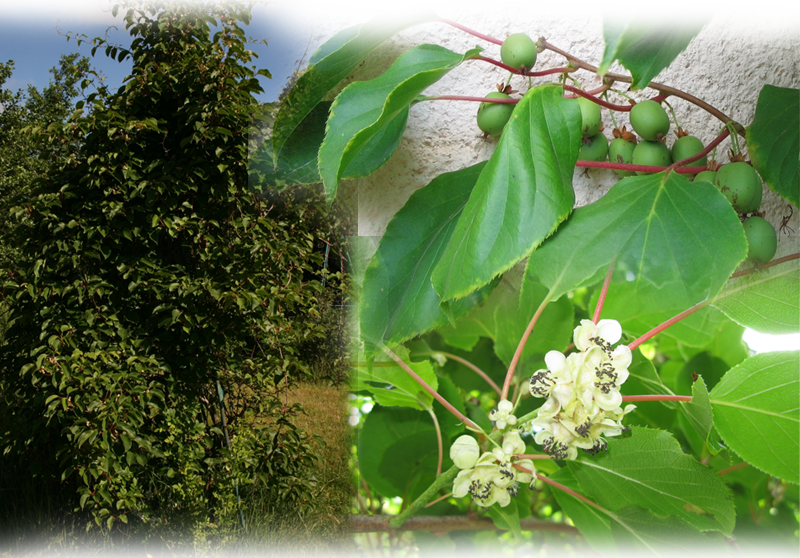
Edible: The fruits are many-seeded berries 2.5 to 4.5 cm long and 6 to 18 g in weight, resembling gooseberries in shape, which is why they are also called Manchurian gooseberries. Unlike the large-fruited kiwi the skin is smooth and hairless and is simply eaten along with the flesh. The flavour is characteristically kiwi, though sweeter and finer, with a hint of gooseberry. Ripening comes late, from the end of September into October; the fruit stays firm for a good while and can be cut as a whole cluster, which eases both picking and storage. Besides eating fresh it suits juice, wine and jam as well as drying and freezing. Vitamin C content runs from 60 to 300 mg per 100 g.
Medicinal: Fruit very rich in vitamins (C&E), with 2-6 times more vitamin C than lemon. It aids digestion and boosts the immune system.
Other uses: The wood of the hardy kiwi is heavily contorted and unsuitable for working; prunings can at best be chipped. Its real quality beyond the fruit lies in its habit: as a left-twining liana it covers house walls, walls, fences and pergolas, quickly forming a dense, load-bearing tangle that turns brilliant yellow in autumn. The strikingly red leaf stalks and the fragrant, cream-white flowers with their dark purple stamens also make it useful as an ornamental. Incidentally, cooks use the fruit juice to tenderise meat, since the enzyme it contains breaks down protein.
Growing
Site: The hardy kiwi is a vigorous liana climbing 10 to 15 m, so it needs a permanently load-bearing structure, a trellis or pergola, not a light plant support. Sex is the decisive question: the species is mostly dioecious, and without a male plant no fruit sets. One male supplies six to eight females within 15 to 30 m, but grows markedly more strongly because it carries no fruit; without generous spacing it smothers the females. It roots shallowly, so the ground should not be cultivated; mulching suits it well but attracts mice. Avoid late-frost sites and frost hollows. Care: Keep the base of the plant covered, and give it even moisture in summer or the fruit stays small. Young plants are frost-tender and need winter protection, while established ones take -30 to -40 °C in full dormancy. Prune twice: in summer cut side branches back to five or seven buds and spent shoots to three or five, and about every three years remove the exhausted canes entirely. Deer fray the stems. At flowering time it pays to have bees and bumblebees about. Harvest comes late, from the end of September into October.
Propagation
Vegetative propagation runs through short hardwood cuttings in containers, softwood cuttings under film, and layering. All three preserve the cultivar and with it the sex of the mother plant, which matters particularly here. Seed is possible but useless for fruit growing: sex only becomes apparent years later at first flowering, and the offspring divide roughly in half, around 45 per cent female and 55 per cent male. The seed needs several months of cold before sowing, and the seedlings are prone to damping off and want good ventilation. Young plants stay frost-tender for the first few years and need winter protection, even though established specimens are markedly hardy.
Value for wildlife
The hardy kiwi is dioecious: male and female flowers sit on separate plants, so both sexes are needed for fruit to set — the exception being self-fertile cultivars such as 'Issai'. The inconspicuous white flowers of early summer offer little nectar but do provide pollen, and the visitors recorded are mainly bumblebees, among them the tree, buff-tailed and red-tailed species. Pollination is done by insects, above all bees and bumblebees; commercial growers of the related kiwi species bring in bee colonies for the purpose, and in a garden too it pays to have pollinators about at flowering time. As an East Asian climber it feeds no local caterpillars, but its dense tangle of stems gives birds good cover and nest sites.
Notable
Special features: One male plant for every 6-8 female plants; Each plant can yield up to 70kg; Fruits develop on second-year wood and fruit spurs on older wood; Pruning is most effective in winter (due to dormant sap flow); Propagation through layering, cuttings, and root cuttings.
Origin & habitat
North-east Asia, from Japan to the eastern Himalaya. The hardy kiwi is native to northern Japan, Korea and north-east China, extending west into the eastern Himalaya and north into Siberia including the southern Kurils and Sakhalin. Its remarkable frost hardiness comes from this continental range: fully dormant, an established plant survives -30 to -40 °C. It reached Central Europe first as an ornamental climber for pergolas and house walls, but is now also grown commercially in plantations, in Poland and Austria among other countries. As a neophyte it barely escapes from cultivation here and shows no appreciable tendency to spread.
In its native range the hardy kiwi grows as a left-twining liana in open woodland and especially in floodplain forest, climbing 10 to 15 m into trees and occasionally reaching 25 m. It occupies well-aerated, humus-rich and deep soils with even moisture, preferring the slightly acidic range between about pH 5 and 6.5. It avoids waterlogging and compacted ground. Being shallow-rooted, it depends on an undisturbed, shaded soil surface, a role played in the forest by leaf litter. Its altitudinal range runs from the lowlands to around 2,000 m.
⚠️ Hazards
Like all Actinidia species, the hardy kiwi contains the enzyme actinidin, the principal trigger of kiwi allergy. There is cross-reactivity between the large-fruited kiwi and the hardy kiwi — anyone reacting to one should avoid the other. In sensitive people the enzyme causes tingling or burning in the mouth, and more severe reactions are possible. Oxalate content is low to moderate and only relevant on a strictly low-oxalate diet.
Frequently asked questions
Mini kiwi: how big does it get?
Mini kiwi (Actinidia arguta) grows as a Climber and reaches roughly 17.5 m in height when mature, with a spread of about 2 m. Growth is very fast.
Mini kiwi: what site does it need?
Mini kiwi tolerates partial shade. Suitable soils are Sand, Silt, Loam. Soil moisture should be in the range semi-dry – very wet. The pH may lie between 5.5 and 6.5.
Mini kiwi: is it hardy?
Mini kiwi is listed as hardy in zone 4–8 and survives normal winters outdoors there.
Mini kiwi: will it grow in Central Europe?
Mini kiwi is hardy to zone 4 – that covers all of Central Europe and the British Isles, and every USDA zone from 4 upwards.
Mini kiwi: when does it flower?
In a temperate northern-hemisphere climate it flowers in June.
Mini kiwi: when is it harvested?
In a temperate northern-hemisphere climate the fruit ripens in October.
Mini kiwi: when does it start cropping, and how much?
Mini kiwi first crops after 5 years. Full yield comes after 11–16 years. A mature plant gives up to 50 kg a year, in cultivation up to 9 t per hectare. The productive period lasts about 30 years, within a lifespan of around 40 years. Figures assume a good site; variety, soil and climate shift them considerably.
Mini kiwi: is it poisonous?
No toxicity is recorded for Mini kiwi. With wild plants, never rely on a database alone — only on a confident identification.
Mini kiwi: what is it used for?
Rated on a scale up to 10: Edible 9/10, Medicinal 4/10, Other uses 4/10.
Which Mini kiwi varieties are there?
The Permaplans variety finder lists 52 varieties of Mini kiwi, including 74-49, 74-8, Ambrosia, Ananas, Ananaskaya, Ananasnaya, Bingo, Cinderella, Domino, Fresh Jumbo, Geneva, Hardy Red and 40 more. Each variety has its own page with taste, ripening time, disease resistance and parentage.
Plan this plant into your own garden
Permaplans plans your garden to scale on the map — with a site check, harvest calendar and over 1,000 plants. Free for iPhone, Android, Mac, Windows & Linux.
Will this plant grow where you live? → Check your site
Community experience
What Permaplans users wrote about this plant – taken from the app as is. 1 post.
wir haben zwei Exemplare mit dem Garten übernommen. Brauchen einen regelmäßigen Rückschnitt und feste Rankhilfe, sonst wuchern diese Pflanzen extrem und überwuchern auch andere Pflanzen
Growing it? Write in the app what works for you – your post will show up here.
💬 Get the app and join in