
Kiwi
 9
9 6
6 3
3Will it grow where I live?
Kiwi is hardy to zone 7: lowlands, river valleys and cities across Central Europe are fine, harsher continental or upland sites need winter protection or a container. It also needs warm summers – in Central Europe that means wine-growing regions, cities or a sheltered south-facing wall.
Or check it for your location right here:
Profile
- Family
- Actinidiaceae
- Habit
- Climber
- Height
- 9.5 m
- Spread
- 2 m
- Growth
- medium
- Lifespan
- 50 years
- First yield
- after 5 years
- Yield per plant
- up to 90 kg a year
- Yield in cultivation
- up to 40 t/ha
- Energy yield
- 400 kcal per m² a year
- Hardiness
- zone 7–11
- Shade tolerance
- partial shade
- Soil
- Sand, Silt, Loam
- Soil moisture
- semi-dry – very wet
- pH
- 5 – 6
- Synonyms
- Actinidia chinensis
Flowering & harvest
| J | F | M | A | M | J | J | A | S | O | N | D | |
|---|---|---|---|---|---|---|---|---|---|---|---|---|
| Flowering | ||||||||||||
| Fruit harvest |
Varieties (13)
13 varieties of Kiwi are listed in the Permaplans variety finder — each with its own page: taste, ripening time, disease resistance, parentage and use.
- Abbott Very early-flowering, aromatic kiwi with finely hairy skin.
- Allison Early, broadly rounded kiwi from the classic New Zealand cultivar group.
- AtlasMale pollinator variety for female kiwi plants.
- Blake Partly self-fertile, early-ripening kiwi — handy for small gardens.
- Bruno Early, elongated kiwi with dense dark hairy skin — hardy and productive.
- Chico Californian Hayward selection — practically identical to the world-standard cultivar.
- Elmwood Large-fruited, late-ripening kiwi of the Hayward type.
- Greensill Late-ripening, well-storing New Zealand green kiwi.
- Hayward The world-standard kiwi: large oval fruit with outstanding storage life.
- Matua Early to mid-flowering male pollinator with a long bloom period.
- Monty Extremely fertile, mid-late kiwi bearing many smaller fruit.
- Saanichton 12 Notably cold-hardy green kiwi from British Columbia.
- Tomuri Late-flowering male pollinator — the standard partner for Hayward.
Uses
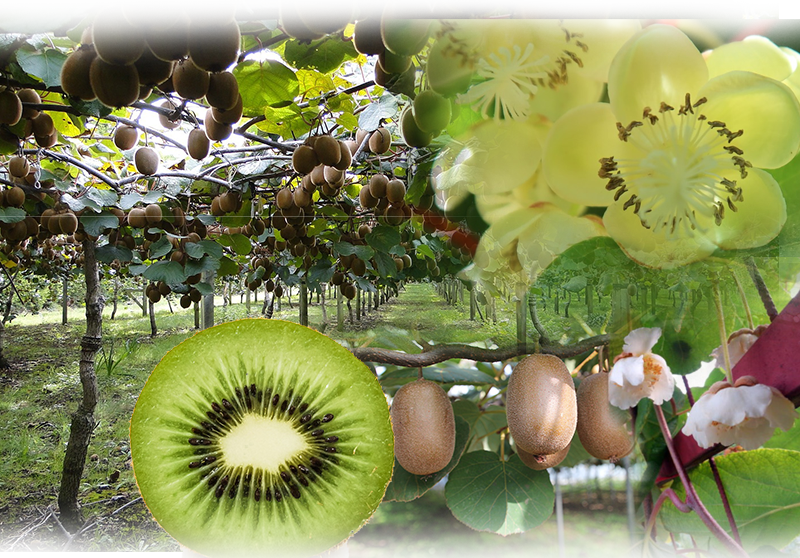
Edible: The fruit is a 5 to 8 cm long, brown-hairy berry with green, radially patterned flesh and numerous tiny black seeds. It is eaten raw, scooped or peeled, and suits fruit salads, cake toppings, chutneys and preserves. Notable is the very high vitamin C content of around 45 to 90 mg per 100 g, alongside potassium, dietary fibre and folate. Harvest hard and unripe shortly before the first hard frosts; the fruit ripens within a few days at 15 to 20 degrees, distinctly faster next to apples because of their ethylene. Stored cool and dark at 0 to 2 degrees it keeps for several months. Raw kiwi will not let gelatine set and turns dairy products bitter within a short time, because the enzyme actinidin breaks down the proteins; brief heating destroys it. The fruit also contains oxalates, which can irritate sensitive mucous membranes.
Other uses: The kiwi fruits on one-year wood arising from two-year canes and on short fruiting spurs on older wood - the whole pruning system follows from this. The canes are used as living green for pergolas and covered walks, because the large rounded leaves cast dense shade and the plant covers a structure quickly. Fresh flesh contains the protein-splitting enzyme actinidin; it makes the fruit a natural meat tenderiser but conversely prevents gelatine from setting with raw kiwi and turns dairy products bitter. Yellow-fruited species and cultivars contain less actinidin and are therefore better suited to yoghurt and quark. The shoots and roots contain compounds that affect cats much as valerian or catmint does, which is why young plants may be chewed and rubbed to pieces.
Growing
Site: The kiwi is a vigorous liana reaching 6 to 10 m of cane depending on cultivar and needs a permanent load-bearing structure - a pergola, espalier or steel or hardwood T-bar, not a garden-centre trellis. It wants a fully sunny and strictly sheltered position, because the large leaves tear in wind and young shoots snap off; a south wall with an overhang is ideal. The soil must be humus-rich, evenly moist and slightly acidic; above pH 7 chlorosis sets in and chalky soils are out of the question. The key planning point is dioecy: every fruiting cultivar needs a male pollinator within about 10 m, usually 'Matua' or 'Tomuri' for 'Hayward'. Only 'Jenny' and 'Solo' crop without a partner, and then less heavily. Cats like to dig at and rub against young Actinidia plants and can destroy them. Care: Water demand is high; the shallow-rooting plant needs regular watering in dry spells and a permanent mulch layer, yet will not tolerate waterlogging. Feed with an emphasis on nitrogen in spring and never after July, so the wood ripens. Established plants tolerate about -15 to -18 degrees when dormant, but young growth is killed by even light late frost - in frost-prone sites a fleece over the framework pays off. Prune twice: in winter cut spent fruiting canes back to two or three buds beyond the last fruit, and in summer shorten overlong shoots. Without pruning the plant goes bare inside and fruits only at the perimeter. First fruit comes after four to five years. Harvest still hard before the first hard frost; the fruit ripens in store.
Propagation
Kiwi is propagated by cuttings and grafting, because seed-raised plants take years to reveal whether they are male or female. Softwood cuttings are taken in June and July from half-ripe shoots with two or three buds, the leaves halved, and rooted under film or mist at around 20 to 25 degrees bottom heat; rooting takes four to six weeks. Hardwood cuttings from the winter prunings root considerably less well. Cultivars are whip-grafted onto seedling rootstocks in winter or budded in August. Seed raising is worthwhile only for rootstocks: seed from fully ripe fruit is washed out, dried and needs about three months of moist cold stratification at 2 to 5 degrees, after which it germinates at roughly 10 to 20 degrees. Seedlings flower only after four to seven years, so the sex ratio shows up that late.
Value for wildlife
The kiwi is a neophyte from central China with no ties to native insects, and it plays no role as a caterpillar host. Its large creamy-white flowers in May and June are above all a source of pollen, and pollinators visit them chiefly for that. in Central Europe five bumblebee species are regularly recorded at the flowers, among them buff-tailed, red-tailed, early and tree bumblebee; commercial growers secure pollination with honeybee colonies or mechanically, since wind also carries part of the pollen. For birds the plant offers little, though ripe or split fruit is taken, as it is by wasps. Its real contribution in the garden is structural: the dense tangle of an established pergola gives birds cover and nesting opportunities.
Notable
Special features: Dioecious - a male pollinator ('Matua', 'Tomuri') needed per fruiting cultivar, only 'Jenny'+'Solo' self-fertile; needs a permanent load-bearing structure, 6-10 m of cane; lime-sensitive, chlorosis above pH 7; large leaves vulnerable to wind; first crop after 4-5 years; harvest hard, ripens in store; actinidin prevents setting with gelatine; cats destroy young plants; young growth lost to even light late frost;
Origin & habitat
East Asia: central China. The natural range of the species lies in the Yangtze catchment, above all in the provinces of Hubei, Sichuan, Shaanxi and Hunan. Only in 1904 did the New Zealand teacher Mary Isabel Fraser bring seed to New Zealand, where the first selections were raised; commercial export to England began from there in 1952, and in 1959 the fruit was given the trade name kiwi in London. Today it is grown worldwide in regions with mild winters. China is by far the largest producer with around 64 per cent of the 2024 world crop, followed by New Zealand, Italy, Chile, Greece and Turkey.
In its homeland the kiwi grows as a vigorous woody liana in the deciduous mountain and ravine forests of central China, mostly between 500 and 1800 m. It climbs through trees and shrubs into the canopy but roots in the moist, humus-rich, slightly acidic forest floor in partial shade. The climate is humid subtropical with high air humidity, mild winters and a long frost-free growing season of six to eight months. Characteristic is the combination of evenly moist soil year-round and shelter from wind provided by the surrounding forest - both explain the demands of the cultivated plant. Genuine wild populations have declined sharply through forest clearance.
⚠️ Hazards
Allergy, latex cross-allergy, mucous membrane irritation Kiwi is among the more common triggers of food allergy, particularly in children. The main allergen is the protein-splitting enzyme actinidin; reactions range from tingling and burning in the mouth through swollen lips to, in rare cases, anaphylactic shock. There is a pronounced cross-allergy within the latex-fruit syndrome, that is to natural latex as well as banana, avocado and sweet chestnut; anyone reacting to these should avoid kiwi. Independently of that, the oxalate crystals it contains irritate sensitive mucous membranes and produce a scratchy feeling in the mouth even in non-allergic people. Yellow-fruited cultivars contain less actinidin and are often better tolerated.
Frequently asked questions
Kiwi: how big does it get?
Kiwi (Actinidia deliciosa) grows as a Climber and reaches roughly 9.5 m in height when mature, with a spread of about 2 m. Growth is medium.
Kiwi: what site does it need?
Kiwi tolerates partial shade. Suitable soils are Sand, Silt, Loam. Soil moisture should be in the range semi-dry – very wet. The pH may lie between 5 and 6.
Kiwi: is it hardy?
Kiwi is listed as hardy in zone 7–11 and survives normal winters outdoors there.
Kiwi: will it grow in Central Europe?
Kiwi is hardy to zone 7: lowlands, river valleys and cities across Central Europe are fine, harsher continental or upland sites need winter protection or a container. It also needs warm summers – in Central Europe that means wine-growing regions, cities or a sheltered south-facing wall.
Kiwi: when does it flower?
In a temperate northern-hemisphere climate it flowers from May to June.
Kiwi: when is it harvested?
In a temperate northern-hemisphere climate the fruit ripens in November.
Kiwi: when does it start cropping, and how much?
Kiwi first crops after 5 years. A mature plant gives up to 90 kg a year, in cultivation up to 40 t per hectare. Figures assume a good site; variety, soil and climate shift them considerably.
Kiwi: is it poisonous?
No toxicity is recorded for Kiwi. With wild plants, never rely on a database alone — only on a confident identification.
Kiwi: what is it used for?
Rated on a scale up to 10: Edible 9/10, Medicinal 6/10, Other uses 3/10.
Which Kiwi varieties are there?
The Permaplans variety finder lists 13 varieties of Kiwi, including Abbott, Allison, Atlas, Blake, Bruno, Chico, Elmwood, Greensill, Hayward, Matua, Monty, Saanichton 12 and 1 more. Each variety has its own page with taste, ripening time, disease resistance and parentage.
Plan this plant into your own garden
Permaplans plans your garden to scale on the map — with a site check, harvest calendar and over 1,000 plants. Free for iPhone, Android, Mac, Windows & Linux.
Will this plant grow where you live? → Check your site
Community experience
No first-hand reports for this plant yet.
Growing it? Write in the app what works for you – your post will show up here.
💬 Get the app and join in