
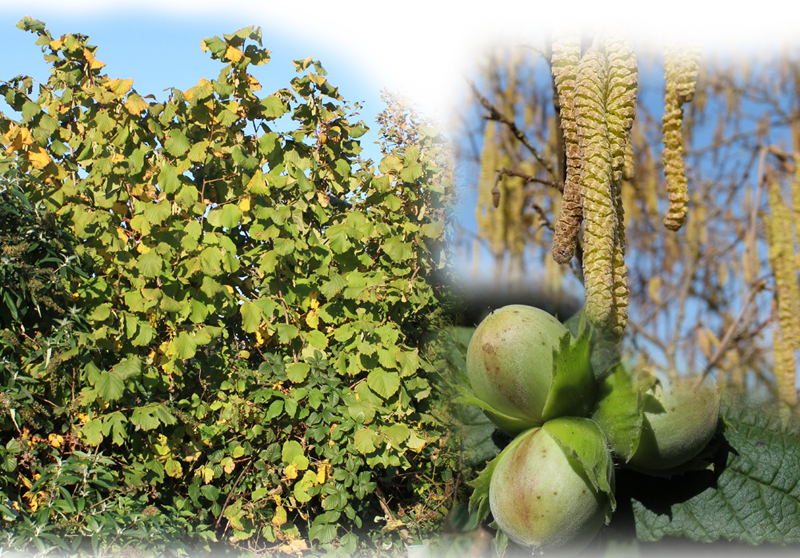
Hazelnut
 7
7 4
4 9
9Will it grow where I live?
Hazelnut is hardy to zone 4 – that covers all of Central Europe and the British Isles, and every USDA zone from 4 upwards.
Or check it for your location right here:
Profile
- Family
- Betulaceae
- Habit
- Shrub
- Height
- 6 m
- Spread
- 6 m
- Growth
- fast
- Lifespan
- 80 years
- First yield
- after 4 years
- Full yield
- after 12 years
- Yield per plant
- up to 10 kg a year
- Yield in cultivation
- up to 1.5 t/ha
- Energy yield
- 850 kcal per m² a year
- Hardiness
- zone 4–8
- Shade tolerance
- full shade
- Soil
- Sand, Silt, Loam
- Soil moisture
- semi-dry – very moist
- pH
- 6 – 7.5
- Synonyms
- Hasel
Flowering & harvest
| J | F | M | A | M | J | J | A | S | O | N | D | |
|---|---|---|---|---|---|---|---|---|---|---|---|---|
| Flowering | ||||||||||||
| Fruit harvest |
Varieties (29)
29 varieties of Hazelnut are listed in the Permaplans variety finder — each with its own page: taste, ripening time, disease resistance, parentage and use.
- Barcelona For decades Oregon's leading cultivar: a large, round nut for the in-shell and kernel market.
- Bergers Zellernuss
- Butler Large-nutted in-shell cultivar and proven pollenizer for Barcelona and Ennis.
- Corabel Large-fruited, late-ripening French variety with heavy yields.
- Cosford Old English cob cultivar with thin shell and abundant pollen - a classic pollenizer.
- Daviana
- Emoa 1
- Englische Zeller
- Ennis Very large show nut for the in-shell market with an attractive, bright shell.
- Fuscorubra
- Gubener Zellernuss
- Gunslebert Productive, frost-hardy garden cultivar and reliable pollenizer from Germany.
- Hallesche Riesennuss One of the oldest German varieties with exceptionally large nuts.
- Jefferson EFB-resistant Barcelona successor with large, round kernels - Oregon's current leading cultivar.
- Katalonski Aromatic, sweet-nutty variety from Catalonia.
- Lange Zellernuss Productive filbert with elongated, aromatic nuts.
- Negret Small, aromatic leading cultivar of Catalonia (Reus) for the confectionery industry.
- Palaz High-yielding Ordu standard cultivar of Turkey's Black Sea region with round kernels.
- Römische Zeller
- Rotblättrige Zellernuss
- Segorbe Robust Spanish kernel cultivar and key pollenizer for Negret.
- Tombul Turkey's world-class Giresun cultivar - a round, highly aromatic kernel for confectionery.
- Tonda di Giffoni Campania's premium confectionery cultivar - round kernel with top-class roasting aroma.
- Tonda Gentile delle Langhe The 'Nocciola Piemonte' - the world benchmark for aroma, heart of gianduja and praline.
- Tonda Gentile Romana Round aromatic nut from Lazio (DOP), prized by confectioners for its fine roasting aroma.
- Webb's Prize Cob English cobnut with large, tasty nuts and reliable yields.
- Wunder von Bollweiler Hardy, late-ripening Alsatian variety with large, thin-shelled nuts.
- Yamhill Compact, EFB-resistant cultivar with small round kernels for the shelled-kernel industry.
- Zellersche Riesennuss Large-nutted filbert selection for the home garden.
Uses
Edible: Seeds can be consumed raw or roasted in various foods like bread, cakes, cookies, and sweets. They are a nutritious option for raw consumption and can also be processed into plant milk due to their high oil content. The seeds mature in mid- to late autumn and may require protection from squirrels. When stored cool and unshelled, they can be kept for at least 12 months. These seeds yield a clear yellow oil suitable for culinary uses such as salad dressings and baking.
Other uses: The seed contains up to 65% of a non-drying oil utilized in various products like paints and cosmetics. It can also be used to polish and oil wood effectively, providing a lovely finish. Finely ground seeds are incorporated into facial masks and cosmetics. These plants can serve as tall hedges and should be minimally trimmed or left untouched when harvesting seeds. The bark and leaves are sources of tannins. The soft wood is ideal for inlay work, small furniture, hurdles, basketry, and more. Additionally, the twigs are employed as dowsing rods, and the wood yields high-quality charcoal favored by artists.
Growing
Prefers sunny to partially shaded locations with well-drained, humus-rich soils having neutral to slightly alkaline pH. Tolerates moderate moisture but avoids waterlogging. The plant produces vigorous suckers and should be planted with a spacing of about 4 to 6 meters to allow ample room for growth. Regular pruning encourages strong shoots and facilitates harvesting. It is frost-hardy and does not require special winter protection. Planting multiple cultivars is recommended for effective pollination, as hazel generally requires cross-pollination. Fertilization with organic matter in spring supports healthy growth. Susceptible to: Hazelnut gall mite (deformed buds), Hazelnut weevil (seed feeder), Powdery mildew.
Propagation
Seeds should be sown right after harvest in autumn in a cool environment. Germination typically happens in late winter or spring. Before planting, it's recommended to soak stored seeds in warm water for 48 hours, followed by a warm stratification period of 2 weeks and then a cold period of 3-4 months. Germination usually takes place within 1-6 months at a temperature of 20°C. Once the seedlings reach a suitable size, they can be transferred to individual pots and grown in a cool environment or a sheltered outdoor area during the initial winter. By late spring or early summer, they should be planted in their permanent spot. Propagation through layering is a straightforward process that can be carried out in autumn and takes approximately 6 months. In spring, dividing the runners is a simple method, and they can be directly planted in their permanent location.
Value for wildlife
Hazel provides food for many insects, including pollen and leaves for various butterfly caterpillars and leafhoppers. Its nuts are an important food source for small mammals like squirrels and birds such as nuthatches and jays, which also help disperse the seeds. The plant offers shelter and nesting sites for birds and other animals. Flowering in February and March makes it an early pollen source for bees.
Notable
Special features: +Wind-tolerant. Only the 1-year-old, weak shoots bear fruit. Flowers tolerate frosts down to -8°C. Yields (see above) are primarily produced by grafted varieties, often hybrids with, or especially with, Corylus maxima (Hazel) in sun! Also grafted onto tree hazel → no coppicing; Legends + Magical forest builder & nature connector.
Origin & habitat
Europe, Asia Minor and the Caucasus. Hazel occupies the continent from central Norway and southern Sweden to the Iberian Peninsula and Sicily, eastwards across Turkey and the Caucasus to northern Iran; there are scattered occurrences in the North African Atlas. It was one of the first shrubs to return to Central Europe after the last ice age and shaped post-glacial vegetation so strongly that an entire pollen zone is named after it. In the Alps it climbs to about 1500 metres. In Germany, Austria and Switzerland it is distributed throughout and is among the commonest woody plants of field hedges, woodland edges and floodplain woods.
Hazel grows best in oceanic and suboceanic climates in positions with warm summers: in open woodland, along woodland edges and in field hedges. It is a light-demanding plant but tolerates moderate shade, and by Ellenberg's values it is indifferent to moisture, soil reaction and nitrogen — hence its very wide range of sites. Its optimum lies on moist, well-aerated, warm soils with a high humus content and neutral to alkaline reaction; it does not thrive on nutrient-poor sands or on acid, waterlogged ground. In plant-sociological terms it occurs in Central Europe above all in oak-hornbeam and floodplain woodland, with its true optimum in older blackthorn scrub on potential beech woodland sites. On open block scree it forms hazel scrub communities of its own.
⚠️ Hazards
Allergic reactions to hazelnuts can occur, especially in individuals with nut allergies.
Frequently asked questions
Hazelnut: how big does it get?
Hazelnut (Corylus avellana) grows as a Shrub and reaches roughly 6 m in height when mature, with a spread of about 6 m. Growth is fast.
Hazelnut: what site does it need?
Hazelnut tolerates full shade. Suitable soils are Sand, Silt, Loam. Soil moisture should be in the range semi-dry – very moist. The pH may lie between 6 and 7.5.
Hazelnut: is it hardy?
Hazelnut is listed as hardy in zone 4–8 and survives normal winters outdoors there.
Hazelnut: will it grow in Central Europe?
Hazelnut is hardy to zone 4 – that covers all of Central Europe and the British Isles, and every USDA zone from 4 upwards.
Hazelnut: when does it flower?
In a temperate northern-hemisphere climate it flowers in March.
Hazelnut: when is it harvested?
In a temperate northern-hemisphere climate the fruit ripens in October.
Hazelnut: when does it start cropping, and how much?
Hazelnut first crops after 4 years. Full yield comes after 12 years. A mature plant gives up to 10 kg a year, in cultivation up to 1.5 t per hectare. Figures assume a good site; variety, soil and climate shift them considerably.
Hazelnut: is it poisonous?
No toxicity is recorded for Hazelnut. With wild plants, never rely on a database alone — only on a confident identification.
Hazelnut: what is it used for?
Rated on a scale up to 10: Edible 7/10, Medicinal 4/10, Other uses 9/10.
Which Hazelnut varieties are there?
The Permaplans variety finder lists 29 varieties of Hazelnut, including Barcelona, Bergers Zellernuss, Butler, Corabel, Cosford, Daviana, Emoa 1, Englische Zeller, Ennis, Fuscorubra, Gubener Zellernuss, Gunslebert and 17 more. Each variety has its own page with taste, ripening time, disease resistance and parentage.
Plan this plant into your own garden
Permaplans plans your garden to scale on the map — with a site check, harvest calendar and over 1,000 plants. Free for iPhone, Android, Mac, Windows & Linux.
Will this plant grow where you live? → Check your site
Community experience
No first-hand reports for this plant yet.
Growing it? Write in the app what works for you – your post will show up here.
💬 Get the app and join in