
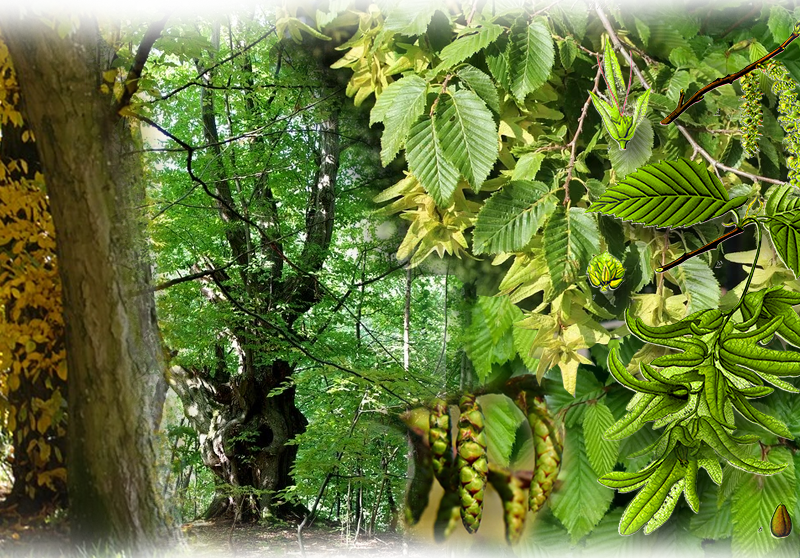
Hornbeam
 3
3 4
4 8
8Will it grow where I live?
Hornbeam is hardy to zone 5 – that covers all of Central Europe and the British Isles, and every USDA zone from 5 upwards.
Or check it for your location right here:
Profile
- Family
- Betulaceae
- Habit
- Tree
- Height
- 25 m
- Spread
- 20 m
- Growth
- medium
- Lifespan
- 150 years
- First yield
- after 15 years
- Hardiness
- zone 5–7
- Shade tolerance
- full shade
- Soil
- Sand, Silt, Loam, Clay
- Soil moisture
- semi-dry – near water
- pH
- 4 – 7
Flowering & harvest
| J | F | M | A | M | J | J | A | S | O | N | D | |
|---|---|---|---|---|---|---|---|---|---|---|---|---|
| Flowering | ||||||||||||
| Fruit harvest | ||||||||||||
| Leaf harvest |
Uses
Edible: Hornbeam is not a fruit plant, but it does yield two edible parts of modest significance. The young, still-soft leaves of the spring flush are eaten raw, added to salads or worked into herb butter and herb salt; they taste mild and faintly nutty, but toughen quickly and gather tannin as they age, so the window runs only a few weeks in April and May. The nutlets are small, hard-shelled and firmly enclosed in their winged bract; they hold an oily kernel that is edible, but the ratio of effort to return rules out any serious use. Historically hornbeam mattered more as a fodder tree: pollarded and shredded, it supplied winter feed for livestock over centuries.
Medicinal: Hornbeam plays almost no part in medicine. What is recorded is the use of the tannin-rich bark as an astringent: decoctions were used to wash out wounds and as a gargle for sore throats, and young leaves served as a dressing on minor injuries. No evidence of efficacy exists for this, and any effect is confined to the general action of tannins. The species has a tradition of its own in the Bach flower system, where Hornbeam is listed as a remedy for the feeling of mental weariness before a task in hand — an attribution without pharmacological basis, mentioned here only as a historically attested use.
Other uses: Hornbeam timber is the hardest and toughest of the Central European broadleaves — heavy, fine-fibred, dense and exceptionally resistant to wear, while difficult to work and poor at splitting. It was the classic wood for anything that must take friction and impact: cogs and shafts in water and wind mills, plane bodies, tool handles, chopping blocks, parquet and, to this day, the action parts in piano building. As firewood it has the highest calorific value of the native broadleaves. The bark yields a yellow dye. In the landscape hornbeam was moreover the mainstay of coppice and pollard management, and is planted today as hedge, topiary, windbreak and street tree where soil compaction and clipping defeat other species.
Growing
Site: Hornbeam is the hedging tree of Central Europe, and the reason is marcescence: clipped plants keep their brown foliage through the winter and give a screen no other deciduous species provides. It is also the only one of the large broadleaves to endure permanent half-shade, which is why it works beneath old trees and on the north side of buildings. It tolerates heavy, compacted and seasonally wet soils and copes with urban conditions. Important for planning: as a heart-rooter it competes strongly in the root zone with perennials and vegetable beds, and a hedge draws noticeable water and nutrients from the bed beside it — allow half a metre of clearance. It flowers in April and is wind-pollinated, and as a member of the birch family its pollen triggers allergies; right outside a bedroom window it is a poor choice. Left unclipped it reaches 20 metres. Care: The timing of the cut is the one real source of error. Prune from late June into July, once the first flush has finished, and again in late summer if needed. Do not prune in spring: hornbeam bleeds heavily from the cuts then. Clip hedges to a trapezoid, wider at the base than the top, or the hedge goes bare from below. Its excellent capacity to reshoot allows drastic cuts into old wood, right down to coppicing — an over-aged hedge can be renewed this way in two years. An established hedge needs hardly any feeding; young plants want even watering through their first two summers. Deer browse young plants readily, so a fence is necessary in the first years where deer are about. Diseases play practically no part.
Propagation
Hornbeam is raised from seed. The winged nutlets ripen from September to October and carry a stubborn dormancy: once they have dried out, they germinate only in the second spring. The nurseryman's trick is green collection — the fruits are picked in August while the wings are still greenish and sown at once, so the seedbed comes up the following spring. With dry-stored seed, a warm-cold stratification of two to three months warm followed by three to four months cold does the job. Hedging plants normally go in as two- or three-year-old, repeatedly transplanted seedlings, which secures a dense structure from the base. Cuttings root poorly and play no part; layering, by contrast, is reliable. Special forms such as the upright 'Fastigiata' are grafted onto seedling stocks in winter.
Value for wildlife
Hornbeam is one of the mainstay insect plants of Central European broadleaved woodland. Over seventy insect and mite species live on it, among them 56 species of moth and butterfly caterpillars — four of them found on nothing else — and four beetle species. For bees it matters only as a pollen source: it flowers in April and is wind-pollinated, offering no nectar, but its pollen is used by two wild bee species and by honeybees at a time when any pollen counts. The nutlets hang on into winter and are worked out by hawfinches, other finches and tits. Its greatest contribution, though, is structural: a clipped hornbeam hedge keeps its withered foliage through the winter and so becomes a densely covered roosting and nesting place of a kind otherwise only evergreens provide; blackbirds, dunnocks and warblers nest in it in spring. Old pollards develop cavities and deadwood and support woodpeckers, bats and wood-dwelling beetles.
Notable
Special features: +Wind, embankment & privacy protection, ++Head+Climbing tree; were hewn and bent with axes to grow together with blackberries, dog roses etc. to form impenetrable enclosures/landwehrs; Likes to be associated with oaks; Winter standing (retains leaves); <1% of the German forest, ++Firewood: 2200kWh/rm, 4.2kWh/kg;
Origin & habitat
Europe and western Asia: centred on Central Europe, extending to southern Scandinavia, the Balkans, northern Anatolia, the Caucasus and the Alborz range of northern Iran. The northern limit runs from southwest England through northern Belgium to northern Denmark, where hornbeam reaches its northernmost point at 57 degrees 30 minutes north. In altitude it ranges from sea level in the north to 2,300 metres in the Alborz. Its range follows the suboceanic climate: it avoids both the summer-dry Mediterranean and the continental cold of Eastern Europe, yet at its range margins tolerates temperatures down to minus 30 degrees. Throughout Central Europe it is common and not at risk.
Hornbeam is the character species of the oak-hornbeam woods (Carpinion betuli), the community that replaces beech on fertile, fresh to periodically wet soils — wherever waterlogging, a fluctuating water table or frost hold beech back. Typical soils are brown earths and pseudogleys in the mesotrophic to eutrophic range. Ecologically it is a half-shade to shade plant: it endures years of shading in the understorey and waits, which makes it a reliable companion of oak and ash. Its most striking trait is marcescence — the withered autumn foliage stays on the twigs through winter, particularly on young and regularly clipped plants. Pollination is by wind, and the nutlets carry a three-lobed wing that spins them away on winter gusts.
Frequently asked questions
Hornbeam: how big does it get?
Hornbeam (Carpinus betulus) grows as a Tree and reaches roughly 25 m in height when mature, with a spread of about 20 m. Growth is medium.
Hornbeam: what site does it need?
Hornbeam tolerates full shade. Suitable soils are Sand, Silt, Loam, Clay. Soil moisture should be in the range semi-dry – near water. The pH may lie between 4 and 7.
Hornbeam: is it hardy?
Hornbeam is listed as hardy in zone 5–7 and survives normal winters outdoors there.
Hornbeam: will it grow in Central Europe?
Hornbeam is hardy to zone 5 – that covers all of Central Europe and the British Isles, and every USDA zone from 5 upwards.
Hornbeam: when does it flower?
In a temperate northern-hemisphere climate it flowers in May.
Hornbeam: when is it harvested?
In a temperate northern-hemisphere climate the fruit ripens in November.
Hornbeam: is it poisonous?
No toxicity is recorded for Hornbeam. With wild plants, never rely on a database alone — only on a confident identification.
Hornbeam: what is it used for?
Rated on a scale up to 10: Edible 3/10, Medicinal 4/10, Other uses 8/10.
Plan this plant into your own garden
Permaplans plans your garden to scale on the map — with a site check, harvest calendar and over 1,000 plants. Free for iPhone, Android, Mac, Windows & Linux.
Will this plant grow where you live? → Check your site
Community experience
No first-hand reports for this plant yet.
Growing it? Write in the app what works for you – your post will show up here.
💬 Get the app and join in