
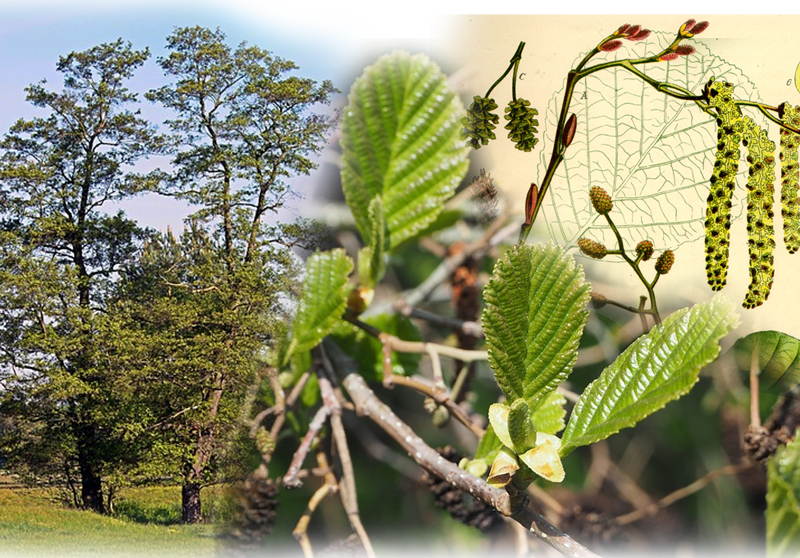
Black alder
 7
7 9
9Will it grow where I live?
Black alder is hardy to zone 4 – that covers all of Central Europe and the British Isles, and every USDA zone from 4 upwards.
Or check it for your location right here:
Profile
- Family
- Betulaceae
- Habit
- Tree
- Height
- 25 m
- Spread
- 10 m
- Growth
- very fast
- Lifespan
- 120 years
- First yield
- after 6 years
- Hardiness
- zone 4–8
- Shade tolerance
- partial shade
- Soil
- Silt, Loam, Clay
- Soil moisture
- semi-dry – near water
- pH
- 4.4 – 7.2
- Synonyms
- rle
Flowering & harvest
| J | F | M | A | M | J | J | A | S | O | N | D | |
|---|---|---|---|---|---|---|---|---|---|---|---|---|
| Flowering | ||||||||||||
| Fruit harvest |
Uses
Other uses: Alder trees are resilient to pruning and exposure to saltwater, suitable for windbreaks or hedgerows. They have a rapid growth rate of over one meter per year, making them ideal pioneer species for restoring forests on abandoned farmland and challenging terrains. Alders facilitate the fixation of atmospheric nitrogen by binding bacteria to their roots, benefiting neighboring plants. Additionally, they are valuable for land reclamation and biomass production. The annual productivity of alders ranges from 6 to 9 tons per hectare, with an estimated yield of 11.8 tons of pulverized fuel ash and 8.66 tons per hectare annually. Alders are recommended for firewood plantations in tropical highlands. The bark of alder trees has been historically used in toothpaste and as a natural dye. Alder wood, known for its water resistance, flexibility, softness, and ease of handling, is commonly utilized in furniture making, pencil production, bowl crafting, and other wooden items.
Growing
Site: Black alder belongs in the wet part of the plot — a stream bank, a hollow, a pond edge or a compacted waterlogged patch. Groundwater within reach of the roots, down to about 1.5 metres, is the real requirement; on dry sand and on limestone it fails. Its root nodules noticeably enrich the soil with nitrogen: good for hungry neighbours, bad for anything that needs lean conditions. It grows fast, is markedly light-demanding and soon shades its own surroundings. Its roots follow water and will enter drains and leaking pipes. Flowering in February and March releases large amounts of strongly allergenic pollen — do not plant it right outside bedroom windows or seating areas. Care: Do not fertilise; the alder supplies its own nitrogen through its root nodules. Young plants need protection from browsing, and from beavers near water. It takes cutting extremely well: coppiced to the stool it regrows vigorously, pollards can be maintained for decades, and in coppice rotation the wood is ready after 20 to 25 years. Alder leaf beetle can strip a tree almost bare in summer; the alder refoliates and intervention is not worthwhile. More serious is alder dieback caused by Phytophthora alni along running water, shown by small yellowed leaves and black tarry patches at the stem base. There is no treatment — remove affected trees and disinfect cutting tools.
Propagation
Seed is the simplest route. The small, narrowly winged nutlets sit in woody cone-like catkins that turn brown from October; harvest before they open in winter and let the cones after-ripen dry. Freshly sown seed germinates in spring without pretreatment, while stored seed benefits from about four weeks of cold stratification. Sow shallowly onto permanently moist substrate, as the seedlings will not tolerate drying out. The yield is low: a kilogram holds roughly 700,000 seeds, from which only 20,000 to 25,000 plantable seedlings can be raised on average. In the wild the nutlets float and stay viable for over a year, which is how alder colonises new stretches of bank. Vegetatively it regenerates readily from the stool; hardwood cuttings root unreliably.
Value for wildlife
Black alder is among the most productive native trees for wildlife. Its foliage feeds the caterpillars of some 95 moth and butterfly species, about 23 of them confined to alders, plus roughly ten beetle species tied to the genus, foremost the alder leaf beetle. It matters little to wild bees — the catkins are wind-pollinated and yield no nectar — but honeybees and bumblebees collect its pollen in February and March when almost nothing else is in flower. The seeds are a staple winter food for siskin, redpoll, goldfinch and hawfinch; at least 16 bird species use them. Alder carr additionally supplies deadwood, cavity trees and hard-to-reach cover for waterfowl and amphibians.
Notable
Special features: Calorific value per annual growth: 32,800 kWh/ha; 70 kg nitrogen/ha; At 20-25 years, the wood is already ready for harvest; low calorific value, but low smoke; black ink from alder cones; young twigs as sticky mosquito traps; stilt houses like those in Venice on water-resistant alder wood; ~2.1% of German forests; 1,500 kWh/m²; 4.1 kWh/kg waterlogged wood is as hard and strong as oak
Origin & habitat
Europe to western Siberia, Asia Minor and North Africa. Black alder covers almost all of Europe from the Mediterranean to central Scandinavia; it is absent from the far north and from northern Russia. Eastwards its range extends through the Caucasus and Asia Minor into western Siberia, southwards to isolated outposts in the mountains of North Africa. Its centre lies in the lowlands and lower montane belt, rarely above 800 metres. In North America, New Zealand and southern South America it has escaped from forestry plantings and is locally regarded as a problematic introduction.
Black alder is the stand-forming tree of alder carr, of stream and floodplain woodland and of alder-ash forest. It roots in permanently waterlogged gleys, stagnogleys and fens where other trees fail, and tolerates periodic inundation. It is absent from dry sandy soils and from limestone sites. Root nodules with bacteria of the genus Frankia fix atmospheric nitrogen and enrich even biologically inert raw soils, which makes it a successful pioneer on spoil heaps, tips and drained bogs as long as groundwater stays within reach of the roots. Being markedly light-demanding, it is pushed onto the wet sites by more competitive species.
Frequently asked questions
Black alder: how big does it get?
Black alder (Alnus glutinosa) grows as a Tree and reaches roughly 25 m in height when mature, with a spread of about 10 m. Growth is very fast.
Black alder: what site does it need?
Black alder tolerates partial shade. Suitable soils are Silt, Loam, Clay. Soil moisture should be in the range semi-dry – near water. The pH may lie between 4.4 and 7.2.
Black alder: is it hardy?
Black alder is listed as hardy in zone 4–8 and survives normal winters outdoors there.
Black alder: will it grow in Central Europe?
Black alder is hardy to zone 4 – that covers all of Central Europe and the British Isles, and every USDA zone from 4 upwards.
Black alder: when does it flower?
In a temperate northern-hemisphere climate it flowers in April.
Black alder: when is it harvested?
In a temperate northern-hemisphere climate the fruit ripens in October.
Black alder: is it poisonous?
No toxicity is recorded for Black alder. With wild plants, never rely on a database alone — only on a confident identification.
Black alder: what is it used for?
Rated on a scale up to 10: Medicinal 7/10, Other uses 9/10.
Plan this plant into your own garden
Permaplans plans your garden to scale on the map — with a site check, harvest calendar and over 1,000 plants. Free for iPhone, Android, Mac, Windows & Linux.
Will this plant grow where you live? → Check your site
Community experience
No first-hand reports for this plant yet.
Growing it? Write in the app what works for you – your post will show up here.
💬 Get the app and join in