
 6
6 3
3 6
6Will it grow where I live?
Tree hazel is hardy to zone 5 – that covers all of Central Europe and the British Isles, and every USDA zone from 5 upwards.
Or check it for your location right here:
Profile
- Family
- Betulaceae
- Habit
- Tree
- Height
- 20 m
- Spread
- 7 m
- Growth
- slow
- Lifespan
- 120 years
- First yield
- after 7 years
- Yield per plant
- up to 10 kg a year
- Yield in cultivation
- up to 2 t/ha
- Energy yield
- 300 kcal per m² a year
- Hardiness
- zone 5–7
- Shade tolerance
- partial shade
- Soil
- Sand, Silt, Loam
- Soil moisture
- dry – very moist
- pH
- 6 – 9
- Synonyms
- Haselbaum,
Flowering & harvest
| J | F | M | A | M | J | J | A | S | O | N | D | |
|---|---|---|---|---|---|---|---|---|---|---|---|---|
| Flowering | ||||||||||||
| Fruit harvest |
Uses
Edible: Seeds can be consumed raw or cooked and are high in oil content, with a pleasant taste resembling hazelnuts. They mature in the fall and need protection from squirrels. When stored unpeeled in a cool location, they can last for a minimum of 12 months and are utilized for making edible oil.
Medicinal: The tuber of C. yanhusuo possesses antispasmodic, hallucinogenic, and heart rate-reducing qualities. Harvested in spring before flowering, it is dried for use. Caution is advised when using the plant, especially for treating Parkinson's disease and neurological disorders. In Sweden, the plant is grown for medicinal purposes, with limited information available. Traditionally, the tuber is known for pain relief, improving circulation, and promoting relaxation. Additionally, it has antiseptic properties and is applied in treating diverse conditions.
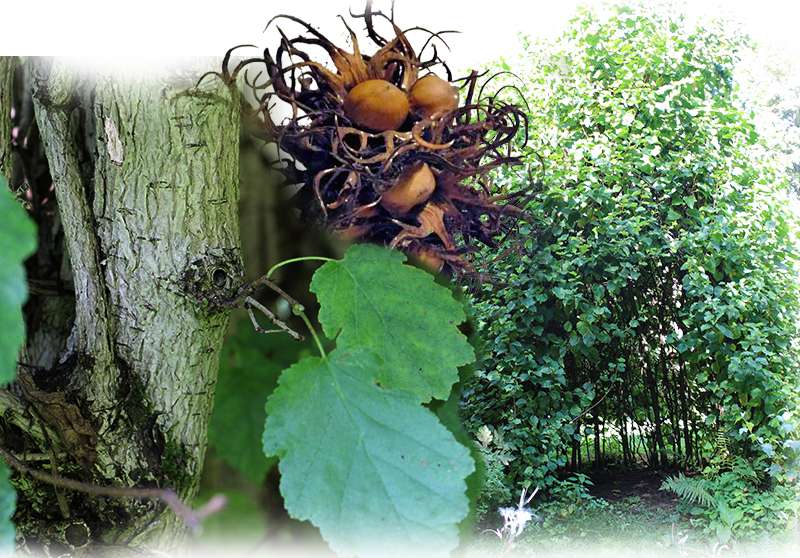
Other uses: The wood of Turkish hazel is firm, moderately hard, elastic and markedly slow to rot; it is valued for furniture, turnery and inlay work and makes good firewood. The seeds yield an oil used in paints and pharmacy. Horticulturally its most important role is as a grafting rootstock for hazelnut cultivars, to which it gives a stable, sucker-free trunk. Crosses with American hazel have produced the trazels, highly resistant to eastern filbert blight, and crosses with common hazel the Corylus × colurnoides known for some 150 years. The straight, pliable young shoots weave well and are used in living willow-style structures.
Growing
Site: Turkish hazel becomes a conical tree of fifteen to twenty metres and needs room accordingly — it is no hedging plant. Its taproot makes it wind-firm and resistant to drought, heat and pollution, and thus one of the most dependable climate-adapted street trees for paved settings; that same root also makes it almost impossible to move, so plant it young and in its final place. Unlike common hazel it produces no suckers and does not spread. The ripe nuts drop by themselves and roll about on paving, so it is awkward over terraces and parking spaces. The catkins open in February and March and shed strongly allergenic pollen — keep a distance from seating and bedroom windows. For a worthwhile nut crop you need several trees, or a common hazel nearby as a pollen donor. Care: Formative pruning is unnecessary, as the tree builds a continuous trunk of its own accord; it grows about sixty centimetres a year at first, later some thirty-five. Young plants need a vole basket and browsing protection, after which the tree largely looks after itself. First nuts fall from the third or fourth year, full cropping begins only in the twelfth and amounts to four or five, at best ten kilograms per tree — but only every four to five years, with markedly lighter crops in between. Plantation spacing is six by six metres. Harvest in September from the ground, ideally with netting or a sweeper, before squirrels and corvids take over. The nut weevil can be kept in check by consistently collecting infested nuts; the species is resistant to eastern filbert blight. Unshelled and cool, the nuts keep for about a year.
Propagation
Turkish hazel is raised from seed. Sown fresh in autumn it usually germinates the following spring, though often only a year later — that is normal, not a failure, so do not clear the bed prematurely. Stored nuts need a warm phase of several weeks followed by three to four months of cold stratification. Mouse protection over the seedbed is essential, as the nuts are reliably plundered. Because seedlings immediately drive a strong taproot, they belong in deep pots or straight into their final position; later attempts to move them often fail. Layering and suckers, which make common hazel so easy to multiply, are not available here. Conversely, Turkish hazel is itself a valued grafting rootstock for hazelnut cultivars, precisely because it forms a continuous trunk and does not sucker.
Value for wildlife
As a tree from south-eastern Europe, Turkish hazel supports considerably fewer species in central Europe than the native common hazel: one wild bee, Andrena varians, and five moth caterpillars are documented so far, among them the hazel leaf-miner and the mottled beauty. Its contribution lies elsewhere. The catkins open in February and March and then release large amounts of pollen — valuable to honeybee colonies and early-flying bumblebee queens at a time when almost nothing else is out. The nuts feed squirrels, edible dormice, nuthatches, jays and great spotted woodpeckers, which also carry them off and bury them. And as a large, long-lived tree it supplies nest sites, perches and later cavities on hot, dry sites where native species struggle.
Notable
Special features: wind+drought+pollutant-resistant → good street tree, difficult to transplant; easy to weave for natural structures; in Bremen, there is a hazel tree planted in 1802 (12 m tall); initially rapid growth: 60 cm per year, later 35 cm; see also the hazel tree house by Konstantin Kirsch (www.naturbauten.org)
Origin & habitat
South-eastern Europe to the Himalaya. The natural range of Turkish hazel runs from the Balkans — Serbia, Bosnia, Bulgaria, northern Greece — across the Carpathians and Asia Minor into the Caucasus, and on into northern Iran, northern Pakistan and the western Himalaya. Nowhere does it form stands; it always occurs as scattered individual trees. It has been planted in central Europe as a park and street tree since the sixteenth century and is an inconspicuous introduction here that rarely self-seeds. Since around 2000 it has also been grown in plantations for nut production in Bavaria and Baden-Württemberg.
Turkish hazel grows in warmth-loving mixed deciduous forest in the hill country of south-eastern Europe and western Asia, mostly between 300 and 1,800 metres, in ravine woodland, at the foot of slopes and in stream valleys together with beech, hornbeam, oak, maple and lime. It prefers deep, often calcareous soils with good subsoil water, yet tolerates summer drought at the surface because it drives a strong taproot downwards. Unlike common hazel it is not a shrubby woodland-edge species but a single-stemmed forest tree that grows up within closed stands, reaching twenty metres.
⚠️ Hazards
Nut allergy Hazelnuts are among the food allergens subject to mandatory labelling, and the nuts of Turkish hazel are equivalent to those of common hazel in this respect.
Frequently asked questions
Tree hazel: how big does it get?
Tree hazel (Corylus colurna) grows as a Tree and reaches roughly 20 m in height when mature, with a spread of about 7 m. Growth is slow.
Tree hazel: what site does it need?
Tree hazel tolerates partial shade. Suitable soils are Sand, Silt, Loam. Soil moisture should be in the range dry – very moist. The pH may lie between 6 and 9.
Tree hazel: is it hardy?
Tree hazel is listed as hardy in zone 5–7 and survives normal winters outdoors there.
Tree hazel: will it grow in Central Europe?
Tree hazel is hardy to zone 5 – that covers all of Central Europe and the British Isles, and every USDA zone from 5 upwards.
Tree hazel: when does it flower?
In a temperate northern-hemisphere climate it flowers from April to May.
Tree hazel: when is it harvested?
In a temperate northern-hemisphere climate the fruit ripens in October.
Tree hazel: when does it start cropping, and how much?
Tree hazel first crops after 7 years. A mature plant gives up to 10 kg a year, in cultivation up to 2 t per hectare. Figures assume a good site; variety, soil and climate shift them considerably.
Tree hazel: is it poisonous?
No toxicity is recorded for Tree hazel. With wild plants, never rely on a database alone — only on a confident identification.
Tree hazel: what is it used for?
Rated on a scale up to 10: Edible 6/10, Medicinal 3/10, Other uses 6/10.
Plan this plant into your own garden
Permaplans plans your garden to scale on the map — with a site check, harvest calendar and over 1,000 plants. Free for iPhone, Android, Mac, Windows & Linux.
Will this plant grow where you live? → Check your site
Community experience
What Permaplans users wrote about this plant – taken from the app as is. 1 post.
Konstantin Kirsch hat eine Naturbaute aus Baum-haseln wachsen. Ich habe Baum-Haseln zum erstenmal in Städten als Allee-Baum entdeckt und war verblüfft wieso kann Hasel so ein Baum sein.
Growing it? Write in the app what works for you – your post will show up here.
💬 Get the app and join in