
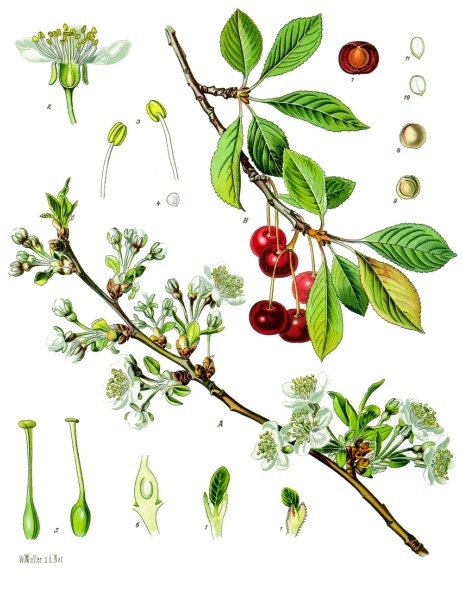
Sour cherry
 7
7 4
4 5
5Will it grow where I live?
Sour cherry is hardy to zone 3 – that covers all of Central Europe and the British Isles, and every USDA zone from 3 upwards.
Or check it for your location right here:
Profile
- Family
- Rosaceae
- Habit
- Tree
- Height
- 6.5 m
- Spread
- 6 m
- Growth
- medium
- Lifespan
- 50 years
- First yield
- after 6 years
- Hardiness
- zone 3–9
- Shade tolerance
- light shade
- Soil
- Sand, Silt, Loam
- Soil moisture
- dry – moist
- pH
- 6 – 7.5
Flowering & harvest
| J | F | M | A | M | J | J | A | S | O | N | D | |
|---|---|---|---|---|---|---|---|---|---|---|---|---|
| Flowering |
Varieties (26)
26 varieties of Sour cherry are listed in the Permaplans variety finder — each with its own page: taste, ripening time, disease resistance, parentage and use.
- Achat Large-fruited, Monilia-tolerant Pillnitz Morello variety with intense flavour.
- Beutelspacher Rexelle
- Carmine Jewel Compact, very cold-hardy sour cherry with sweet, dark flesh.
- Csengődi Robust Hungarian sour cherry with high brown-rot resistance.
- Diemitzer Amarelle
- Filsener Glaskirsche
- Gerema Robust dark Morello-type from Geisenheim, reliable-cropping and self-fertile.
- Heimanns Rubin
- Karneol Large-fruited, mild Pillnitz sour cherry, also good for fresh eating.
- Kelleris 16 Early, very hardy Danish sour cherry for harsh sites, self-fertile.
- Königin Hortense
- Köröser Weichsel Aromatic Hungarian Pándy sour cherry with firm, dark flesh and high quality.
- Korund
- Ludwigs Frühe Early, self-fertile amarelle with juicy, sweet-tart, aromatic flesh.
- Meteor Cold-hardy, compact amarelle from Minnesota, ideal for small gardens in cold zones.
- Minister von Podbielski
- Montmorency The world's leading amarelle with light flesh and clear juice, the US juice-industry standard.
- Morellenfeuer
- Morina Very late, rain-crack-resistant Pillnitz Morello with high Monilia tolerance.
- North Star Genetic dwarf Morello from Minnesota, extremely hardy and space-saving.
- Rote Maikirsche
- Safir Late, Monilia-tolerant Pillnitz Morello with intense flavour for processing.
- Schattenmorelle The classic dark Morello-type sour cherry for preserving, self-fertile and shade-tolerant.
- Schöne von Chatenay
- Stevnsbaer
- Ungarische Traubige Heavy-bearing Hungarian sour cherry (Balaton) with firm, dark flesh, self-fertile.
Uses
Edible: The fruits reach 15 to 20 millimetres, are light to blackish red and distinctly more acid than sweet cherries. The cultivar groups differ considerably: Amarelle and glass cherries have pale flesh and uncoloured juice and are mild enough to eat fresh, morellos and sweet morellos are darker and sweet-sour, and the Schattenmorelle is dark red and pronouncedly tart. Their real field is the kitchen: cakes, compote, jam, juice and kirsch. Besides malic and tartaric acid the fruits contain anthocyanins, rutin and chlorogenic acid, along with vitamins A, B, C and E, potassium and folate. The melatonin content of up to 13.5 nanograms per gram is notable, considerably higher in Montmorency than in Balaton.
Medicinal: Folk medicine has used sour cherries since antiquity for intestinal complaints, and dried fruit stalks are traditionally taken as a diuretic tea. In recent years research has focused above all on the juice: effects on uric acid levels in gout and hyperuricaemia, on inflammatory markers, on muscle soreness after exercise and — because of the comparatively high melatonin content — on sleep. No reliable therapeutic recommendations follow from this so far; the evidence is inconsistent and the quantities studied lie well above normal consumption.
Other uses: Besides the fruit, the sour cherry yields usable timber: reddish, medium-hard and fine-pored, though the slender trunks limit it to turnery, tool handles and small furniture parts. As an early and profuse flowering shrub it is a valued bee plant, with nectar sugar content between just under ten and fifteen percent. Seedlings and own-rooted stock serve as rootstocks in fruit growing. Its tendency to sucker makes the species suitable for informal hedges and for stabilising banks, where it forms colonies over time and creates cover. Branches cut in December and brought into the warm will break into flower indoors, a long-standing midwinter custom.
Growing
The sour cherry is less demanding and hardier than the sweet cherry, and is therefore the cherry for harsh sites. It wants full sun and a loose, fertile sandy loam; it tolerates neither waterlogging nor prolonged drought, since its water requirement exceeds that of the sweet cherry. Because it flowers only in April and May it escapes most late frosts. Almost all cultivars are self-fertile, so no second tree is needed. Cropping begins early and is regular. Pruning is decisive: the Schattenmorelle group fruits on one-year-old extension shoots and becomes bare from the inside without annual thinning; spent shoots are cut back to young wood after harvest. The main problem is Monilia blossom wilt, which must be cut back well into healthy wood.
Propagation
Cultivars are always grafted, since seedlings do not come true. The usual method is budding in August at ten to twenty centimetres above ground, with whip grafting and cleft grafting as late-winter options. Rootstocks are wild cherry seedlings for vigorous trees, or dwarfing types such as Gisela or Weiroot for gardens, which give smaller crowns and earlier cropping. Some cultivars, above all the Schattenmorelle, can also be kept own-rooted: they produce abundant root suckers that can be lifted in winter and planted straight into their final position — the traditional cottage-garden route. Seed propagation is reserved for raising rootstocks; the stones need several months of cold-moist stratification over winter.
Value for wildlife
The sour cherry flowers in April and May and then supplies both nectar and pollen generously, with nectar sugar content between just under ten and fifteen percent. Around 46 wild bee species are recorded on it, including the early-flying European orchard bee, which favours stone-fruit blossom — though none of them are specialists. As larval food it matters less than native wild cherries, but moths such as the eyed hawk-moth and the figure of eight feed on its leaves. The greatest value lies in the fruit: blackbirds, starlings and thrushes strip a tree within days, an annoyance in an orchard and a benefit in a wildlife garden. As a shrub with abundant root suckers it forms dense colonies that provide cover and nest sites in hedges.
Notable
Notes: Flowers later than sweet cherry → little late-frost risk; self-fertile, no pollinator needed; Schattenmorelle fruits only on one-year wood → annual pruning essential; fruit of many cultivars does not detach dry → cut with the stalk rather than pull; melatonin and anthocyanin content well above sweet cherry; hardier and less demanding than sweet cherry, suitable for harsh sites;
Origin & habitat
Western Asia and south-eastern Europe, now cultivated throughout the temperate zone worldwide. The sour cherry is not a wild species but a cross between wild cherry and dwarf cherry that arose around the Caspian and Black Seas. No genuine wild populations are known; escaped trees are found in hedgerows and along woodland edges in many places. Cultivation extends to 63 degrees north in Finland and 68 degrees in Norway, and to 1,600 metres in the southern Alps and 1,800 metres in the central Alps. The largest producers are Russia and Turkey, and in the United States above all Michigan. In Germany the main areas are Rhineland-Palatinate, Baden-Württemberg and Saxony.
A crop plant without a natural habitat of its own, the sour cherry occurs in the Central European countryside mainly as an escape: in blackthorn and privet scrub, on vineyard walls and embankments, in open oak woodland and in traditional orchards. It prefers warm, rather dry summer sites with loose, nutrient- and base-rich sandy loams. It dislikes waterlogging, though it tolerates it better than the sweet cherry; its water and nitrogen requirements are higher. Because it grows as a shrub and forms colonies by root suckering, its place is in semi-open hedge and margin structures — where poor grassland meets the edge of woody vegetation.
⚠️ Hazards
Toxic kernels and leaves, toxic to dogs, cats and horses As in all Prunus species, the seeds, leaves and bark contain cyanogenic glycosides that release hydrogen cyanide when chewed or crushed. A single intact stone swallowed by accident is harmless, larger quantities of chewed kernels are not, and home-made kernel extracts are best avoided. The same plant parts are considered toxic to dogs, cats and horses. The flesh of the fruit itself is harmless. The gum that exudes from wounds indicates pruning at the wrong time of year, not a hazard.
Frequently asked questions
Sour cherry: how big does it get?
Sour cherry (Prunus cerasus) grows as a Tree and reaches roughly 6.5 m in height when mature, with a spread of about 6 m. Growth is medium.
Sour cherry: what site does it need?
Sour cherry tolerates light shade. Suitable soils are Sand, Silt, Loam. Soil moisture should be in the range dry – moist. The pH may lie between 6 and 7.5.
Sour cherry: is it hardy?
Sour cherry is listed as hardy in zone 3–9 and survives normal winters outdoors there.
Sour cherry: will it grow in Central Europe?
Sour cherry is hardy to zone 3 – that covers all of Central Europe and the British Isles, and every USDA zone from 3 upwards.
Sour cherry: when does it flower?
In a temperate northern-hemisphere climate it flowers in April.
Sour cherry: is it poisonous?
No toxicity is recorded for Sour cherry. With wild plants, never rely on a database alone — only on a confident identification.
Sour cherry: what is it used for?
Rated on a scale up to 10: Edible 7/10, Medicinal 4/10, Other uses 5/10.
Which Sour cherry varieties are there?
The Permaplans variety finder lists 26 varieties of Sour cherry, including Achat, Beutelspacher Rexelle, Carmine Jewel, Csengődi, Diemitzer Amarelle, Filsener Glaskirsche, Gerema, Heimanns Rubin, Karneol, Kelleris 16, Königin Hortense, Köröser Weichsel and 14 more. Each variety has its own page with taste, ripening time, disease resistance and parentage.
Plan this plant into your own garden
Permaplans plans your garden to scale on the map — with a site check, harvest calendar and over 1,000 plants. Free for iPhone, Android, Mac, Windows & Linux.
Will this plant grow where you live? → Check your site
Community experience
No first-hand reports for this plant yet.
Growing it? Write in the app what works for you – your post will show up here.
💬 Get the app and join in