
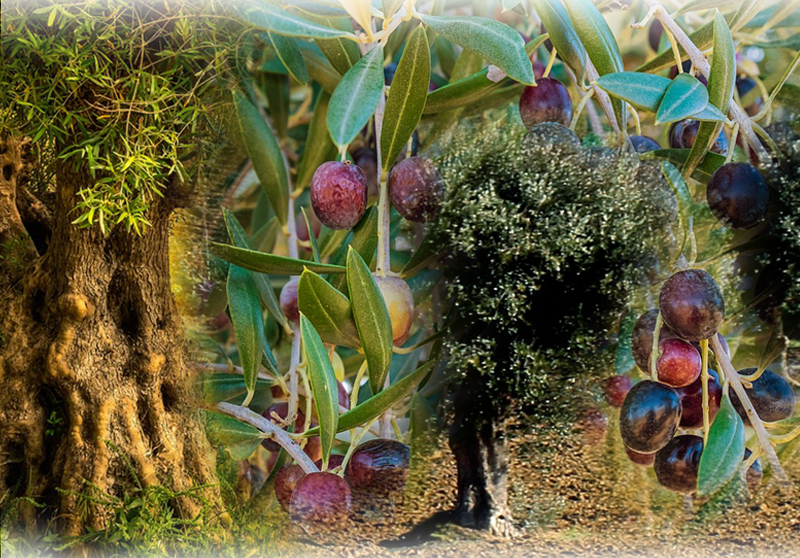
Olive
 9
9 8
8 8
8Will it grow where I live?
Olive is only hardy to zone 8, so outdoors year-round it needs the mildest spots in Central Europe – wine-growing regions, the Rhine valley, coasts, Lake Constance, Ticino – or a container overwintered under cover. Most of the British Isles and the Pacific coast of North America qualify. It also needs warm summers – in Central Europe that means wine-growing regions, cities or a sheltered south-facing wall.
Or check it for your location right here:
Profile
- Family
- Oleaceae
- Habit
- Tree
- Height
- 9 m
- Spread
- 8 m
- Growth
- slow
- Lifespan
- 2000 years
- First yield
- after 8 years
- Full yield
- after 60–100 years
- Yield per plant
- up to 200 kg a year
- Yield in cultivation
- up to 5 t/ha
- Energy yield
- 150 kcal per m² a year
- Hardiness
- zone 8–11
- Shade tolerance
- full sun
- Soil
- Sand, Silt, Loam
- Soil moisture
- very dry – very moist
- pH
- 5.5 – 8
- Synonyms
- Olivenbaum
Flowering & harvest
| J | F | M | A | M | J | J | A | S | O | N | D | |
|---|---|---|---|---|---|---|---|---|---|---|---|---|
| Flowering | ||||||||||||
| Fruit harvest |
Varieties (18)
18 varieties of Olive are listed in the Permaplans variety finder — each with its own page: taste, ripening time, disease resistance, parentage and use.
- Arbequina Early-bearing small-fruited Spaniard – the basis of mild fruity premium oils and ideal for high-density hedge planting.
- Arbosana Low-vigour Catalan variety – with Arbequina and Koroneiki a leading cultivar of super-high-density groves.
- Ascolana Tenera Large-fruited table olive from Le Marche – the base of stuffed, deep-fried 'Olive all'Ascolana'.
- Chemlali Tunisia's dominant oil variety – extremely drought- and heat-tolerant, the backbone of North African oil exports.
- Coratina Powerful Apulian variety – intensely bitter, pungent oils with exceptionally high polyphenol content.
- Cornicabra Spain's second most important oil variety from central Castile – aromatic, very stable and frost-hardy.
- Empeltre Ebro valley variety – yields very mild, sweetish oils and black naturally-cured table olives.
- Frantoio Tuscan reference oil variety – planted worldwide as the quality benchmark for fruity-pungent oils.
- Gordal Sevillana Giant 'Queen olive' from Seville – the largest Spanish table olive, meaty and showy.
- Hojiblanca Andalusian dual-purpose variety – both a black table olive and the basis of balanced oils.
- Kalamata World-famous dark-purple Greek table olive – plump, meaty and PDO-protected.
- Koroneiki Greece's leading oil variety – tiny fruits but the highest oil yield and very aromatic, stable oil.
- Leccino Mild Tuscan partner to Frantoio – frost-hardy, early-ripening and tolerant of the olive disease Xylella.
- Manzanilla The world's most traded green table olive – the classic Spanish 'cocktail' olive.
- Nocellara del Belice Sicilian dual-purpose variety – world-famous as the bright-green, buttery 'Castelvetrano' table olive.
- Picual The world's most planted oil variety – robust, with highly stable oil rich in oleic acid and polyphenols.
- Souri Ancient Levantine variety – defining the oils of Lebanon, Syria, Israel and Palestine, very aromatic and stable.
- Taggiasca Fine Ligurian variety – delicate sweet oils and choice black table olives of the Riviera (kin to Cailletier/Nice).
Uses
Edible: Olives are commonly used in the Mediterranean region as a stimulant and flavoring agent in cuisine. The fruits are typically preserved in water, brine, oil, salt, or lye, or can be dried and consumed without curing, known as "fachouilles." Cured olives are enjoyed as a relish, stuffed with pimento or almonds, or incorporated into various dishes like bread, soups, and salads. "Olives schiacciate" are green olives that are crushed, preserved in oil, and used in salads. Each fruit contains 20-50 µg of vitamin D per 100 g and can reach up to 4 cm in length. The seed is rich in edible, non-drying oil used in salads and cooking as a condiment due to its strong flavor. Olive oil comes in different grades, with the highest quality known as "extra virgin," obtained by cold-pressing the seeds without heat or chemical solvents. Monounsaturated olive oil is believed to lower the risk of cardiovascular disease with regular consumption. The seed also contains protein, a unique characteristic among seeds. Additionally, an edible manna is derived from the olive tree.
Medicinal: The plant has diuretic properties. There is no evidence of a laxative effect, but it contains an alkaloid with mydriatic effects. The seeds, known for their pungent taste and highly toxic potency, are utilized in Tibetan medicine. They offer analgesic, anthelmintic, antibacterial, anti-inflammatory, and antipyretic properties. Regular consumption boosts physical vitality and aids in treating infectious diseases, toothaches, worm-induced intestinal pain, and impotence. A seed decoction is employed to address fever.
Other uses: The oil from the seeds serves various purposes like soap production, illumination, and lubrication. It is beneficial as a hair treatment and for dandruff. Dyes in chestnut-brown and purple hues come from fresh, ripe fruits, with blue and black dyes from the skins. Yellow-green dye is obtained from the leaves. These plants help secure arid, dusty inclines. The wood, hard and heavy with a lovely grain, is easily polished and faintly fragrant. It is favored in woodturning, joinery, and esteemed by wood craftsmen.
Growing
Site: Free-draining and rather lean — waterlogging kills it more reliably than frost does. In Central Europe the winter alone decides: at about -12 °C it is only marginally hardy and belongs in a container, in the warmest sheltered spot, ideally against a south-facing wall. Planted out it succeeds only in mild vine-growing areas. Its powers of recovery are reassuring: from the woody burls at the root collar it reshoots after frost or cutting damage — an apparently dead tree is rarely lost. Care: In summer water too little rather than too much. Feed only from spring until about July; later feeding forces soft wood that survives the winter poorly. Overwinter bright at 5 to 10 °C, never warm indoors — there it drops its leaves and exhausts itself; water only enough to keep the rootball from drying out. In winter quarters scale and mealybugs are the commonest problem, so check the undersides of leaves regularly. Thin in spring, since it flowers on the previous year's wood.
Propagation
Cultivars are not raised from seed, as seedlings do not come true and bear only after many years. Vegetative propagation is the norm: cuttings of semi-ripe shoots root given even moisture and bottom heat and yield genetically identical plants; commercial growing also grafts onto seedling rootstocks. A peculiarity of the species are the woody burls at the root collar, from which new plants can likewise be raised — the same capacity lets old trees reshoot from the stump after frost or fire. Wild plants are dispersed by birds that eat the drupes. Sowing succeeds only after the flesh has been removed completely and the seed stratified at length.
Value for wildlife
The olive flowers in inconspicuous, fragrant panicles and is pollinated primarily by wind; insect pollination is not required for fruit to set. Bees and wild bees do visit the flowers, but mainly for pollen — as a nectar source the olive is of little value. For the insect fauna of Central Europe it hardly matters in any case, since it is usually grown in a container here and rarely reaches the age and flowering mass it achieves in its native range. There, by contrast, old olive groves rank among the most valuable cultural habitats of all: the gnarled, cavity-rich trunks shelter bats, little owls and hoopoes along with a rich deadwood fauna.
Notable
Special features: Drought-resistant, tolerates salty air; stabilizes dry slopes; Cultivation: Trees/ha: traditional 30-200, intensive 250-600, super-intensive 1500-3000; There are self-fertile fruit/oil varieties; 100kg~15L oil; Old trees produce >200kg olives, but only every 6th/7th season; Flowering requires 2 months below 10°C;
Origin & habitat
Mediterranean region and western Asia. The wild form Olea europaea subsp. sylvestris, the oleaster, is native throughout the Mediterranean — from the Iberian peninsula to the eastern Mediterranean coast. Genetic evidence points to the northern Levant as the primary centre of domestication; from there the cultivated olive spread across the whole Mediterranean. Today it is additionally grown in California, South America, South Africa and Australia. There is no natural occurrence in Central Europe; the northernmost planting in Europe has stood at Stommeln near Cologne since 2008, with over 170 trees.
The olive belongs to the evergreen sclerophyllous vegetation of the Mediterranean and is a character species of the Oleo-Ceratonion — the warmest tier of the maquis, tied to hot, summer-dry coastal country. There it grows on dry, stony and shallow soils, in open woodland and scrub, mostly near the coast up to about 200 m. Its optimum lies at annual mean temperatures of 15 to 20 °C and annual rainfall of 500 to 700 mm. Summer drought is part of its habitat and is buffered by deep roots and hard, small-surfaced foliage. Winter cold alone is limiting: severe frosts endanger both crop and stands.
⚠️ Hazards
Olives picked straight from the tree are inedibly bitter. The cause is oleuropein, a bitter compound that protects the fruit against browsers. Olives must therefore be debittered before eating — by soaking in water over several weeks, curing in brine, dry-salting, or treatment with lye. Plain soaking is the gentlest method but takes longest.
Frequently asked questions
Olive: how big does it get?
Olive (Olea europaea) grows as a Tree and reaches roughly 9 m in height when mature, with a spread of about 8 m. Growth is slow.
Olive: what site does it need?
Olive tolerates full sun. Suitable soils are Sand, Silt, Loam. Soil moisture should be in the range very dry – very moist. The pH may lie between 5.5 and 8.
Olive: is it hardy?
Olive is listed as hardy in zone 8–11 and survives normal winters outdoors there.
Olive: will it grow in Central Europe?
Olive is only hardy to zone 8, so outdoors year-round it needs the mildest spots in Central Europe – wine-growing regions, the Rhine valley, coasts, Lake Constance, Ticino – or a container overwintered under cover. Most of the British Isles and the Pacific coast of North America qualify. It also needs warm summers – in Central Europe that means wine-growing regions, cities or a sheltered south-facing wall.
Olive: when does it flower?
In a temperate northern-hemisphere climate it flowers in May.
Olive: when is it harvested?
In a temperate northern-hemisphere climate the fruit ripens from September to October.
Olive: when does it start cropping, and how much?
Olive first crops after 8 years. Full yield comes after 60–100 years. A mature plant gives up to 200 kg a year, in cultivation up to 5 t per hectare. Figures assume a good site; variety, soil and climate shift them considerably.
Olive: is it poisonous?
No toxicity is recorded for Olive. With wild plants, never rely on a database alone — only on a confident identification.
Olive: what is it used for?
Rated on a scale up to 10: Edible 9/10, Medicinal 8/10, Other uses 8/10.
Which Olive varieties are there?
The Permaplans variety finder lists 18 varieties of Olive, including Arbequina, Arbosana, Ascolana Tenera, Chemlali, Coratina, Cornicabra, Empeltre, Frantoio, Gordal Sevillana, Hojiblanca, Kalamata, Koroneiki and 6 more. Each variety has its own page with taste, ripening time, disease resistance and parentage.
Plan this plant into your own garden
Permaplans plans your garden to scale on the map — with a site check, harvest calendar and over 1,000 plants. Free for iPhone, Android, Mac, Windows & Linux.
Will this plant grow where you live? → Check your site
Community experience
No first-hand reports for this plant yet.
Growing it? Write in the app what works for you – your post will show up here.
💬 Get the app and join in