
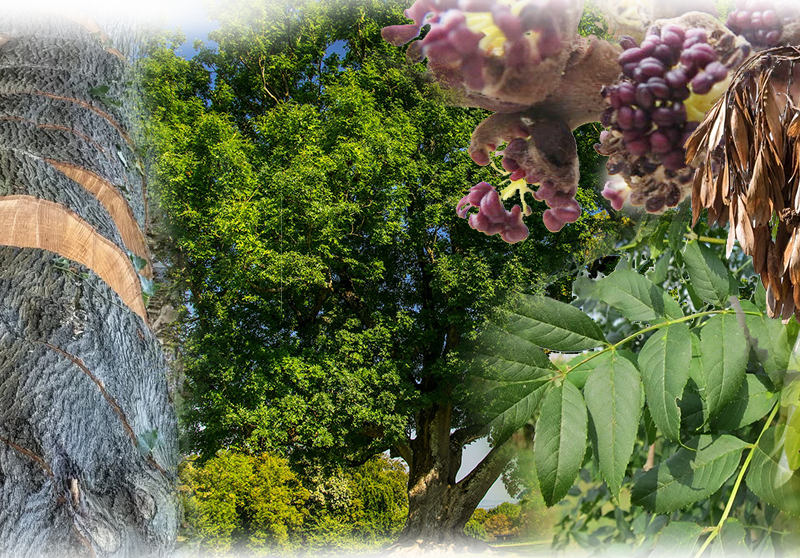
Ash
 4
4 5
5 9
9Will it grow where I live?
Ash is hardy to zone 5 – that covers all of Central Europe and the British Isles, and every USDA zone from 5 upwards.
Or check it for your location right here:
Profile
- Family
- Oleaceae
- Habit
- Tree
- Height
- 33 m
- Spread
- 17 m
- Growth
- very fast
- Lifespan
- 300 years
- First yield
- after 27 years
- Hardiness
- zone 5–8
- Shade tolerance
- partial shade
- Soil
- Sand, Silt, Loam
- Soil moisture
- semi-dry – near water
- pH
- 5 – 8.5
Flowering & harvest
| J | F | M | A | M | J | J | A | S | O | N | D | |
|---|---|---|---|---|---|---|---|---|---|---|---|---|
| Flowering | ||||||||||||
| Fruit harvest |
Uses
Edible: Unripe seeds, vegetable filling, spices, young tender leaves, hop substitute (beer), seeds, baking spice (powdered), cooking oil. The unripe seeds were bought and rid of bitterness. The vegetable filling was marinated in salt and vinegar, then seasoned with spices. The young tender leaves are edible in their raw state. The hop substitute is employed in brewing beer. The seeds serve as a powdered baking spice and are combined with cooking oil.
Medicinal: Leaves can be applied for snakebites. A combination of laxative leaves, fruit, and wood shavings in tea form is beneficial for rheumatism. Wood shavings tea is effective against syphilis. Tea derived from the bark of young branches serves as a styptic for fever. A mixture of ash and vinegar is useful for treating sprained or broken legs.
Other uses: Leaves, bark, and wood play vital roles in the tree. Leaves can be used as animal feed and for coloring. Bark contains tannin, while wood is durable and versatile, suitable for various tools and equipment. Trees offer homes to diverse animal and plant species.
Growing
Site: The health question comes before the site question. Ash dieback, caused by the fungus Hymenoscyphus fraxineus introduced from Asia, has been spreading since the early 1990s. By 2013 at least 95 per cent of Denmark's ash trees were affected, and a 2016 study considers a collapse of European populations over the coming decades possible. Planting a new ash is therefore currently a gamble; where it is done anyway, insist on demonstrably tolerant provenances, on which several forest research institutes are working. The ash demands mineral, deep, fresh to moist soils and avoids pH values below 4.2; it will also take dry limestone rendzinas provided the water supply is adequate. As a heart-rooter with strong near-surface lateral roots - a 90-year-old ash reaches out 350 cm - it lifts paving and paths and is no tree for a cramped front garden. It transpires a great deal of water and can attack damp masonry. At 30 m after a hundred years it needs plenty of room, but casts only light shade and comes into leaf late, so spring flowers thrive beneath it. Its wind-borne seed comes up all over the garden. Its March and April flowers are a strong pollen allergen and do not belong close to sleeping or seating areas. Care: Young ash trees tolerate shade but need increasing light with age and are displaced by beech on good sites; on extreme sites with drought, wet ground or steep slopes it holds its own better. Do not fertilise. Browsing by roe and red deer is considerable in the first years and protection is worthwhile. Prune in late summer, not during sap flow. Watch for ash dieback in the form of dead patches on stem and branches without slime flux, wilting and prematurely shed leaves and dying shoot tips; affected wood is cut out, there is no treatment against the fungus, and a tree above a path or seat must then be checked regularly for the risk of falling limbs. Pull the abundant seedlings in May while they still come up easily. The old practice of pollarding and shredding for leaf hay remains an option and keeps the tree small. Ash lives 250 to 300 years.
Propagation
Ash is easy to raise from seed but demands patience. The winged nutlets ripen from October to November and drop throughout the winter; they spin away up to 60 m, exceptionally 125 m. The seed is deeply dormant and usually lies in the ground for two winters, but stays viable for up to six years. To avoid waiting, harvest green: pick fully developed seed in late summer before it has dried on the tree and sow it straight into an outdoor bed, and it will usually germinate the following spring. Dry-stored seed needs a double stratification - about eight to twelve weeks warm at 20 degrees, then twelve to sixteen weeks moist and cold at 2 to 5 degrees. Germination is epigeal and the net-veined cotyledons reach about 5 cm. Seedlings are lined out after the first or second year. Ornamental forms such as the weeping or one-leaved ash are grafted onto seedling rootstocks of the species. Because of ash dieback it is worth collecting seed from conspicuously healthy old trees standing amid infected stands.
Value for wildlife
The ash is one of the most species-rich native trees there is. A 2014 study estimated around a thousand species associated with ash or ash woodland, among them 239 invertebrates, 55 mammals and 12 birds; 44 species depend on it obligately and disappear with it. As a caterpillar host it carries around 35 moth and butterfly species including two specialists, plus three hoverfly and two beetle species. For flower visitors, by contrast, it offers little: it is the only wind-pollinated member of the olive family, and its March and April flowers have no nectaries and yield only pollen. Sex expression varies from purely male through hermaphrodite to purely female trees. The seed bunches hang all winter and are eaten by bullfinch, hawfinch and chaffinch; short-toed treecreeper, marsh, great and blue tit use the bark and cavities. The deeply fissured bark of old trees carries rich moss and lichen communities.
Notable
Special features: Floodplain, ravine, city & pollard tree, transpires a lot of water/may attack masonry, lets in a lot of sun/casts weak shade; currently major ash dieback due to fungi & co; can change sex; produces offshoots quickly; cult tree of male initiation; 2% of the German forest, Bw: 2100kWh/rm, 4.1kWh/kg; 80 years until ready for felling;
Origin & habitat
Europe to the Caucasus and Asia Minor. The ash covers almost all of Europe: to the north its range runs from Scotland via the Trondheim Fjord and southern Norrland into the Finnish region of Satakunta, to the east as far as the Volga, the Crimea and the Caucasus, though it is absent from the Russian steppes. In the south it occurs on the Balkan Peninsula, in Italy and on the Iberian Peninsula roughly as far as the central Galicia-Ebro line. In the mountains it climbs to 1700 m in Tyrol, 1400 m in the Bavarian Alps and 1800 m in the Caucasus. Until the 1990s it was one of the commonest broadleaved trees in Central Europe; its population has declined sharply since then through ash dieback.
Occurs in various deciduous forest types, often mixed with beech, maple, oak, and alder. Prefers fresh to moist, mineral-rich, and deep soils, often base-rich and calcareous, but can also tolerate seasonally waterlogged sites. Found in river floodplains, slopes, and valleys, generally up to altitudes of about 1000 to 1700 meters. Young plants tolerate shade, while mature trees require more light and open crowns. The species thrives in temperate climates with moderate humidity.
⚠️ Hazards
Irritation from wood dust Ash wood dust irritates the airways when sawing and sanding; a dust mask is worthwhile.
Frequently asked questions
Ash: how big does it get?
Ash (Fraxinus excelsior) grows as a Tree and reaches roughly 33 m in height when mature, with a spread of about 17 m. Growth is very fast.
Ash: what site does it need?
Ash tolerates partial shade. Suitable soils are Sand, Silt, Loam. Soil moisture should be in the range semi-dry – near water. The pH may lie between 5 and 8.5.
Ash: is it hardy?
Ash is listed as hardy in zone 5–8 and survives normal winters outdoors there.
Ash: will it grow in Central Europe?
Ash is hardy to zone 5 – that covers all of Central Europe and the British Isles, and every USDA zone from 5 upwards.
Ash: when does it flower?
In a temperate northern-hemisphere climate it flowers from April to May.
Ash: when is it harvested?
In a temperate northern-hemisphere climate the fruit ripens in August.
Ash: is it poisonous?
Individual parts of Ash are noted as mildly problematic — the plant does not count as poisonous. With wild plants, never rely on a database alone, only on a confident identification.
Ash: what is it used for?
Rated on a scale up to 10: Edible 4/10, Medicinal 5/10, Other uses 9/10.
Plan this plant into your own garden
Permaplans plans your garden to scale on the map — with a site check, harvest calendar and over 1,000 plants. Free for iPhone, Android, Mac, Windows & Linux.
Will this plant grow where you live? → Check your site
Community experience
No first-hand reports for this plant yet.
Growing it? Write in the app what works for you – your post will show up here.
💬 Get the app and join in