
Wild service tree
 6
6 2
2 2
2Will it grow where I live?
Wild service tree is hardy to zone 5 – that covers all of Central Europe and the British Isles, and every USDA zone from 5 upwards.
Or check it for your location right here:
Profile
- Family
- Rosaceae
- Habit
- Tree
- Height
- 20 m
- Spread
- 8.5 m
- Growth
- medium
- Lifespan
- 100 years
- First yield
- after 8 years
- Hardiness
- zone 5–9
- Shade tolerance
- partial shade
- Soil
- Sand, Silt, Loam
- Soil moisture
- dry – moist
- pH
- 6 – 8
Flowering & harvest
| J | F | M | A | M | J | J | A | S | O | N | D | |
|---|---|---|---|---|---|---|---|---|---|---|---|---|
| Flowering |
Uses
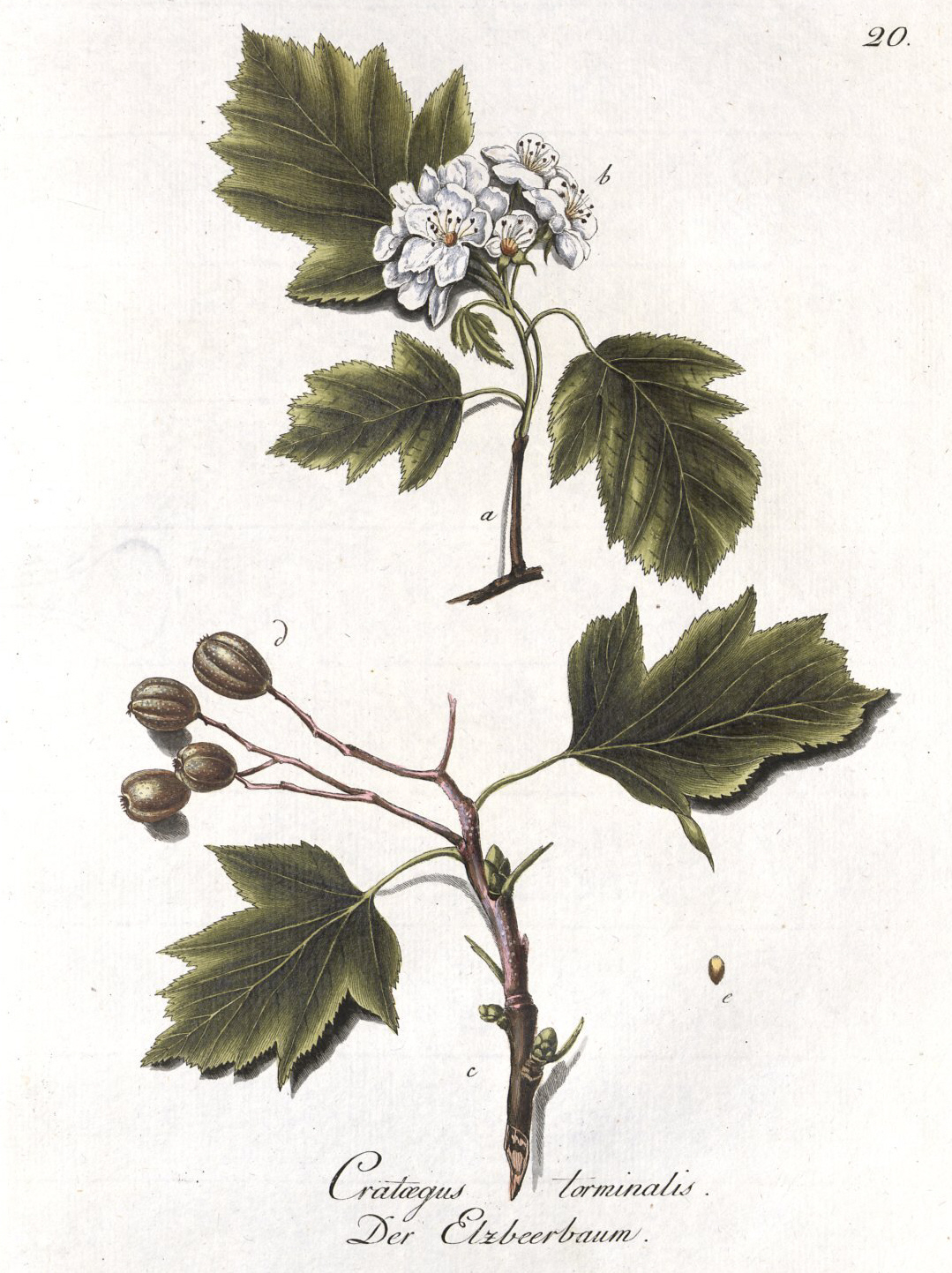
Edible: The oval, apple-like drupes are 1.2 to 1.8 cm across, at first olive green, then reddish yellow with pale dots and finally leather brown with large lenticels. They ripen in October and November but hang on the tree for a long time. Fresh from the tree they are astringent and inedible because of their tannins; only after frost do they go soft and taste pleasantly acidic and aromatic, much like a medlar or apple purée. The flesh contains numerous stone cells. Recorded constituents are vitamin C, tannins, fruit acids, pectin and flavonol glycosides. The fruit is usually processed: blended with low-acid fruit into compote, jam, jelly and juice. Distillation yields the French brandy Eau d'Alizier and the Austrian Adlitzbeerwasser - one of the most expensive spirits there is, fetching around 150 euros per litre.
Medicinal: The specific name torminalis derives from the Latin tormina, meaning gripes or dysentery, and points to its old use: dried unripe fruit was employed in folk medicine against dysentery and diarrhoea, a practice already mentioned by Pliny. The German name Ruhrbirne, dysentery pear, preserved it. The effect is plausible through the high tannin content, which contracts mucous membranes - the same property that makes the unripe fruit inedible. There is no proof of efficacy by present-day standards and the use should be understood historically. Documented constituents are vitamin C, tannins, fruit acids, pectin and flavonol glycosides.
Other uses: The timber is the real treasure of this tree. Yellowish white when fresh and darkening to reddish, it is very hard, tough and fine-grained, and ranks among the hardest woods in Europe. Cabinetmakers, turners and sculptors value it alike; traditionally it was worked into flutes and other musical instruments, small furniture and formerly slide rules. As veneer it is often traded under the name pearwood and used for high-value interiors. Because the species is scarce and yields little timber, top prices are paid in the trade. The tree is also planted in the wider landscape and on farmsteads, prized for its brilliant yellow-orange to red autumn colour. In the Vienna Woods several municipalities have joined forces as the Wiesenwienerwald Elsbeere region, jointly marketing fruit, spirits and craftwork made from the wood.
Growing
Site: A warm, fully sunny position on deep calcareous soil is the precondition; in frost hollows and on heavy wet ground the tree stays stunted. At 8 to 20, exceptionally 25 m with a rounded-ovate crown, this is a tree for large gardens, farmsteads and traditional orchards, not for a small plot. It produces root suckers and can build up thickets over time - a nuisance in tended beds and beside paths, but welcome as the backbone of a hedge or for stabilising a bank. The flowers smell unpleasant, which is noticeable next to a seating area in May and June. As a member of the rose family it is within the host range of fireblight, so keep distance from apple, pear and quince orchards. Care: The wild service tree is self-fertile and needs no pollination partner. Young plants grow slowly and need browsing protection for the first years, as roe deer favour the soft shoots. Prune only in youth to establish a straight leader and as little as possible thereafter; large wounds close poorly. Do not fertilise. Diseases and pests are largely irrelevant, with occasional aphids. Harvest in October and November by hand, traditionally from tall ladders in the Vienna Woods stands. The fruit hangs on for a long time and becomes soft and palatable only after frost - wait too long and the birds take their share. The tree is full-grown at 100 years and lives 200 to 300 years.
Propagation
The wild service tree can be raised from seed or grafted. Several seeds up to 7 mm long sit in each fruit; they are deeply dormant and need cold stratification over at least one winter. Freshly cleaned seed sown into an outdoor bed in autumn germinates in the second spring, often spread over two years. Grafting is faster and true to type: hawthorn and pear seedlings are the traditional rootstocks. At the Klosterneuburg research centre large-fruited Vienna Woods selections were additionally tested on the quince rootstock BA 29; grafts planted in 2011 already fruited in 2012 to 2013, though growth on quince is considered possibly too weak and graft affinity is not conclusively settled. The species also produces root suckers, which can be separated.
Value for wildlife
The wild service tree is a native bird-shelter and bird-food species with good insect value. Its pure white flowers stand in felted corymbs 7 to 12 cm across, open in May and June and yield nectar generously; around 37 wild bee species use them, none of them specialised, alongside about eight hoverfly species. The unpleasant scent attracts mainly flies and beetles. As a caterpillar host it carries around ten moth and butterfly species including one specialist, plus one beetle species bound to it. At least eleven bird species eat the fruit, among them hawfinch, golden oriole, jay, blackbird, fieldfare and carrion crow, and they also disperse the seed. The dense, low-branched crown and the sucker thickets provide cover and nesting sites.
Notable
Special features: Self-fertile, no pollinator needed; flowers smell unpleasant; harvest only after frost, fruit hangs on late; produces root suckers and multi-stemmed thickets; deep-rooting, warmth-loving, summer-warm+winter-mild sites; timber fetches top prices; full-grown at 100 years, lifespan 200-300 years; no nursery cultivars on the market;
Origin & habitat
Europe, Asia Minor, Transcaucasia and North Africa. The species is centred on central and southern Europe; northwards its range reaches Denmark, eastwards Asia Minor and the Caucasus, southwards the mountains of North Africa. In Germany it occurs scattered through Baden-Württemberg, Rhineland-Palatinate, Hesse, Lower Saxony and above all Franconia, which holds roughly half the German population. In Austria the Vienna Woods east of Vienna are the best-known stands. In the Alps it climbs to about 900 m.
The wild service tree is a warmth-loving species of low, summer-warm and winter-mild country, favouring south-facing slopes and ridges. It grows on nutrient-rich calcareous loams as well as on deep, free-draining stony soils, and roots deeply. Its stronghold is open oak and oak-hornbeam woodland, downy oak communities and woodland margins. It is a light-demanding tree that tolerates light shade when young but needs abundant light at maturity; beech is its superior shade competitor and displaces it from the better sites. It never forms stands of its own and always remains an admixed species.
⚠️ Hazards
Unripe fruit hard to digest No toxic effect is known. Unripe fruit is strongly astringent and inedible because of its high tannin content, and larger amounts can upset the stomach. It becomes palatable only once frost has made it soft. The flesh contains numerous hard stone cells and seeds up to 7 mm long, which should be removed during processing.
Frequently asked questions
Wild service tree: how big does it get?
Wild service tree (Sorbus torminalis) grows as a Tree and reaches roughly 20 m in height when mature, with a spread of about 8.5 m. Growth is medium.
Wild service tree: what site does it need?
Wild service tree tolerates partial shade. Suitable soils are Sand, Silt, Loam. Soil moisture should be in the range dry – moist. The pH may lie between 6 and 8.
Wild service tree: is it hardy?
Wild service tree is listed as hardy in zone 5–9 and survives normal winters outdoors there.
Wild service tree: will it grow in Central Europe?
Wild service tree is hardy to zone 5 – that covers all of Central Europe and the British Isles, and every USDA zone from 5 upwards.
Wild service tree: when does it flower?
In a temperate northern-hemisphere climate it flowers in May.
Wild service tree: is it poisonous?
No toxicity is recorded for Wild service tree. With wild plants, never rely on a database alone — only on a confident identification.
Wild service tree: what is it used for?
Rated on a scale up to 10: Edible 6/10, Medicinal 2/10, Other uses 2/10.
Plan this plant into your own garden
Permaplans plans your garden to scale on the map — with a site check, harvest calendar and over 1,000 plants. Free for iPhone, Android, Mac, Windows & Linux.
Will this plant grow where you live? → Check your site
Community experience
No first-hand reports for this plant yet.
Growing it? Write in the app what works for you – your post will show up here.
💬 Get the app and join in