
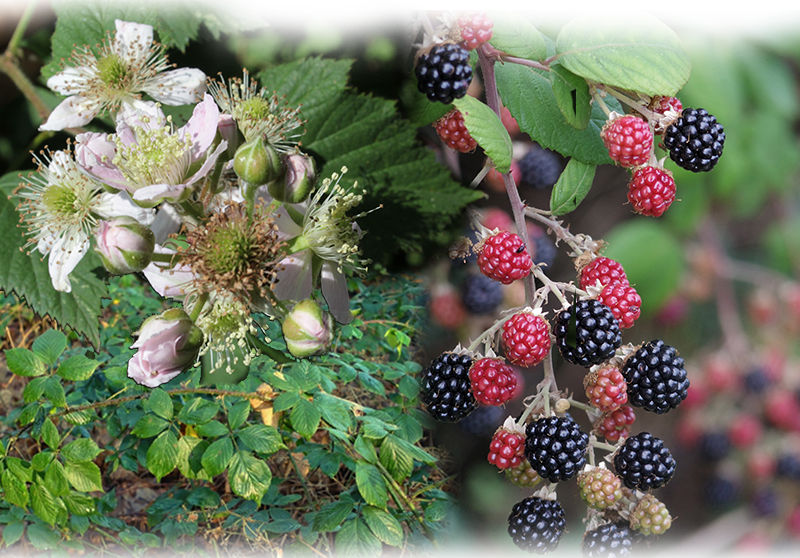
Blackberry
 9
9 6
6 4
4Will it grow where I live?
Blackberry is hardy to zone 5 – that covers all of Central Europe and the British Isles, and every USDA zone from 5 upwards.
Or check it for your location right here:
Profile
- Family
- Rosaceae
- Habit
- Shrub
- Height
- 3 m
- Spread
- 3 m
- Growth
- very fast
- Lifespan
- 30 years
- First yield
- after 2 years
- Full yield
- after 3 years
- Productive years
- 6–25 years
- Hardiness
- zone 5–9
- Shade tolerance
- full shade
- Soil
- Sand, Silt, Loam
- Soil moisture
- very dry – very wet
- pH
- 4.5 – 8
- Synonyms
- Brombeeren
Flowering & harvest
| J | F | M | A | M | J | J | A | S | O | N | D | |
|---|---|---|---|---|---|---|---|---|---|---|---|---|
| Flowering | ||||||||||||
| Fruit harvest |
Varieties (16)
16 varieties of Blackberry are listed in the Permaplans variety finder — each with its own page: taste, ripening time, disease resistance, parentage and use.
- Asterina Modern thornless variety with sweet, aromatic berries and a long harvest.
- Black Satin Productive thornless variety with juicy, glossy-black fruit.
- Chester Thornless Hardy, very productive thornless late variety favoured for commercial growing.
- Dirksen Thornless
- Karaka Black New Zealand variety famed for very long, glossy berries and an extended harvest.
- Kiowa Thorny variety producing some of the largest berries of any blackberry.
- Loch Ness Europe's most popular thornless garden blackberry with an upright, compact habit.
- Loch Tay Early, thornless variety with sweet berries and compact, upright growth.
- Navaho
- Ouachita Thornless, erect variety with sweet, firm berries and good shelf life.
- Reuben First productive primocane (autumn-fruiting) blackberry with very large berries.
- Theodor Reimers Proven, very hardy German standard variety with intensely aromatic fruit.
- Thornfree Proven thornless semi-trailing garden blackberry with a long harvest window.
- Thornless Evergreen Robust thornless classic with huge yields and deeply cut, fern-like leaves.
- Triple Crown Thornless variety prized for excellent sweet flavour and large berries.
- Wilsons Frühe Historic, very early thorny variety, long the standard early blackberry.
Uses
Edible: The glossy black aggregate fruits consist of twenty to fifty drupelets and ripen from August into October, with good cultivars carrying on into November. Unlike the raspberry, the fruit does not come away from the conical receptacle when picked — it stays inside the berry as a pale plug and is the surest way to tell the two apart. Fully ripe, blackberries are very juicy and aromatic; picked unripe they are not only sour but also sit heavily on some people's stomachs. Besides fresh eating they yield juice, must, wine, liqueur, compote, preserve, jelly and fruit leather. Dried leaves, preferably young ones, are a classic ingredient of herbal tea blends. The fruit is not the only edible part: the young shoots of March and April, stripped of their prickly midrib, taste mildly tart raw and can be steamed like spinach.
Medicinal: Dried bramble leaves are a traditional ingredient of herbal tea blends, credited with an anti-inflammatory effect and drunk by tradition for fever and complaints of the respiratory tract. The fruit was said to strengthen the stomach and build the blood, and occasionally to ease rheumatism. All of these are handed-down uses without proven efficacy.
Other uses: A violet to dull blue dye can be obtained from the fruit; it was once used to deepen the colour of red wine. Stripped of thorns and bark, the tough canes make usable weaving and binding material for baskets and twine. The species has its greatest effect, though, at the stand level: as a pioneer it covers clear-fells, burnt ground and abandoned land, and its far-reaching root system binds banks and protects them from erosion. In hedgerows and field hedges it forms opaque, virtually impassable barriers that give small mammals and birds cover — and shield young trees from browsing so effectively that whole generations of woody plants come up under the thorns.
Growing
Blackberries are undemanding: moderately fertile, free-draining soil from calcareous to slightly acid will do, while waterlogging and salty sites are avoided. Sun gives the sweetest fruit; in half shade it ripens later and more sparsely. The weak point is frost hardiness — because many types are winter- to semi-evergreen they count as only moderately hardy and repay a mild, sheltered position, with winter protection worthwhile in harsh areas. In commercial growing the canes are trained on a wire frame with three or four wires, upright cultivars as a fan and trailing ones horizontally; spacing is 1.5 to 4 m depending on cultivar, with 2.5 to 3 m between rows. Pruning follows the two-year rhythm: spent canes are cut out at the base after harvest and the new season's canes tied in.
Propagation
Blackberries are most easily propagated vegetatively, and the long canes do much of the work themselves: bend a cane tip down in summer and cover it with soil, and it will root within a few weeks and can be severed in autumn as a plant in its own right. Layering whole shoots and lifting rooted suckers work just as reliably. Softwood cuttings in summer and root cuttings in winter are further options. Seed is possible but matters only in breeding: it is collected before full ripeness and stratified. Since most microspecies reproduce asexually and the garden cultivars are hybrids, seedlings do not come true anyway.
Value for wildlife
The bramble is among the most valuable of all wild shrubs. Its long, staggered flowering has yielded records of 53 wild bee species, along with hoverflies, beetles and butterflies in numbers; because the bloom stretches over weeks, it is a dependable summer forage. It serves as a larval food plant for 21 moth and butterfly species, four of them specialists. The fruit is used by 32 bird species and by many mammals, from dormice to foxes. Its real asset, though, is structure: impenetrable thorny thickets provide breeding habitat for shrikes, warblers and dunnocks and give hedgehogs and small mammals cover from predators.
Notable
Special features: Drought-resistant; It rapidly spreads across vast and disrupted areas with tendrils that can grow up to a meter long, which then re-root and produce runners; Shields young trees from wildlife harm; The shoots perish after fruiting, while the roots have a lifespan of more than 100 years; Numerous varieties and popular species exist, some without thorns.
Origin & habitat
Europe to the Mediterranean and Macaronesia. The name covers not a single species but an aggregate of several hundred closely related microspecies which reproduce largely asexually and can therefore hardly be told apart cleanly. The group occupies large parts of the northern hemisphere into arctic latitudes and also occurs in tropical mountains. In central Europe the wild blackberry is native and ranges from the lowlands up to around 1,700 m. At least sixteen different Rubus species have gone into the garden cultivars, which is why botanists no longer list them as Rubus fruticosus but as Rubus sect. Rubus.
The blackberry is a plant of transitions. It colonises clear-fells, woodland edges, scrub margins, open woodland and scree slopes — anywhere a site has been disturbed and closed woodland has not yet returned. Moderately fertile soil is enough for it, and anything from calcareous to slightly acid suits it; only salt it tolerates poorly. It does best on fresh to dry ground in sun or half shade. In that role it acts as a pioneer: its thorny tangles keep browsing animals away from young tree seedlings, so that the next generation of woodland can grow up under its protection.
⚠️ Hazards
No poisonous parts known. The canes and leaf midribs are strongly prickled — wear gloves when picking and pruning.
Frequently asked questions
Blackberry: how big does it get?
Blackberry (Rubus fruticosus) grows as a Shrub and reaches roughly 3 m in height when mature, with a spread of about 3 m. Growth is very fast.
Blackberry: what site does it need?
Blackberry tolerates full shade. Suitable soils are Sand, Silt, Loam. Soil moisture should be in the range very dry – very wet. The pH may lie between 4.5 and 8.
Blackberry: is it hardy?
Blackberry is listed as hardy in zone 5–9 and survives normal winters outdoors there.
Blackberry: will it grow in Central Europe?
Blackberry is hardy to zone 5 – that covers all of Central Europe and the British Isles, and every USDA zone from 5 upwards.
Blackberry: when does it flower?
In a temperate northern-hemisphere climate it flowers in June.
Blackberry: when is it harvested?
In a temperate northern-hemisphere climate the fruit ripens in August.
Blackberry: when does it start cropping, and how much?
Blackberry first crops after 2 years. Full yield comes after 3 years. The productive period lasts about 6–25 years, within a lifespan of around 30 years. Figures assume a good site; variety, soil and climate shift them considerably.
Blackberry: is it poisonous?
No toxicity is recorded for Blackberry. With wild plants, never rely on a database alone — only on a confident identification.
Blackberry: what is it used for?
Rated on a scale up to 10: Edible 9/10, Medicinal 6/10, Other uses 4/10.
Which Blackberry varieties are there?
The Permaplans variety finder lists 16 varieties of Blackberry, including Asterina, Black Satin, Chester Thornless, Dirksen Thornless, Karaka Black, Kiowa, Loch Ness, Loch Tay, Navaho, Ouachita, Reuben, Theodor Reimers and 4 more. Each variety has its own page with taste, ripening time, disease resistance and parentage.
Plan this plant into your own garden
Permaplans plans your garden to scale on the map — with a site check, harvest calendar and over 1,000 plants. Free for iPhone, Android, Mac, Windows & Linux.
Will this plant grow where you live? → Check your site
Community experience
No first-hand reports for this plant yet.
Growing it? Write in the app what works for you – your post will show up here.
💬 Get the app and join in