
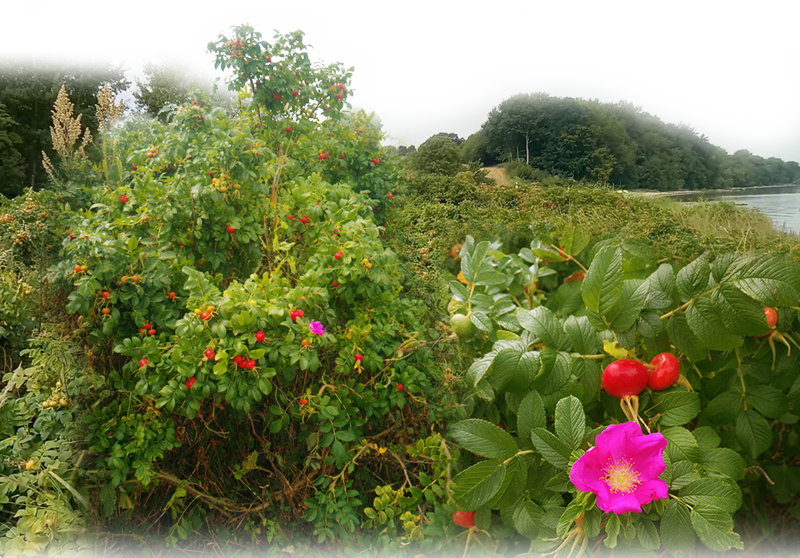
Rugosa rose
 6
6 4
4 6
6Will it grow where I live?
Rugosa rose is hardy to zone 3 – that covers all of Central Europe and the British Isles, and every USDA zone from 3 upwards.
Or check it for your location right here:
Profile
- Family
- Rosaceae
- Habit
- Shrub
- Height
- 2 m
- Spread
- 2 m
- Growth
- very fast
- Lifespan
- 50 years
- First yield
- after 3 years
- Yield per plant
- up to 8 kg a year
- Yield in cultivation
- up to 10 t/ha
- Energy yield
- 1620 kcal per m² a year
- Hardiness
- zone 3–9
- Shade tolerance
- partial shade
- Soil
- Sand, Silt, Loam
- Soil moisture
- dry – very wet
- pH
- 4.5 – 6.5
- Synonyms
- Apfelrose, Japan-Rose, Sylter Rose
Flowering & harvest
| J | F | M | A | M | J | J | A | S | O | N | D | |
|---|---|---|---|---|---|---|---|---|---|---|---|---|
| Flowering | ||||||||||||
| Fruit harvest |
Uses
Edible: Fruit (raw, cooked): jam, tea; 10 tons per hectare correspond to approximately 1620 calories per square meter. Blossoms (raw, cooked): flavoring. Tender early spring shoots (cooked) and seeds (rich in Vitamin E) can be powdered for flour or dietary supplements. Leaves are suitable for making tea. Young leaves can be used as a flavoring, for acidity, or in tea preparation. Blossoms can be used as a seasoning, for beverages, or as nectar.
Medicinal: Fruits are very rich in vitamins A, C (0.8g/100g!), E, minerals, flavonoids, bioactive compounds, and essential fatty acids. The leaves assist with fever, the flowers promote circulation and can aid in loss of appetite, digestive and menstrual issues, as well as problems with the spleen and liver. The root is beneficial for coughs.
Other uses: Salt- and pollutant-tolerant hedge for coastal winds; ornamental plant for erosion control on sand dunes. A hedge that is tolerant to salt and pollutants and can withstand strong coastal winds is ideal for protecting sand dunes from erosion. This hedge serves not only as a decorative element but also helps to protect the environment and preserve the landscape.
Growing
Site: The decisive judgement comes before the spade goes in, because rugosa rose is very hard to get rid of again. It throws vigorous, far-reaching suckers and forms impenetrable thickets within a few years; without a rhizome barrier or regularly mown ground around it, it travels through beds and under fences. As a deliberate boundary hedge, on banks and for binding soil that is its strength; in a perennial border it is a mistake. The densely bristled, prickly shoots make it excellent screening and access control, but a source of injury beside paths and play areas. It needs sun and an acid to neutral, free-draining soil; on lime it goes chlorotic. Near the coast and anywhere close to dunes, heath or dry grassland it should be avoided — there it is a serious displacer. Care: Few shrubs are less demanding. It is exceptionally hardy, tolerates salt, wind and urban air, and is far less prone to blackspot, mildew and rust than garden roses — spraying is unnecessary. No feeding is needed; excess nitrogen only encourages suckering. Pruning amounts largely to holding the area: once a year in early spring, cut or mow off the suckers beyond the intended outline. Every few years, cutting old stems back to about 30 centimetres rejuvenates the stand, though it costs the following year's hips. Flowering and fruiting run alongside each other from August to October — several pickings give the best quality, and anyone wanting hips should leave the spent flowers rather than deadheading.
Propagation
The simplest route is the one the plant takes by itself: suckers are cut away with a spade in spring or autumn, lifted with a piece of root and moved; they establish almost without exception. Root cuttings are equally reliable — lay ten-centimetre lengths of finger-thick root horizontally in sandy soil in winter. Hardwood cuttings of ripened one-year-old wood root outdoors in late autumn without special measures. Seed is possible but slow: extract the achenes from the hips, clean off the flesh and sow outdoors in autumn; they need a warm period followed by a cold one and usually germinate only in the second spring. Seedlings vary in flower colour and habit. More important than technique is restraint: near the coast the species should not be propagated, and neither prunings nor fruit should be disposed of in the wider landscape.
Value for wildlife
The large, open, bowl-shaped and strongly scented flowers, from May into October, are easily accessible to bees: they offer abundant pollen and are worked heavily by bumblebees, honeybees and pollen-collecting solitary bees, with single-flowered forms many times more valuable than double cultivars. As a larval food plant it serves the brown-tail moth among others, whose webs can be found in the shoots in spring. The fleshy hips, up to 2.5 centimetres across, hang into winter and are important late food for blackbirds, thrushes and greenfinches, while the thorny thicket provides cover and secure nest sites for hedgerow birds and small mammals. That high individual value has to be set against the damage it does at landscape scale: in dunes and on nutrient-poor ground its dense stands displace a species-rich, highly specialised vegetation. In a settlement it is a gain; in open coastal country it is not.
Notable
Special features: forms many runners (rhizome barrier or cut back); despite its intoxicating scent, beautiful flowers, dense foliage, and the largest fleshy hips, it is fought as an "invasive neophyte"; there are over 200 species of wild roses, other cultivated ones include: dog, vitamin, apple, alpine, and damask (flower) rose.
Origin & habitat
East Asia: north-eastern China, Korea, Japan and the Russian Far East as far as Kamchatka. Its natural stronghold is the coastline of the Sea of Japan and the Sea of Okhotsk, where it grows right down to the surf zone. It reached Europe in 1854 and was planted on a huge scale as a tough ornamental and hedging shrub, for dune stabilisation and in roadside plantings. From there it has naturalised extensively along the North Sea and Baltic coasts, in Denmark, the Netherlands and the Baltic states, where it displaces grey dune vegetation. In Germany it appears on the management list of invasive species; it is not on the EU Union list, so no planting ban applies.
Coastal dunes, sandy and shingle shores, cliffs and the margins of salt marsh — a habitat of salt spray, blowing sand, drought and full sun to which hardly any other woody plant is adapted. The species roots deeply and builds an extensive rhizome network that binds drifting sand; that very quality makes it a valuable pioneer in its homeland and a problem in Europe. It requires acid to neutral, free-draining soils, ideally between pH 4 and 5, and goes chlorotic on limey ground. Waterlogging it will not take, while drought, wind and de-icing salt trouble it not at all — which is why it also persists on roadsides far inland.
⚠️ Hazards
There is a layer of hairs around the seeds just below the fruit pulp. These hairs can cause irritation in the mouth and digestive tract if ingested.
Frequently asked questions
Rugosa rose: how big does it get?
Rugosa rose (Rosa rugosa) grows as a Shrub and reaches roughly 2 m in height when mature, with a spread of about 2 m. Growth is very fast.
Rugosa rose: what site does it need?
Rugosa rose tolerates partial shade. Suitable soils are Sand, Silt, Loam. Soil moisture should be in the range dry – very wet. The pH may lie between 4.5 and 6.5.
Rugosa rose: is it hardy?
Rugosa rose is listed as hardy in zone 3–9 and survives normal winters outdoors there.
Rugosa rose: will it grow in Central Europe?
Rugosa rose is hardy to zone 3 – that covers all of Central Europe and the British Isles, and every USDA zone from 3 upwards.
Rugosa rose: when does it flower?
In a temperate northern-hemisphere climate it flowers from May to August.
Rugosa rose: when is it harvested?
In a temperate northern-hemisphere climate the fruit ripens from August to September.
Rugosa rose: when does it start cropping, and how much?
Rugosa rose first crops after 3 years. A mature plant gives up to 8 kg a year, in cultivation up to 10 t per hectare. Figures assume a good site; variety, soil and climate shift them considerably.
Rugosa rose: is it poisonous?
Individual parts of Rugosa rose are noted as mildly problematic — the plant does not count as poisonous. With wild plants, never rely on a database alone, only on a confident identification.
Rugosa rose: what is it used for?
Rated on a scale up to 10: Edible 6/10, Medicinal 4/10, Other uses 6/10.
Plan this plant into your own garden
Permaplans plans your garden to scale on the map — with a site check, harvest calendar and over 1,000 plants. Free for iPhone, Android, Mac, Windows & Linux.
Will this plant grow where you live? → Check your site
Community experience
No first-hand reports for this plant yet.
Growing it? Write in the app what works for you – your post will show up here.
💬 Get the app and join in