
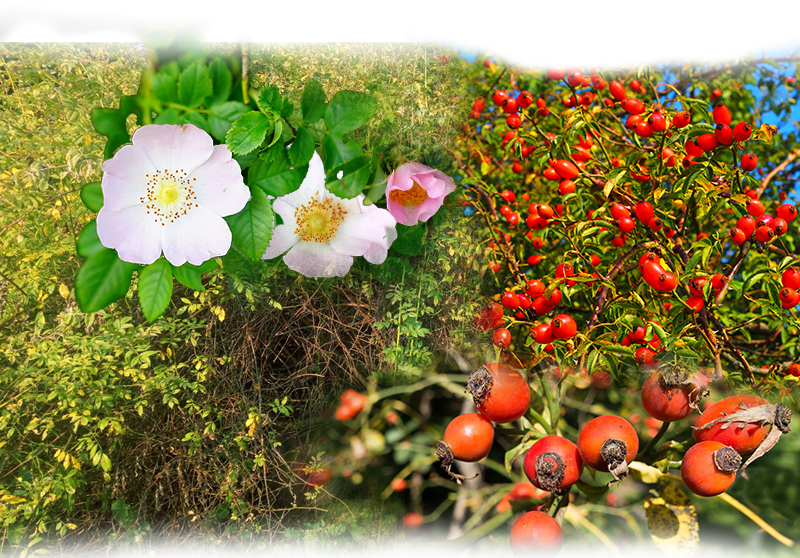
Dog rose
 6
6 6
6 8
8Will it grow where I live?
Dog rose is hardy to zone 3 – that covers all of Central Europe and the British Isles, and every USDA zone from 3 upwards.
Or check it for your location right here:
Profile
- Family
- Rosaceae
- Habit
- Shrub
- Height
- 3 m
- Spread
- 4 m
- Growth
- very fast
- Lifespan
- 200 years
- First yield
- after 3 years
- Full yield
- after 3 years
- Yield per plant
- up to 3 kg a year
- Yield in cultivation
- up to 10 t/ha
- Energy yield
- 1620 kcal per m² a year
- Hardiness
- zone 3–7
- Shade tolerance
- partial shade
- Soil
- Sand, Silt, Loam, Clay
- Soil moisture
- dry – very wet
- pH
- 5.5 – 7.5
Flowering & harvest
| J | F | M | A | M | J | J | A | S | O | N | D | |
|---|---|---|---|---|---|---|---|---|---|---|---|---|
| Flowering | ||||||||||||
| Fruit harvest |
Uses
Edible: Fruit: raw, sweet and soft after frost, cooked, dried; jam, syrup, baby food supplement, wine, oil; 3-10 tons per hectare, about 1000 calories per square meter. Seeds: rich in Vitamin E, powdered as flour or supplement; remove seed hairs to avoid itching powder. Petals: raw or cooked as vegetable or for jam. Leaves: dried as tea substitute.
Medicinal: Fruit rich in vitamins A, C (especially in the peel), E, K, B1, B2, B6, minerals, antioxidants, and essential fatty acids. This fruit boosts the immune system, benefits the stomach and heart, reduces inflammation, alleviates pain in arthritis, and lowers blood pressure. It can aid in colds, flu, gastritis, and spring fatigue. The moist petals can be placed on the eyes, Bach flowers can enhance vitality, the seeds are beneficial for kidneys and bladder, and the oil can regenerate the skin and help with wounds and wrinkles.
Other uses: Erosion control and soil stabilization, wind-resistant protective hedge, food and nesting site, rootstock for roses, fragrant plant. These plants serve as erosion control and soil stabilizers, provide protection against wind, act as food and nesting sites, can be used as rootstock for roses, and emit a pleasant fragrance.
Growing
Site: Undemanding on almost any free-draining soil, in sun to light shade. Two traits govern where to plant it: it throws vigorous suckers and will wander through a bed without a root barrier — 40 cm deep is barely enough, 60 cm is safe; a few cultivars produce no suckers. And it is densely prickled, which is wanted in an impenetrable protective hedge and a nuisance beside paths and seating. Ecologically it is among the most valuable native species: 51 caterpillar species live on it, 27 bird species use the hips as winter food, and the thorny thicket shields nests from predators. Care: Regular cutting back keeps it vigorous and stops it going bare at the centre. Long sleeves and stout gloves are advisable for pruning and picking. It needs little water once established, and no feeding — on lean soil it flowers and fruits better. Hip tortrix moth and hip fly can infest the fruit; affected hips are sorted out at harvest. Pick after the first frost, when the hips turn soft and sweet; failing that, put them briefly in the freezer.
Propagation
The simplest route is via its own root suckers: rooted suckers can be severed and moved in autumn or early spring. Hardwood cuttings of ripened shoots, taken in late autumn and pushed into the ground over winter, also root reliably. Sowing is possible but slow: the seeds sit in deep dormancy and need a cold period over at least one and often two winters before emerging, so they are best placed in an outdoor seedbed straight after harvest. Seedlings do not come true. In rose growing the dog rose itself serves as a robust rootstock for garden roses.
Value for wildlife
The dog rose is among the most valuable native wild shrubs. Its flowers are pure pollen flowers without nectar: the colour contrast between the yellow stamens and the pale pink petals draws visitors, which collect pollen alone. Around 40 wild bee species are documented, none of them specialists. Its role as larval food weighs far more heavily: 51 lepidopteran species develop on it, five of them exclusively on roses. Three beetle and three hoverfly species are added to these. The hips ripen late and often hang into spring — 27 bird species use them as winter food and disperse the achenes through digestion and caching. The thorny thicket carries nests and protects songbirds effectively against nest predators.
Notable
Special features: constantly renews itself through root shoots; climbs with the help of its thorns: e.g. 1000-year-old rose bush in Hildesheim reaching 10m; Used by Celts as incense (love, femininity, intuition, sexuality); Harvest fruits on sunny days for optimal vitamin content; Only pluck the petals = encourages further fruit formation; There are over 200 species of wild roses, other cultivated varieties include: potato, vitamin, apple, alpine, and damask rose.
Origin & habitat
Europe, north-west Africa and western Asia. The dog rose occupies almost all of Europe and is absent only from the far north: it does not occur in Iceland or Finland, and in Norway it reaches roughly the 62nd parallel. Eastwards the range runs from Lake Ladoga to the Volga, with outlying occurrences as far as the Urals; to the south it continues into north-west Africa and western Asia. In the Alps it climbs to 1,680 m, and in the Caucasus region it grows at altitudes up to about 1,300 m. In North America it is naturalised as a neophyte, and in parts of Australia and New Zealand it is regarded as a weed of pasture.
The dog rose is a shrub of fringes and transitions: it grows in hedgerows and scrub, along woodland edges and in open woodland, on path and roadside verges, on pasture and on banks. In phytosociological terms it is a character species of blackthorn scrub (Prunetalia). It prefers moderately dry to fresh, base-rich and moderately acid to mild soils and tolerates full sun as readily as light shade. As a heat-loving pioneer it also colonises raw soils, beach ridges and fresh embankments, where suckers let it cover ground quickly and bind the soil. It roots deeply, withstands drought well and is markedly frost-hardy at around -28 °C.
⚠️ Hazards
There is a layer of hairs around the seeds just below the fruit pulp. These hairs can cause irritation in the mouth and digestive tract if ingested.
Frequently asked questions
Dog rose: how big does it get?
Dog rose (Rosa canina) grows as a Shrub and reaches roughly 3 m in height when mature, with a spread of about 4 m. Growth is very fast.
Dog rose: what site does it need?
Dog rose tolerates partial shade. Suitable soils are Sand, Silt, Loam, Clay. Soil moisture should be in the range dry – very wet. The pH may lie between 5.5 and 7.5.
Dog rose: is it hardy?
Dog rose is listed as hardy in zone 3–7 and survives normal winters outdoors there.
Dog rose: will it grow in Central Europe?
Dog rose is hardy to zone 3 – that covers all of Central Europe and the British Isles, and every USDA zone from 3 upwards.
Dog rose: when does it flower?
In a temperate northern-hemisphere climate it flowers in June.
Dog rose: when is it harvested?
In a temperate northern-hemisphere climate the fruit ripens from October to November.
Dog rose: when does it start cropping, and how much?
Dog rose first crops after 3 years. Full yield comes after 3 years. A mature plant gives up to 3 kg a year, in cultivation up to 10 t per hectare. Figures assume a good site; variety, soil and climate shift them considerably.
Dog rose: is it poisonous?
No toxicity is recorded for Dog rose. With wild plants, never rely on a database alone — only on a confident identification.
Dog rose: what is it used for?
Rated on a scale up to 10: Edible 6/10, Medicinal 6/10, Other uses 8/10.
Plan this plant into your own garden
Permaplans plans your garden to scale on the map — with a site check, harvest calendar and over 1,000 plants. Free for iPhone, Android, Mac, Windows & Linux.
Will this plant grow where you live? → Check your site
Community experience
No first-hand reports for this plant yet.
Growing it? Write in the app what works for you – your post will show up here.
💬 Get the app and join in