
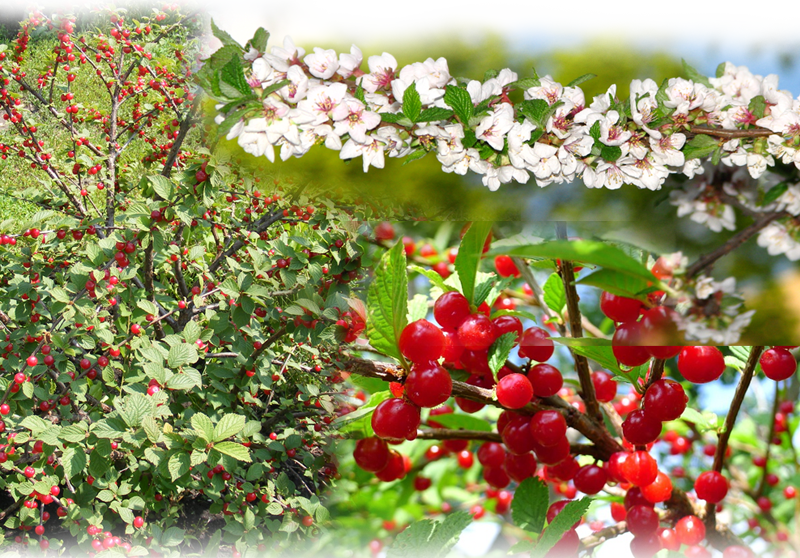
Nanking cherry
 7
7 2
2 5
5Will it grow where I live?
Nanking cherry is hardy to zone 3 – that covers all of Central Europe and the British Isles, and every USDA zone from 3 upwards.
Or check it for your location right here:
Profile
- Family
- Rosaceae
- Habit
- Shrub
- Height
- 1.8 m
- Spread
- 2.5 m
- Growth
- fast
- Lifespan
- 25 years
- First yield
- after 3 years
- Full yield
- after 4 years
- Productive years
- 15 years
- Yield per plant
- up to 7 kg a year
- Yield in cultivation
- up to 24 t/ha
- Energy yield
- 1500 kcal per m² a year
- Hardiness
- zone 3–8
- Shade tolerance
- partial shade
- Soil
- Sand, Silt, Loam
- Soil moisture
- semi-dry – very moist
- pH
- 5 – 7.5
- Synonyms
- Filzkirsche, Sandkirsche
Flowering & harvest
| J | F | M | A | M | J | J | A | S | O | N | D | |
|---|---|---|---|---|---|---|---|---|---|---|---|---|
| Flowering | ||||||||||||
| Fruit harvest |
Varieties (3)
3 varieties of Nanking cherry are listed in the Permaplans variety finder — each with its own page: taste, ripening time, disease resistance, parentage and use.
Uses
Edible: Fruit - can be eaten raw or cooked, being juicy with a slightly sweet to sour taste. Unripe fruits can be pickled. The fruit has a diameter of about 12 mm and holds a large seed that can be consumed raw or cooked, but should be avoided if too bitter. The buds are cooked and eaten, whether they are flower or leaf buds is uncertain.
Medicinal: Although no specific mention was found for this type, all members of the genus contain substances that break down into hydrogen cyanide (cyanide or prussic acid) in water. In small amounts, this highly toxic compound stimulates respiration, improves digestion, and provides a sense of well-being.
Other uses: A green dye can be obtained from the leaves and a dark grey to green one from the fruit. The fruits contain around 0.7 per cent fruit acids, up to twelve per cent sugar and about 30 milligrams of vitamins per 100 grams. They ripen from late June into July, sit stalkless and densely on the two-year-old shoots inside the shrub, and are bright scarlet, freestone and up to 3.5 grams; Russian selections reach 1.8 centimetres and 3.6 grams. In full bearing a shrub of those cultivars yields five to seven, exceptionally ten kilograms. The fruit does not keep and must be processed at once. Besides eating fresh it gives juice, jam, preserve, compote, cake toppings, liqueur and wine.
Growing
Site: Full sun and a free-draining, humus-rich soil, sandy-loamy to somewhat heavier; moderate soil moisture is ideal, drought is tolerated well, waterlogging is not. A sheltered spot is unnecessary — the species is hardy to about minus thirty-four degrees and thrives in rough districts. Because it flowers abundantly but does not always fruit as freely, plant several shrubs together for a good set. The flowers are self-fertile, yet cross-pollination raises the yield markedly; besides other Nanking cherries, Prunus virginiana, P. pensylvanica and P. besseyi serve as partners. Care: It flowers and fruits as a three- to four-year-old seedling but is short-lived, lasting ten to fifteen years. Pruning is not essential, though a hard rejuvenation cut every few years prevents premature ageing. Cutting the two-year-old shoots back to five or ten buds straight after flowering forfeits that season's crop on them but produces long one-year canes that flower freely the year after. In wet, rainy summers twig blight (Monilia) appears; cut back into healthy wood and the shrubs reliably break again. Hares and mice leave the species alone.
Propagation
Unlike the grafted fruiting Prunus species, the Nanking cherry is easily raised from seed — it stands close to the wild form and seedlings come out serviceable. The stones are taken from the ripe fruit, washed and cold-stratified over winter, then sown in an outdoor bed; the plants flower and fruit in their third or fourth year. Heavy-bearing selections and named cultivars are instead passed on by softwood cuttings taken from vigorously growing shoots in early summer. Older shrubs produce a few root suckers that can be separated off. Conversely the species itself serves as a dwarfing rootstock for other cherries — a way of keeping sweet and sour cherries smaller.
Value for wildlife
The Nanking cherry flowers very early, usually before the leaves emerge from April onwards, supplying nectar and pollen at a time when little else is in bloom — which makes it valuable for wild bees and bumblebees. The flowers are openly built and accessible to insects of every tongue length. Insect pollination is decisive for a good fruit set even though the flowers are self-fertile. The small, bright red fruits are highly popular with birds and are usually stripped before anyone else gets to them; netting is easier here than on a full-sized cherry tree. As a larval food plant for native butterflies and moths this East Asian species plays almost no part. Hares and mice do not touch it.
Notable
Features: easy to care for; produces some root shoots; 'Orient' variety is self-fertile; can also be pollinated by P. pumila & P. virginiana, which are also interesting small cherry shrubs; Fruit 3.5g → Full yield = 2000 fruits; popular with birds, requiring better protection than the large cherry tree.
Origin & habitat
East Asia: northern China, Korea and the Himalaya. The Nanking cherry comes from northern and western China including Tibet, from Mongolia, Korea and Japan, and reaches south into the Himalaya; records for northern India are not secure. Both of its common names point to that origin: Korean cherry and Nanking cherry, after the eastern Chinese city. It has been in cultivation in Europe since 1870, and the Arnold Arboretum brought it to the United States in 1892. Here it is grown as an ornamental and picking shrub rather than a commercial fruit; Russia, by contrast, developed its own breeding line with eighteen described cultivars, none of them so far available in western Europe. The species does not escape in Central Europe.
In its native range the Nanking cherry grows in open woodland, on mountain slopes and along forest edges in the continental mountain regions of East Asia. Those sites are marked by hard, dry winters and warm summers, which explains its exceptional frost hardiness: it survives around minus thirty-four degrees Celsius and ranks among the most cold-tolerant fruit species of all. It demands full sun; in shade it barely flowers or fruits. It is adaptable as to soil, preferring somewhat heavier to sandy-loamy, humus-rich ground with moderate moisture, and tolerates drought well. Waterlogging and heavy, compacted sites do not suit it.
⚠️ Hazards
Toxic kernels and leaves, toxic to dogs, cats and horses As in all Prunus species, the seeds, leaves and bark contain cyanogenic glycosides that release hydrogen cyanide when chewed or crushed. A single intact stone swallowed by accident is harmless, larger quantities of chewed kernels are not, and home-made kernel extracts are best avoided. The same plant parts are considered toxic to dogs, cats and horses. The flesh of the fruit itself is harmless. The gum that exudes from wounds indicates pruning at the wrong time of year, not a hazard.
Frequently asked questions
Nanking cherry: how big does it get?
Nanking cherry (Prunus tomentosa) grows as a Shrub and reaches roughly 1.8 m in height when mature, with a spread of about 2.5 m. Growth is fast.
Nanking cherry: what site does it need?
Nanking cherry tolerates partial shade. Suitable soils are Sand, Silt, Loam. Soil moisture should be in the range semi-dry – very moist. The pH may lie between 5 and 7.5.
Nanking cherry: is it hardy?
Nanking cherry is listed as hardy in zone 3–8 and survives normal winters outdoors there.
Nanking cherry: will it grow in Central Europe?
Nanking cherry is hardy to zone 3 – that covers all of Central Europe and the British Isles, and every USDA zone from 3 upwards.
Nanking cherry: when does it flower?
In a temperate northern-hemisphere climate it flowers in April.
Nanking cherry: when is it harvested?
In a temperate northern-hemisphere climate the fruit ripens in August.
Nanking cherry: when does it start cropping, and how much?
Nanking cherry first crops after 3 years. Full yield comes after 4 years. A mature plant gives up to 7 kg a year, in cultivation up to 24 t per hectare. The productive period lasts about 15 years, within a lifespan of around 25 years. Figures assume a good site; variety, soil and climate shift them considerably.
Nanking cherry: is it poisonous?
Individual parts of Nanking cherry are noted as mildly problematic — the plant does not count as poisonous. With wild plants, never rely on a database alone, only on a confident identification.
Nanking cherry: what is it used for?
Rated on a scale up to 10: Edible 7/10, Medicinal 2/10, Other uses 5/10.
Which Nanking cherry varieties are there?
The Permaplans variety finder lists 3 varieties of Nanking cherry, including Efimka, Red Ninja, Snövit. Each variety has its own page with taste, ripening time, disease resistance and parentage.
Plan this plant into your own garden
Permaplans plans your garden to scale on the map — with a site check, harvest calendar and over 1,000 plants. Free for iPhone, Android, Mac, Windows & Linux.
Will this plant grow where you live? → Check your site
Community experience
No first-hand reports for this plant yet.
Growing it? Write in the app what works for you – your post will show up here.
💬 Get the app and join in