
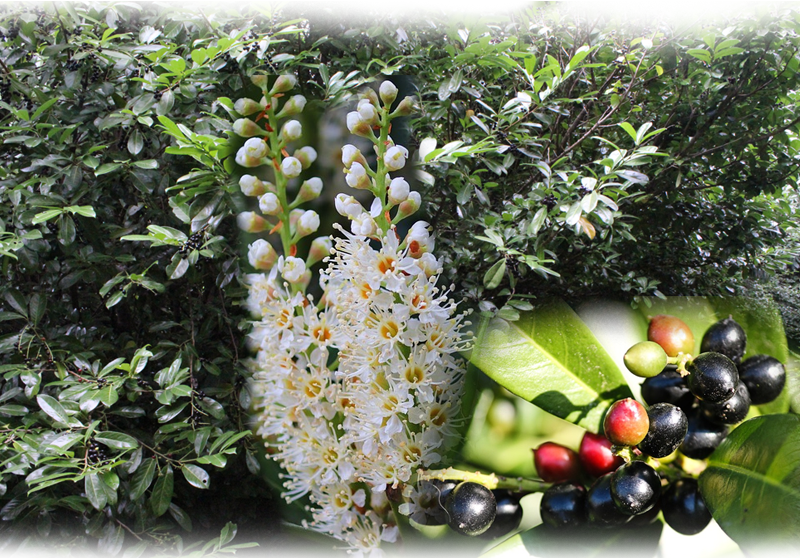
Cherry laurel
 4
4 4
4 8
8Will it grow where I live?
Cherry laurel is hardy to zone 6, which covers nearly all of Central Europe and the British Isles; only harsh upland sites (Alps, high ridges) call for winter protection.
Or check it for your location right here:
Profile
- Family
- Rosaceae
- Habit
- Shrub
- Height
- 6.5 m
- Spread
- 10 m
- Growth
- fast
- Lifespan
- 100 years
- First yield
- after 4 years
- Hardiness
- zone 6–8
- Shade tolerance
- full shade
- Soil
- Sand, Silt, Loam, Clay
- Soil moisture
- dry – very wet
- pH
- 5.5 – 8
- Synonyms
- Lorbeerkirsche
Flowering & harvest
| J | F | M | A | M | J | J | A | S | O | N | D | |
|---|---|---|---|---|---|---|---|---|---|---|---|---|
| Flowering | ||||||||||||
| Fruit harvest |
Uses
Edible: The flesh of ripe berries is only weakly toxic and is traditionally used in Turkey, where the species is known as taflan. Regional forms there carry noticeably larger, roughly olive-sized and sweeter fruit than the ornamental hedging clones common further north. It is made into jelly and jam, dried or pickled — all processes in which heat and drying largely destroy the cyanogenic compounds. The decisive step is removing the stones: seeds and leaves contain substantial amounts of prunasin and amygdalin and release hydrogen cyanide when chewed. Eating larger quantities raw is inadvisable, particularly for children, and with the small-fruited ornamental clones of Central European hedges the effort hardly pays.
Medicinal: Leaves and seeds contain cyanogenic glycosides, chiefly prunasin and amygdalin, which release hydrogen cyanide when chewed or crushed. Historically cherry laurel water was prepared from them as an antispasmodic and sedative and given for whooping cough, asthma and digestive complaints; a cold leaf extract served as an eyewash. These uses are obsolete and dangerous — the margin between an effective and a toxic dose is too narrow to observe without laboratory control. Poisoning presents as breathlessness, convulsions and loss of consciousness. The plant has no place in self-medication, and leaf prunings should not be left within reach of children or grazing animals.
Other uses: This plant is excellent for pruning and is particularly suitable for hedges, especially in shady areas. Some varieties like 'Cherry Brandy', 'Otto Luyken', 'Zabelina', and 'Schipkaensis' grow low and make excellent ground cover for sunny or shady locations. The distilled water from the leaves is used in perfumery. The leaves can also be used to eliminate strong odors like garlic or cloves, provided that the fat has been completely removed first. Dyes can be extracted from the leaves and fruits. The wood, with a pinkish-gray color, is utilized for turning and woodworking.
Growing
Cherry laurel tolerates deep shade like almost no other hedging shrub, but flowers and fruits appreciably only in brighter positions. It needs free-draining, humus-rich soil that never dries out; compacted or waterlogged ground causes root problems. Its weak point is winter: with frozen soil and simultaneous winter sun the evergreen foliage transpires water the roots cannot replace — leaves turn brown and whole shoots die back. A mulch layer over the root zone and watering on frost-free days prevent this. In wet years and foggy districts shot hole disease appears; an airy position and thinning reduce infection pressure. Prune with hand secateurs rather than hedge shears, since cut leaves tear and brown. Pruning before or immediately after flowering suppresses seed set — the single most effective measure against naturalisation.
Propagation
Cherry laurel is neither grafted nor raised from seed but propagated from cuttings — the decisive difference from the fruiting Prunus species. Cultivars do not come true from seed, and sowing only adds to the naturalisation problem. The standard method is semi-ripe tip cuttings from July to September: ten to fifteen centimetre pieces of pencil-thick shoot with two or three nodes, lower leaves removed and the remaining one or two leaves cut back by half to limit transpiration. Under high humidity beneath film they root in four to eight weeks. Hardwood cuttings taken in autumn also root, but more slowly. Layering succeeds almost without fail, since low branches root of their own accord. Prunings bearing fruit belong neither on the compost heap nor in the landscape.
Value for wildlife
The ecological value of cherry laurel is low and bears no relation to how widely it is planted. The flowers are openly built and accessible to insects of every tongue length, yet nectar and pollen value are rated only two, and actual insect visitation stays sparse and species-poor. Extrafloral nectaries on the leaf undersides attract predatory ants outside the flowering period; honeybees and wild bees use them as nectar thieves without pollinating. As a larval food plant for native butterflies and moths the species is effectively irrelevant. Only the bird relationship is significant — and that is precisely the problem: blackbirds, thrushes, starlings, jays and pigeons eat the black drupes and carry the stones far into woodland; wild boar, roe deer, foxes and rodents contribute as well.
Notable
Special features: tolerant to drought and sea winds, highly responsive to pruning; The 'Camelliifolia' type yields abundant high-quality fruit resembling cherries; numerous varieties that grow low to the ground; young leaves contain extrafloral nectaries attracting bees, ants, etc.; typically blooms twice annually in spring and midsummer; fast-spreading.
Origin & habitat
Black Sea region and Asia Minor. The natural range runs from Bulgaria and European Turkey along the Black Sea coast and across the Caucasus to Georgia, Azerbaijan and northern Iran; records from Albania, Libya and Tajikistan are considered doubtful and the Romanian stands disputed. Clusius received the plant from Constantinople in 1576 and grew it in Vienna; from 1889 Berlin nurseries introduced hardy cultivars such as 'Schipkaensis' and 'Zabeliana', and since the 1990s cherry laurel has been the best-selling screening shrub in Central Europe. From gardens it escapes by bird dispersal — naturalised stands are documented in Ticino, northern Italy, across Switzerland and even around Hamburg and Berlin. Switzerland banned sale, propagation and new planting in September 2024; in Germany the species is on the Grey List.
In its native range cherry laurel grows in the understorey of the humid, winter-mild broadleaf and mixed forests of the Black Sea region, often beneath beech, spruce and fir in the Colchian mountain forests, and locally extends beyond the closed treeline. Ecologically it is a suboceanic shade plant: it needs fresh, moderately acid to neutral soils of moderately poor to moderately rich nutrient status, tolerates lime but no salt, and remains tied to the warmer colline zone. That combination — deep shade, year-round humid air and mild winters — explains why it invades Central European woodland precisely where the climate has an oceanic character.
⚠️ Hazards
Highly toxic, toxic to dogs, cats and grazing animals All parts of cherry laurel except the fruit flesh contain cyanogenic glycosides, with seeds and leaves the most heavily loaded. Chewed kernels and crushed leaves release hydrogen cyanide; poisoning presents as breathlessness, convulsions and loss of consciousness. Children are especially at risk from the attractive black fruits — the flesh is usable once processed, the stone is not. Prunings are toxic to dogs, cats and grazing animals and belong neither within reach of animals nor on the compost heap.
Frequently asked questions
Cherry laurel: how big does it get?
Cherry laurel (Prunus laurocerasus) grows as a Shrub and reaches roughly 6.5 m in height when mature, with a spread of about 10 m. Growth is fast.
Cherry laurel: what site does it need?
Cherry laurel tolerates full shade. Suitable soils are Sand, Silt, Loam, Clay. Soil moisture should be in the range dry – very wet. The pH may lie between 5.5 and 8.
Cherry laurel: is it hardy?
Cherry laurel is listed as hardy in zone 6–8 and survives normal winters outdoors there.
Cherry laurel: will it grow in Central Europe?
Cherry laurel is hardy to zone 6, which covers nearly all of Central Europe and the British Isles; only harsh upland sites (Alps, high ridges) call for winter protection.
Cherry laurel: when does it flower?
In a temperate northern-hemisphere climate it flowers in May.
Cherry laurel: when is it harvested?
In a temperate northern-hemisphere climate the fruit ripens in September.
Cherry laurel: is it poisonous?
Individual parts of Cherry laurel are noted as mildly problematic — the plant does not count as poisonous. With wild plants, never rely on a database alone, only on a confident identification.
Cherry laurel: what is it used for?
Rated on a scale up to 10: Edible 4/10, Medicinal 4/10, Other uses 8/10.
Plan this plant into your own garden
Permaplans plans your garden to scale on the map — with a site check, harvest calendar and over 1,000 plants. Free for iPhone, Android, Mac, Windows & Linux.
Will this plant grow where you live? → Check your site
Community experience
No first-hand reports for this plant yet.
Growing it? Write in the app what works for you – your post will show up here.
💬 Get the app and join in