
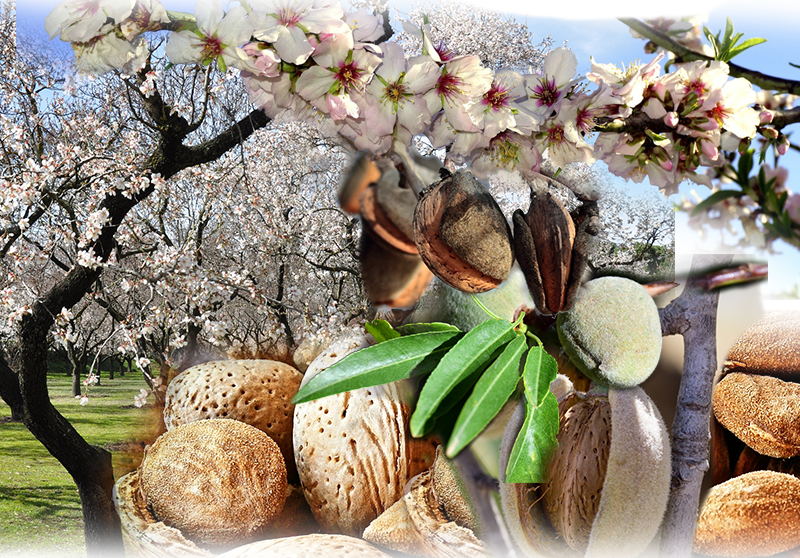
Almond
 9
9 5
5 6
6Will it grow where I live?
Almond is hardy to zone 7: lowlands, river valleys and cities across Central Europe are fine, harsher continental or upland sites need winter protection or a container. It also needs warm summers – in Central Europe that means wine-growing regions, cities or a sheltered south-facing wall.
Or check it for your location right here:
Profile
- Family
- Rosaceae
- Habit
- Tree
- Height
- 6.5 m
- Spread
- 6 m
- Growth
- medium
- Lifespan
- 300 years
- First yield
- after 6 years
- Yield per plant
- up to 40 kg a year
- Yield in cultivation
- up to 2 t/ha
- Energy yield
- 600 kcal per m² a year
- Hardiness
- zone 7–10
- Shade tolerance
- full sun
- Soil
- Sand, Silt, Loam
- Soil moisture
- very dry – very moist
- pH
- 5.5 – 8.5
- Synonyms
- P. amygdalus. P. communis. L. Amygdalus communis. A. dulcis, Mandelbaum
Flowering & harvest
| J | F | M | A | M | J | J | A | S | O | N | D | |
|---|---|---|---|---|---|---|---|---|---|---|---|---|
| Flowering | ||||||||||||
| Fruit harvest |
Varieties (16)
16 varieties of Almond are listed in the Permaplans variety finder — each with its own page: taste, ripening time, disease resistance, parentage and use.
- Butte Small, high-yielding California variety, often planted paired with Padre.
- Carmel California's classic Nonpareil partner – narrow kernel, soft shell, reliable yield.
- Desmayo Largueta Traditional Spanish variety with an elongated pointed kernel – a classic for roasted almonds.
- Dürkheimer Krachmandel Sweet German almond from Bad Dürkheim (Palatinate)
- Ferraduel Late-flowering French pollenizer for Ferragnès
- Ferragnès Late-flowering French standard cultivar
- Fritz High-yielding California variety with a hard shell – good protection against worm damage.
- Guara Self-fertile, late-blooming Spaniard – frost-safe and suited to solo planting.
- Independence Self-fertile modern California variety – Nonpareil-like quality without pollenizer rows.
- Lauranne Self-fertile, late-flowering almond
- Marcona Spain's round gourmet almond, high in oil, sweet and buttery – the queen of tapas.
- Nonpareil California's benchmark: light, smooth kernel in a thin paper shell, the world trade standard.
- Padre Late-blooming California partner to Butte, hard shell, robust cropper.
- Pizzuta d'Avola Sicilian premium almond from Avola – flat, heart-shaped kernel for confectionery.
- Supernova Self-fertile Italian variety, late-blooming – a modern standard for southern Italy.
- Texas California's late-blooming flavour almond – small, robust kernel in a hard shell.
Uses
Edible: The seeds are harvested in September and October. Boiling and then skinning gives blanched almonds, used sliced, slivered or ground; ground almonds are the basis of marzipan. Green almonds with still-soft shells are used in confectionery or preserved in brine, while burnt almonds are roasted with sugar and spices. Industrially the crop yields almond oil, almond bran and almond milk. Almonds contain around 20 per cent protein, 40 to 55 per cent fatty oil and 13 to 16 per cent carbohydrate, along with potassium, phosphorus, iron, calcium and magnesium and the vitamins B1 and B2. Properly dried and stored they keep for two to three years. Bitter almonds contain amygdalin and cannot be eaten raw.
Medicinal: Almond oil is an odourless, mild-tasting oil consisting largely of oleic acid (around 77 per cent) and linoleic acid (around 20 per cent); it is used externally for skin care and as a carrier oil. Folk medicine credited almonds with action against ulcers and skin complaints, but there is no sound evidence of efficacy. Sweet almonds are a nutrient-rich food, not a remedy. The bitter almond must be kept strictly apart: it contains five to eight per cent amygdalin, which the enzyme emulsin splits to release highly toxic hydrogen cyanide. Seven to ten raw bitter almonds can be lethal for children, fifty to seventy for adults. Heating makes bitter almond oil usable as a flavouring; raw, bitter almonds do not belong in the kitchen.
Other uses: Oil lubricates delicate mechanisms, soaps, and cosmetics soften the skin. Dye from leaves results in green color, while fruits and roots produce dark grey to green dye, and leaves yield yellow dye. Injured leaves, when rubbed, can remove strong odors. Rubber glue is produced, and burnt shells serve as absorbents for coal gas. Burnt fruit skin, rich in potassium, is used for making soap.
Growing
Site: A sheltered position in a vine-growing climate, full sun, a south-west or south slope; frost hollows are out. The soil should be free-draining, not too damp and as calcareous as possible; the almond will not tolerate waterlogging. Reliable fruit set requires winters that are not too hard and long, rain-poor summers with low humidity. The reason lies in its very early flowering, often in February or March: rain during flowering hinders bee flight and at the same time encourages infection with stone-fruit brown rot — the commonest cause of crop failure in Central Europe. A tree of 4 to 8 metres; allow five to six metres. Care: Little pruning is needed. When choosing a cultivar, check whether a pollinator is required: many almond cultivars are self-sterile and need a partner flowering at the same time. Grafting onto peach seedlings markedly improves stability. The fruit ripens in September and October; after it falls or is knocked down, remove the leathery hulls at once and dry the kernels spread out thinly in the sun, or they will mould. Properly dried they keep two to three years. Otherwise the tree is robust, and leaf curl occurs only rarely.
Propagation
Almonds raised from seed come out variable and may be bitter, so sowing serves mainly to raise rootstocks: kernels are stratified after harvest and sown in spring. Named cultivars are grafted, usually by budding or chip budding onto peach seedlings — this markedly improves the trees' stability. Almond seedlings, peach-almond clonal stocks and damson clonal stocks are also options, the last allowing scion grafting as well. Anyone sowing their own should know that bitter almonds contain five to eight per cent amygdalin; the bitterness is immediately apparent on tasting a finished kernel, and bitter kernels do not belong in the kitchen.
Value for wildlife
The almond is among the very first fruit trees to flower, in mild situations as early as February or March and long before the leaves appear. For wild bees that makes it one of the earliest substantial forage sources of the year: around 33 species have been recorded at the flowers, including mining bees, the horned mason bee and common carder and early bumblebees, none of them specialists. Overwintering butterflies such as the large tortoiseshell and the peacock use the bloom after emerging. As a West Asian crop the almond has attracted virtually no caterpillars of its own in Central Europe. Its ecological value therefore lies almost entirely in that early supply of blossom.
Notable
Features: partly self-fertile; grown on almond, peach and plum rootstocks. Almond rootstock is slower but roots more deeply and copes better with poor soil and drought, though it dislikes waterlogging. Peach rootstock is shallower, prefers moister ground and tolerates more acid soil. Plum rootstock suits heavy, wet soils and produces dwarf trees; hybrids are also available.
Origin & habitat
South-west Asia: from western to Central Asia. The almond most probably originates in south-western Asia; its natural sites are scrub on sunny, stony slopes at 700 to 1700 metres. From there it spread early across the whole Mediterranean, where it has been cultivated for some four thousand years. The Romans brought it into Central Europe together with the vine, and it still ripens there in the wine districts — the Palatinate with its 'Dürkheimer Krachmandel' is the best-known German example. Production today centres on California, Spain, Italy, Greece, Morocco, Iran and Pakistan.
The almond is a plant of the dry, warm mountain margins of south-western Asia, growing there in open scrub on stony, usually calcareous soils of sun-exposed slopes between 700 and 1700 metres. This shapes its requirements: it needs warmth, full sun and above all long, rain-poor summers with low humidity. It does not tolerate waterlogged, heavy or permanently moist soils, nor frost pockets. In Central Europe it finds this combination only in the wine-growing areas, preferably on south-west- and south-facing slopes. Damp springs are the limiting factor, since they favour blossom infection by stone-fruit Monilia during its very early bloom.
⚠️ Hazards
Toxic kernels and leaves, toxic to dogs, cats and horses As in all Prunus species, the seeds, leaves and bark contain cyanogenic glycosides that release hydrogen cyanide when chewed or crushed. A single intact stone swallowed by accident is harmless, larger quantities of chewed kernels are not, and home-made kernel extracts are best avoided. The same plant parts are considered toxic to dogs, cats and horses. The flesh of the fruit itself is harmless. The gum that exudes from wounds indicates pruning at the wrong time of year, not a hazard.
Frequently asked questions
Almond: how big does it get?
Almond (Prunus dulcis) grows as a Tree and reaches roughly 6.5 m in height when mature, with a spread of about 6 m. Growth is medium.
Almond: what site does it need?
Almond tolerates full sun. Suitable soils are Sand, Silt, Loam. Soil moisture should be in the range very dry – very moist. The pH may lie between 5.5 and 8.5.
Almond: is it hardy?
Almond is listed as hardy in zone 7–10 and survives normal winters outdoors there.
Almond: will it grow in Central Europe?
Almond is hardy to zone 7: lowlands, river valleys and cities across Central Europe are fine, harsher continental or upland sites need winter protection or a container. It also needs warm summers – in Central Europe that means wine-growing regions, cities or a sheltered south-facing wall.
Almond: when does it flower?
In a temperate northern-hemisphere climate it flowers in April.
Almond: when is it harvested?
In a temperate northern-hemisphere climate the fruit ripens from November to March.
Almond: when does it start cropping, and how much?
Almond first crops after 6 years. A mature plant gives up to 40 kg a year, in cultivation up to 2 t per hectare. Figures assume a good site; variety, soil and climate shift them considerably.
Almond: is it poisonous?
Individual parts of Almond are noted as mildly problematic — the plant does not count as poisonous. With wild plants, never rely on a database alone, only on a confident identification.
Almond: what is it used for?
Rated on a scale up to 10: Edible 9/10, Medicinal 5/10, Other uses 6/10.
Which Almond varieties are there?
The Permaplans variety finder lists 16 varieties of Almond, including Butte, Carmel, Desmayo Largueta, Dürkheimer Krachmandel, Ferraduel, Ferragnès, Fritz, Guara, Independence, Lauranne, Marcona, Nonpareil and 4 more. Each variety has its own page with taste, ripening time, disease resistance and parentage.
Plan this plant into your own garden
Permaplans plans your garden to scale on the map — with a site check, harvest calendar and over 1,000 plants. Free for iPhone, Android, Mac, Windows & Linux.
Will this plant grow where you live? → Check your site
Community experience
No first-hand reports for this plant yet.
Growing it? Write in the app what works for you – your post will show up here.
💬 Get the app and join in