
 9
9 5
5 4
4Will it grow where I live?
Strawberry is hardy to zone 5 – that covers all of Central Europe and the British Isles, and every USDA zone from 5 upwards.
Or check it for your location right here:
Profile
- Family
- Rosaceae
- Habit
- perennial
- Height
- 0.3 m
- Spread
- 0.2 m
- Growth
- fast
- Lifespan
- 5 years
- First yield
- after 1 year
- Full yield
- after 2 years
- Productive years
- 4 years
- Yield per plant
- up to 0.5 kg a year
- Yield in cultivation
- up to 6 t/ha
- Energy yield
- 130 kcal per m² a year
- Hardiness
- zone 5–8
- Shade tolerance
- partial shade
- Soil
- Sand, Silt, Loam
- Soil moisture
- semi-dry – very moist
- pH
- 5.5 – 7
- Synonyms
- Erdbeere, Erdbeeren
- Planned in gardens
- 3×
Flowering & harvest
| J | F | M | A | M | J | J | A | S | O | N | D | |
|---|---|---|---|---|---|---|---|---|---|---|---|---|
| Flowering | ||||||||||||
| Fruit harvest |
Varieties (1)
1 varieties of Strawberry are listed in the Permaplans variety finder — each with its own page: taste, ripening time, disease resistance, parentage and use.
Uses
Edible: Fruit - raw. The best varieties have sweet and juicy fruits with a delightful flavor. Strawberries are a highly popular fruit, easily found during the summer season. Some varieties have fruits with a diameter of up to 3 cm. Young leaves can be eaten raw.
Growing
Strawberries want deep, free-draining soil that nevertheless holds moisture, rich in humus and nutrients, at pH 5.5 to 6.5. Full sun is what brings the crop; in partial shade the plant grows well enough but sets far less fruit. Shelter from wind helps, and late frosts threaten the blossom. A mulch keeps the fruit dry and clean — conifer needles or lava grit both work, while oat straw is unsuitable because it carries stem eelworm. Most cultivars respond to day length and crop once a year; everbearing types fruit through the summer. Stands tire: fruit size and plant health fall off after two or three years as soil-borne diseases and aphid-transmitted viruses accumulate. Every few years, then, a new bed is started in a fresh position, leaving several years before strawberries return to the same ground. Bush beans, spinach, borage, lettuce and garlic all make good companions.
Propagation
The garden strawberry propagates by runners, and that is also the only way to keep a cultivar true: being an octoploid hybrid, its seedlings come out uneven. Sowing is worth it only for breeding new varieties — germination drags on for four weeks or more and the seedlings start very slowly. Runners root by themselves once their leaf rosettes touch soil; pin them down with a wire, or set them straight into a sunken pot. Sever them in July or August so the young plants root in by autumn and crop the following year; plants separated later will not bear until a year after that. Choosing the parent matters: take runners only from healthy, strongly cropping plants, because virus diseases travel along with them.
Value for wildlife
The strawberry flowers in spring, offering nectar and pollen just as wild bees are provisioning their first brood cells; its nectar is rated two out of four and its pollen one. The relationship runs both ways: strawberries are self-fertile, yet insect pollination raises both yield and fruit quality markedly — poorly pollinated flowers give small, misshapen berries. Honey bees, bumblebees and mining bees are among the main visitors. As a garden hybrid with no native range, however, it has no specialist species tied to it and feeds no caterpillars. Anyone wanting to do more for insects than provide pollination is better served by the native wild strawberry. That ripe fruit appeals to birds as well is evident from the netting standard in commercial growing.
Notable
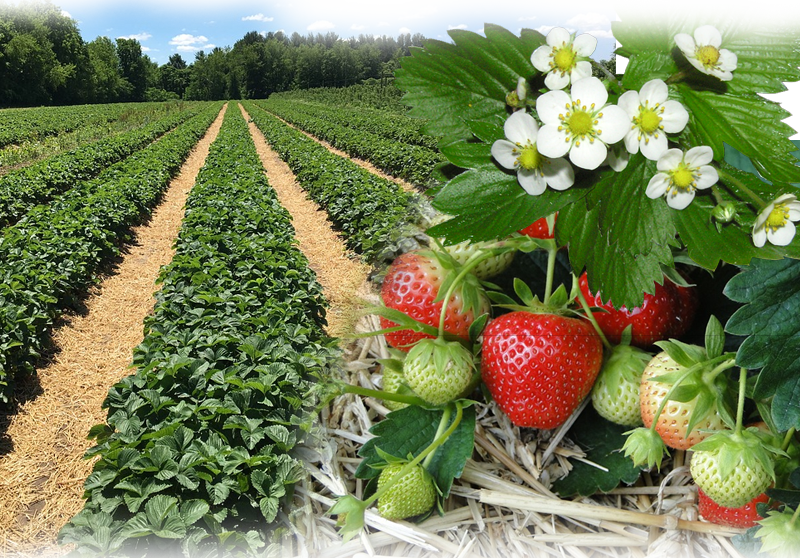
Special features: mulch of lava chippings or pine needles so the fruit lies dry+warm; highly attractive to slugs; yields far higher in other countries (Spain 35t/ha, USA 50t/ha); good neighbours are bush beans, spinach, borage, lettuce, garlic; a less demanding ground cover with stronger medicinal use is wild strawberry F. vesca
Origin & habitat
A garden hybrid with no natural range; arose in 18th-century Europe. The garden strawberry is not a wild species but a chance cross between two American species: the Chilean strawberry (Fragaria chiloensis) and the scarlet strawberry (Fragaria virginiana). It came about in European gardens during the 18th century and is octoploid, with 56 chromosomes. It therefore has no natural distribution area — where it grows today is simply where it is cultivated. World production in 2021 came to 9.175 million tonnes, led by China (3.38 m t), the United States (1.21 m t) and Turkey (669,000 t); Germany ranked 13th with 130,630 tonnes.
Being purely a cultivated plant, the garden strawberry has no natural habitat; it occurs nowhere in the wild. Where it turns up outside beds it is a garden escape, holding on by runners along path edges and banks without forming lasting populations. Its site requirements derive from the American parent species, which grow in coastal dunes and open woodland: deep, free-draining soil that still holds moisture, rich in humus and nutrients, at pH 5.5 to 6.5, with full sun and shelter from wind. Late frosts threaten the blossom. By way of contrast, the native wild strawberry (Fragaria vesca) occupies woodland margins and clearings and makes the less demanding ground cover.
Frequently asked questions
Strawberry: how big does it get?
Strawberry (Fragaria x ananassa) grows as a perennial and reaches roughly 0.3 m in height when mature, with a spread of about 0.2 m. Growth is fast.
Strawberry: what site does it need?
Strawberry tolerates partial shade. Suitable soils are Sand, Silt, Loam. Soil moisture should be in the range semi-dry – very moist. The pH may lie between 5.5 and 7.
Strawberry: is it hardy?
Strawberry is listed as hardy in zone 5–8 and survives normal winters outdoors there.
Strawberry: will it grow in Central Europe?
Strawberry is hardy to zone 5 – that covers all of Central Europe and the British Isles, and every USDA zone from 5 upwards.
Strawberry: when does it flower?
In a temperate northern-hemisphere climate it flowers from April to May.
Strawberry: when is it harvested?
In a temperate northern-hemisphere climate the fruit ripens from June to September.
Strawberry: when does it start cropping, and how much?
Strawberry crops in its first year. Full yield comes after 2 years. A mature plant gives up to 0.5 kg a year, in cultivation up to 6 t per hectare. The productive period lasts about 4 years, within a lifespan of around 5 years. Figures assume a good site; variety, soil and climate shift them considerably.
Strawberry: is it poisonous?
No toxicity is recorded for Strawberry. With wild plants, never rely on a database alone — only on a confident identification.
Strawberry: what is it used for?
Rated on a scale up to 10: Edible 9/10, Medicinal 5/10, Other uses 4/10.
Which Strawberry varieties are there?
The Permaplans variety finder lists 1 varieties of Strawberry, including Senga Sengana. Each variety has its own page with taste, ripening time, disease resistance and parentage.
Plan this plant into your own garden
Permaplans plans your garden to scale on the map — with a site check, harvest calendar and over 1,000 plants. Free for iPhone, Android, Mac, Windows & Linux.
Will this plant grow where you live? → Check your site
Community experience
What Permaplans users wrote about this plant – taken from the app as is. 1 post.
Klettererdbeeren sind die besten Erdbeeren!
Growing it? Write in the app what works for you – your post will show up here.
💬 Get the app and join in