
Quince
 7
7 8
8 5
5Will it grow where I live?
Quince is hardy to zone 5 – that covers all of Central Europe and the British Isles, and every USDA zone from 5 upwards.
Or check it for your location right here:
Profile
- Family
- Rosaceae
- Habit
- Tree
- Height
- 7.2 m
- Spread
- 6 m
- Growth
- medium
- Lifespan
- 50 years
- First yield
- after 3 years
- Full yield
- after 25 years
- Yield per plant
- up to 25 kg a year
- Yield in cultivation
- up to 20 t/ha
- Energy yield
- 500 kcal per m² a year
- Hardiness
- zone 5–9
- Shade tolerance
- full shade
- Soil
- Sand, Silt, Loam
- Soil moisture
- dry – very moist
- pH
- 5 – 7
Flowering & harvest
| J | F | M | A | M | J | J | A | S | O | N | D | |
|---|---|---|---|---|---|---|---|---|---|---|---|---|
| Flowering | ||||||||||||
| Fruit harvest |
Varieties (23)
23 varieties of Quince are listed in the Permaplans variety finder — each with its own page: taste, ripening time, disease resistance, parentage and use.
- Ananasquitte
- Astheimer Perlquitte Aromatic apple quince from Astheim in Franconia.
- Bereczki Birnenquitte
- Champion
- Cydopom
- Cydora
- Cydora Robusta
- Danuviana
- Hemus
- Honigquitte
- Ingenheimer Bombenquitte
- Ispolinskaja Large-fruited quince of Eastern European origin.
- Konstantinopeler ApfelquitteApple-shaped, aromatic quince from Constantinople.
- Aromatnaya Aromatic quince from Crimea.
- Limon Ayvasi
- Muskatnaja
- Portugiesische Birnenquitte
- Riesenquitte von Leskovac
- Rohköstler
- Triumph
- Turuchanskaja
- Vranja
- Wolgograder Weichfruchtige
Uses
Edible: Quince fruit is strongly aromatic, its flesh firm, rather granular and notably rich in pectin. In Central Europe it stays hard and astringent and must be cooked before eating; only in warm climates does it turn soft and juicy enough to eat raw. Cooked it yields jelly, jam, purée, juice and wine, and its high pectin content also makes it a setting aid for low-pectin fruit. Added to stewed apple it lends a powerful aroma. Depending on cultivar the fruit is apple- or pear-shaped and up to about ten centimetres long. The dried, crushed seeds make a mucilaginous drink: simmer for some five minutes and sweeten to taste. The flowers are edible too.
Medicinal: The quince is one of the old medicinal plants of Europe. Two preparations were traditionally used: the mucilage of the seeds and the cooked fruit pulp. Quince seeds contain around 20 % mucilage, which swells in cold water; the mucilage thus obtained was applied externally to irritated skin and mucous membranes and taken for coughs and sore throats. The cooked pulp, rich in pectin, was regarded as a remedy for digestive complaints. Safe handling of the seeds matters here: they contain up to 1.5 % amygdalin, which releases hydrogen cyanide when the seeds are crushed, chewed or ground. For extracting the mucilage the seeds must therefore be soaked whole and then strained off; crushed seeds are not to be used, and the core must not be cooked with the fruit.
Other uses: A substance extracted from the seed coat serves as a replacement for gum arabic to add gloss to the material. The seed comprises 20% mucilage and 15% fatty oils, while the fruit is high in pectin, believed to offer radiation protection. The leaves have 11% tannin.
Growing
Site: Warm, sunny and airy — in Central Europe reliably only in vine-growing areas or against a south- to west-facing wall. The airy position is not a comfort but disease prevention: damp, shaded corners greatly favour quince leaf blight. On lime-rich soils it responds with chlorosis. One advantage of its late flowering in May and June is that it escapes the late frosts that strike other fruit trees — which also suits it to positions at risk of frost in April. Care: Prune sparingly, as it flowers at the tips of one-year-old shoots; a thinning cut in late winter suffices, while hard cutting costs the crop. While the fruit develops in summer the soil should stay evenly moist. Clear fallen leaves thoroughly in autumn — the leaf blight fungus overwinters in them and reinfects in spring. The species is highly susceptible to fire blight, including cultivars marketed as robust; suddenly blackened, withered shoot tips are a suspected case and notifiable in some regions. Harvest September to October before the first harder frosts. In a dry southern climate it pays to raise the rootstock in its final position from a 1 m hardwood cutting driven 70 cm deep, and to graft only in the following year — see propagation.
Propagation
Propagation from cuttings or torn-off shoots succeeds only occasionally with cultivars, so nursery plants are almost invariably grafted — usually onto quince rootstocks raised for the purpose. These rootstocks matter beyond the species itself: quince is the classic dwarfing rootstock for pears and there governs vigour and the onset of cropping. Quince can be raised from seed, but seedlings do not come true; the pips are removed from the core, washed and stratified cold and moist over winter before germinating in spring. Layering is a further workable method for the garden. Grafted trees bear early, often in their third or fourth season. Portuguese practice (Taro): in winter, cut a hardwood cutting about as thick as a broom handle and roughly 1 m long, and drive it vertically 70 cm into the ground — only a hand's width shows above the surface. The quince roots reliably along the buried wood, and because the roots sit below the drying topsoil layer from the outset, the young plant is connected to soil moisture through its first summer. In a dry southern climate that is exactly what decides between establishment and dieback, and it saves irrigation in the first season. The following year the desired quince or pear variety is grafted onto the rooted shoot — you raise the rootstock directly in its final position, with no pot culture and no transplant shock.
Value for wildlife
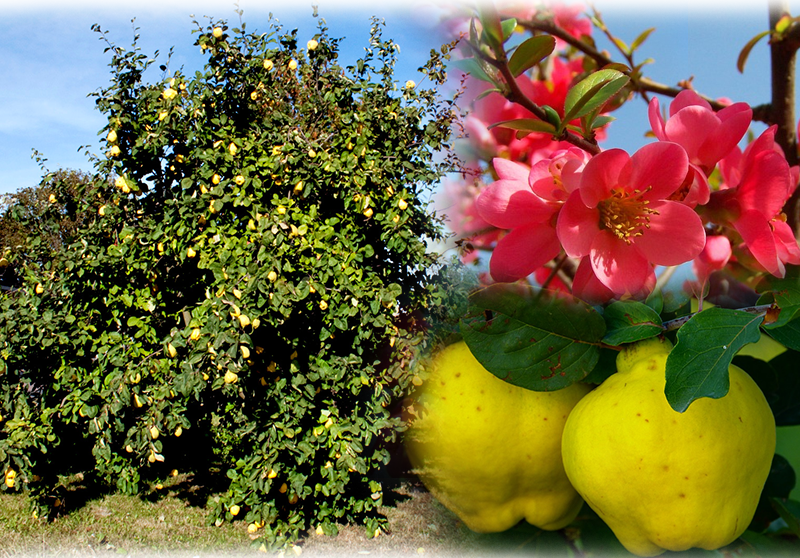
Quince flowers late, in May and June, when most other fruit trees have long finished, and so fills a gap in the foraging calendar. Its large pink solitary flowers are hermaphrodite and are visited by around 29 wild bee species, none of them specialists; honey bees take both nectar and pollen, though not in outstanding quantity. As a crop from the Caucasus region, quince has attracted few caterpillars here — it is a food source for flower visitors rather than a nursery. The heavy, aromatic fruit often hangs late into autumn, and windfalls are taken by wasps, blackbirds and mammals.
Notable
Special features: Very shade-tolerant, but requires plenty of light and warmth for high fruit yields. Harvest before frost; can be stored for 6-9 weeks. To preserve the seed mucilage, soak the seeds in water for 1 hour. A weak-growing rootstock for pears; forms runners: separate in spring; layering takes 1 year.
Origin & habitat
Eastern Caucasus and Transcaucasia. The quince originates in the eastern Caucasus and Transcaucasia. Its occurrences in Turkey, Iran, Turkmenistan, Syria and Afghanistan go back to dispersal by people in the distant past. The earliest evidence of cultivation reaches back some 4,000 years; it is attested in Greece from about 600 BC, among the Romans from 200 BC, and in Central Europe from the ninth century. Today it is grown in southern Europe, western Asia and Central Asia and occasionally escapes in the Mediterranean; in Central Europe it remains confined to gardens and traditional orchards.
In its native range the quince grows along woodland edges, in scrub and on slopes of the Caucasian mountain country, mostly in open, summer-warm places with sufficient soil moisture. It is heat-loving and in Central Europe depends on a vine-growing climate. Fresh, nutrient-rich, free-draining soils suit it; waterlogging and alternately wet ground damage it, and high calcium levels in the soil cause chlorosis. Full sun is a precondition for the fruit to ripen — in Central Europe a south- or west-facing wall proves its worth. Frosts below about -20 °C can cause damage. As a neophyte it fits here into gardens and orchards without penetrating semi-natural vegetation.
⚠️ Hazards
The seed contains hydrogen cyanide, a substance found in many plants of the Rosaceae family, which gives almonds their flavor. Yet, in large quantities, it can cause respiratory issues and potentially be fatal.
Frequently asked questions
Quince: how big does it get?
Quince (Cydonia oblonga) grows as a Tree and reaches roughly 7.2 m in height when mature, with a spread of about 6 m. Growth is medium.
Quince: what site does it need?
Quince tolerates full shade. Suitable soils are Sand, Silt, Loam. Soil moisture should be in the range dry – very moist. The pH may lie between 5 and 7.
Quince: is it hardy?
Quince is listed as hardy in zone 5–9 and survives normal winters outdoors there.
Quince: will it grow in Central Europe?
Quince is hardy to zone 5 – that covers all of Central Europe and the British Isles, and every USDA zone from 5 upwards.
Quince: when does it flower?
In a temperate northern-hemisphere climate it flowers in May.
Quince: when is it harvested?
In a temperate northern-hemisphere climate the fruit ripens in October.
Quince: when does it start cropping, and how much?
Quince first crops after 3 years. Full yield comes after 25 years. A mature plant gives up to 25 kg a year, in cultivation up to 20 t per hectare. Figures assume a good site; variety, soil and climate shift them considerably.
Quince: is it poisonous?
Individual parts of Quince are noted as mildly problematic — the plant does not count as poisonous. With wild plants, never rely on a database alone, only on a confident identification.
Quince: what is it used for?
Rated on a scale up to 10: Edible 7/10, Medicinal 8/10, Other uses 5/10.
Which Quince varieties are there?
The Permaplans variety finder lists 23 varieties of Quince, including Ananasquitte, Astheimer Perlquitte, Bereczki Birnenquitte, Champion, Cydopom, Cydora, Cydora Robusta, Danuviana, Hemus, Honigquitte, Ingenheimer Bombenquitte, Ispolinskaja and 11 more. Each variety has its own page with taste, ripening time, disease resistance and parentage.
Plan this plant into your own garden
Permaplans plans your garden to scale on the map — with a site check, harvest calendar and over 1,000 plants. Free for iPhone, Android, Mac, Windows & Linux.
Will this plant grow where you live? → Check your site
Community experience
No first-hand reports for this plant yet.
Growing it? Write in the app what works for you – your post will show up here.
💬 Get the app and join in