
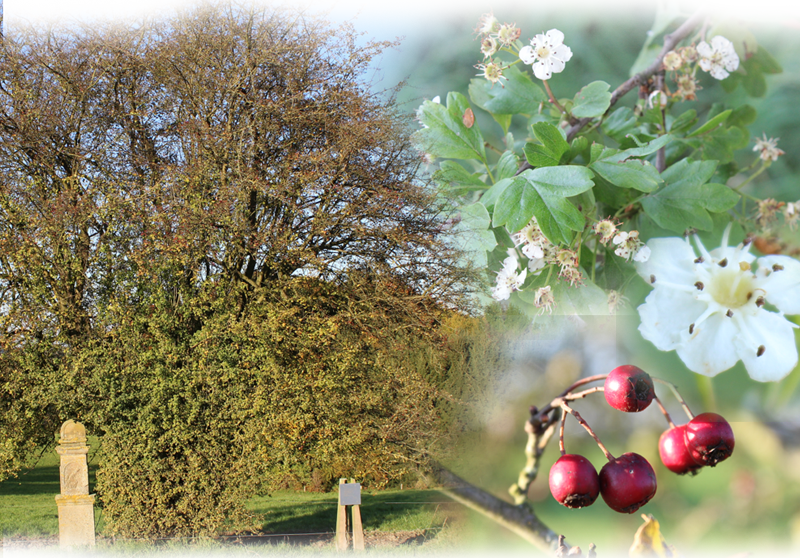
Hawthorn
 3
3 8
8 8
8Will it grow where I live?
Hawthorn is hardy to zone 5 – that covers all of Central Europe and the British Isles, and every USDA zone from 5 upwards.
Or check it for your location right here:
Profile
- Family
- Rosaceae
- Habit
- Tree
- Height
- 7 m
- Spread
- 5 m
- Growth
- medium
- Lifespan
- 300 years
- First yield
- after 7 years
- Full yield
- after 25–50 years
- Yield per plant
- up to 5 kg a year
- Yield in cultivation
- up to 1.2 t/ha
- Energy yield
- 55 kcal per m² a year
- Hardiness
- zone 5–8
- Shade tolerance
- partial shade
- Soil
- Sand, Silt, Loam, Clay
- Soil moisture
- dry – near water
- pH
- 6 – 8
- Synonyms
- Weißdorn
Flowering & harvest
| J | F | M | A | M | J | J | A | S | O | N | D | |
|---|---|---|---|---|---|---|---|---|---|---|---|---|
| Flowering | ||||||||||||
| Fruit harvest |
Uses
Edible: Fruit can be consumed raw or cooked, although it is more commonly used in making jams and preserves due to its unappetizing raw taste. The fruit, typically 1 cm in diameter, contains up to five relatively large seeds at its center, often sticking together, resembling a cherry-like fruit with a single seed. Young shoots offer a pleasant nutty flavor when eaten raw, making them a great addition to salads. Dried leaves can be brewed into a tea, serving as an alternative to Chinese tea. Roasted seeds are sometimes used as a coffee substitute, while the flowers are incorporated into syrups and sweet puddings.
Medicinal: Hawthorn is among the best-studied cardiovascular plants of Central Europe. Leaves with flowers are used, less often the fruits; the active constituents are flavonoids and oligomeric procyanidins, alongside anthocyanin pigments, tannins and essential oils. These substances act as vasodilators, lower blood pressure and reduce inflammation, which is why they are used to make medicines and homoeopathic preparations for the heart and circulation. Traditionally hawthorn is given for declining cardiac performance and the so-called ageing heart, often alongside raised blood pressure. Characteristic is the slow onset: an effect appears only after weeks of regular use, usually as tea or a standardised extract. Older and today without evidence of efficacy is the use of the bark: rich in tannins, it was held to be astringent and was given in folk medicine as a febrifuge, in some accounts explicitly against intermittent fever. That use is historically attested, not demonstrated, and is no longer practised. Also handed down is hawthorn's role as a boundary and protective shrub held to be the dwelling of fairies — a field of meaning that accompanied its place in the old field landscape. Cardiac symptoms belong in medical hands; hawthorn does not replace prescribed therapy, and where heart medication is already being taken its use should be agreed with the treating practice.
Other uses: Hawthorn wood is exceptionally hard and tough, hard to split and to dry, prone to cracking and heavy shrinkage — useless as timber, but very good for tool handles, wooden nails and turnery. It also has one of the highest calorific values among native woods. Its real use, though, is the hedge: hawthorn takes pruning extremely well, regenerates even after hard cutting back, and becomes so dense under browsing or clipping that an impenetrable, stock- and wind-proof barrier results — which is why it stood on the boundaries of fields and pastures for centuries. In nurseries it serves as a rootstock for other rosaceous plants such as medlar, rowan and serviceberry. Dried and ground fruits were added to bread flour in times of scarcity, the origin of the German names Mehlbeere, Mehlfässel and Mehldorn.
Growing
Site: Open and sunny; it tolerates partial shade but flowers and sets fruit distinctly less well there. Lime-loving and otherwise undemanding, it does best on medium, deep, nourishing soils; avoid waterlogging. The most important planning point is distance from orchards and nurseries: hawthorn is a principal host of fire blight and should not stand near them. As a large shrub it reaches 6 to 8 metres, in tree form up to 10 metres, and lives over 100 years; in a hedge allow 50 to 80 centimetres, as a specimen three to four metres. Plant young material — older plants establish poorly after transplanting. Care: Pruning is unnecessary but exceptionally well tolerated: hawthorn regenerates strongly and becomes dense and impenetrable through regular cutting or browsing. Cut outside the bird breeding season, as the hedge is a favoured nesting site. The main danger is fire blight: infection enters through the flowers, shoot tips wilt and hang down; affected plants must be grubbed out at once. The thorns, 1 to 2.5 centimetres long, make gloves and eye protection necessary for hedge work.
Propagation
The seed must be washed clear of the flesh immediately after harvest in September or October, since residues inhibit germination. It is then stratified and sown; hawthorn is notoriously slow and often comes up only in the second spring, so the seedbed should be left standing for two winters. Layering and division of older stools are alternatives. Older plants establish poorly after transplanting — it pays to set out young material. Grafted plants come into cropping considerably sooner than seedlings; hawthorn in turn serves as a rootstock for other rosaceous plants such as medlar, rowan and serviceberry.
Value for wildlife
Common hawthorn is among the most productive woody plants in Central Europe ecologically. Around 41 wild bee species have been recorded at its flowers, along with some 23 hoverfly and 6 beetle species; nectar and pollen per flower are moderate, but the sheer mass of May bloom makes up for it. Its larger contribution is the foliage: 83 moth and butterfly caterpillars feed on it, five of them exclusively on hawthorn. The mealy pome fruits are taken by roughly 32 bird and five mammal species and persist into winter. Because the shrub grows dense and thorny it is also one of the best nesting and shelter plants for hedgerow birds; the red-backed shrike impales its prey on the thorns.
Notable
Special features: always planted to border fields and gardens; held to be the dwelling of fairies, a symbol of virginity and protection; resprouts strongly after browsing+clipping → impenetrable hedge; lives over 100 years, trunk girth to 70cm; !principal host of fire blight - do not plant next to orchards or nurseries!; flowers ~10 days after C. laevigata;
Origin & habitat
Europe to western Asia and North Africa. Common hawthorn occurs throughout Europe, absent only from Iceland and the far north, and extends eastwards to western Asia and the Caucasus, southwards to North Africa. In Central Europe it is among the commonest hedgerow shrubs and climbs to about 1300 metres in the mountains. It was introduced to North America, Australia and New Zealand as a hedging plant and has naturalised widely there. As a shrub of the old field landscape and stock fences it owes much of its European distribution to human land use.
Common hawthorn grows on sunny woodland edges, in natural hedges and scrub, on rocky slopes and in open broadleaved and mixed woodland up to 1300 metres. It makes no particular demands on soil or climate, is lime-loving and prefers medium-heavy, rather deep, nourishing soils that may be fresh to dry; base-rich sites suit it best. Open, sunny positions are the precondition for heavy flowering and fruiting, half shade is tolerated. As a light-demanding fringe shrub it does not persist in dense woodland, but it characterises the transitions between woodland and open land.
Frequently asked questions
Hawthorn: how big does it get?
Hawthorn (Crataegus monogyna) grows as a Tree and reaches roughly 7 m in height when mature, with a spread of about 5 m. Growth is medium.
Hawthorn: what site does it need?
Hawthorn tolerates partial shade. Suitable soils are Sand, Silt, Loam, Clay. Soil moisture should be in the range dry – near water. The pH may lie between 6 and 8.
Hawthorn: is it hardy?
Hawthorn is listed as hardy in zone 5–8 and survives normal winters outdoors there.
Hawthorn: will it grow in Central Europe?
Hawthorn is hardy to zone 5 – that covers all of Central Europe and the British Isles, and every USDA zone from 5 upwards.
Hawthorn: when does it flower?
In a temperate northern-hemisphere climate it flowers in May.
Hawthorn: when is it harvested?
In a temperate northern-hemisphere climate the fruit ripens in October.
Hawthorn: when does it start cropping, and how much?
Hawthorn first crops after 7 years. Full yield comes after 25–50 years. A mature plant gives up to 5 kg a year, in cultivation up to 1.2 t per hectare. Figures assume a good site; variety, soil and climate shift them considerably.
Hawthorn: is it poisonous?
No toxicity is recorded for Hawthorn. With wild plants, never rely on a database alone — only on a confident identification.
Hawthorn: what is it used for?
Rated on a scale up to 10: Edible 3/10, Medicinal 8/10, Other uses 8/10.
Plan this plant into your own garden
Permaplans plans your garden to scale on the map — with a site check, harvest calendar and over 1,000 plants. Free for iPhone, Android, Mac, Windows & Linux.
Will this plant grow where you live? → Check your site
Community experience
No first-hand reports for this plant yet.
Growing it? Write in the app what works for you – your post will show up here.
💬 Get the app and join in